

Published :
Updated :
 For all latest news, follow The Financial Express Google News channel.
Savings certificates (Sanchayapatras) are being made tradable on bond market, among other measures, to systematically force or encourage corporates through applying push and pull factors to meet their long-term financing needs from outside banks.
This switch from banks to capital market for large-and long-tenure borrowings is planned as the government seeks to make the bond market vibrant and thus relieve the banks of burdens of corporate and industrial financing, according to a disclosure made Monday.
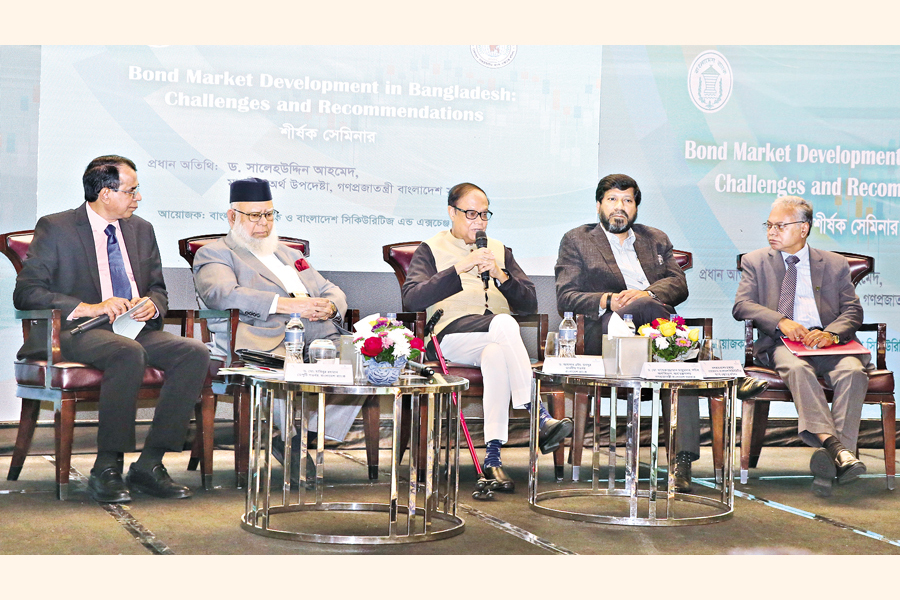
 The move is meant not only to help overcome prevailing liquidity mismatch in banks through lessening NPL (non-performing loan) buildups but also ensure comparatively low-cost and long-term funding instruments for the enterprises, according to a joint study titled 'Bond Market Development in Bangladesh: Challenges and Recommendations' rolled out at a meet.
Bangladesh Bank (BB), under instructions from the chief adviser of the post-uprising government for easing mounting pressure on banks, took the initiative and made the study paper in collaboration with Bangladesh Securities and Exchange Commission (BSEC) and Financial Institutions Division (FID).
Finance Adviser Dr Salehuddin Ahmed was supposed to be present as chief guest at the seminar sharing the study findings and recommendations but he didn't turn up reportedly on health grounds. BB governor Dr Ahsan H. Mansur chaired the event.
Talking about the supply side in developing bond market, the BB governor said they plan to bring corporate sector under push factor. They will push the corporate entities out of the banking sector, not entirely but partial financing requirement must be met through the bond market.
He said the central bank will soon sit with the corporate bodies having lower bond-market exposure to understand what kinds of supports they need from the regulators to get encouraged into the bond market.
"We will not allow corporate to exceed single-borrower-exposure limit. To meet their funding requirements, they either go for overseas borrowing or look for bond and capital markets. We want to apply such push factors," he told the audience.
At the same time, the central-bank governor said, they need to provide them pull factors through which the corporate entities will be attracted to explore the untapped potential available on the bond market.
Under the pull factors, according to him, the government might consider steps to cut bond-issuing timeline and costs along with revisiting prevailing tax treatment and other forms of incentives.
Mr. Mansur, who took the central bank leadership soon after the July-August mass uprising in 2024, said private-sector bond market will not be developed through a liquid, strong and vibrant public-sector bond market.
The country has a huge saving-certificate market of around Tk 6.0 trillion. "If we make it tradable on the secondary market so that the investors can sell it at a discounted premium, whatever the market rate prevails at the time, it will increase the bond market size by another Tk 6.0 trillion very quickly. It is easily doable. Just a decision is needed," the governor said.
President of the International Chamber of Commerce (ICC)-Bangladesh Mahbubur Rahman said that the country's capital market suffers a lot for lack of equities and stocks.
"If bond market is developed here, it will be easier for private enterprises to mobilise funds to meet their capital need," he said.
The renowned business leader said the corporate-bond market would also help the banks lessen their NPL burden. "It has a huge potential and all need to work jointly to make it a success."
Director-General of Bangladesh Institute of Bank Management (BIBM) Dr Md Ezazul Islam, one of the two lead authors of the study paper, said the individual ceiling in savings certificate needs to be lifted aligning the rate with the market and making it tradable on the secondary market.
"It will certainly help allow savers to invest in the savings instruments as much as they can and it will make the market more competitive."
Dr Islam prepared the study along with the other when he was leading the monetary policy department of the central bank before his recent joining as DG of BIBM.
Sharing global market scenario, he said the global market size of bonds, stock market and money market was worth $130 billion, $90 billion and $60 billion respectively in the first half of 2025.
But Bangladesh's financial sector remains heavily bank-dependent-around 80 per cent of debt financing in Bangladesh comes from banks.
"The excessive dependence on bank financing is neither good for the health of the banking system nor for the enterprises," he added.
Finance Secretary Dr Md Khairuzzaman Mozumder said credit mismatch emerged as a serious problem hurting the banking sector badly. To ease the pressure on banks, they plan to develop the bond market.
He said they plan to take the national savings certificate into the secondary market soon. "We have already formed a committee comprising officials from BB, FID and BESEC to this effect."
Bangladesh Securities and Exchange Commission Chairman Khondoker Rashed Maqsood said the chief adviser had instructed them to make a plan how the heavily bank-depended economy can be converted to a capital market-dependent economy.
Since then, he said, they had sat with the central bankers several times to find out challenges and ways-out to facilitate the transition.
Bangladesh Bank research director Md. Abdul Wahab, the other lead author of the paper, said successful implementation of the proposed action plan would facilitate the development of a vibrant and robust bond market in the near term that will support sustainable economic growth and strengthening financial stability.
Deputy governors of BB Dr Md Habibur Rahman and Nurun Nahar, vice- chairman of PRAN Group Uzma Chowdhury, BSEC commissioner Md. Saifuddin, Association of Bankers Bangladesh (ABB) leader Mashrur Arefin, Dhaka Stock Exchange (DSE) Chairman Mominul Islam and Dhaka University Professor Mahmud Osman Imam, among others, spoke at the seminar.
jubairfe1980@gmail.com