


A much-hyped 'social business' is getting institutionalized through newly introduced microcredit banks meant for empowering grassroots down-and-outs and firing up rural economy across Bangladesh.


In what officials tout as a landmark move for the country's financial landscape, the Advisory Council of the post-uprising interim government Thursday endorsed the Microfinance Bank Ordinance that allows individuals and organisations to set up such banks for commercial run in a newly defined way.
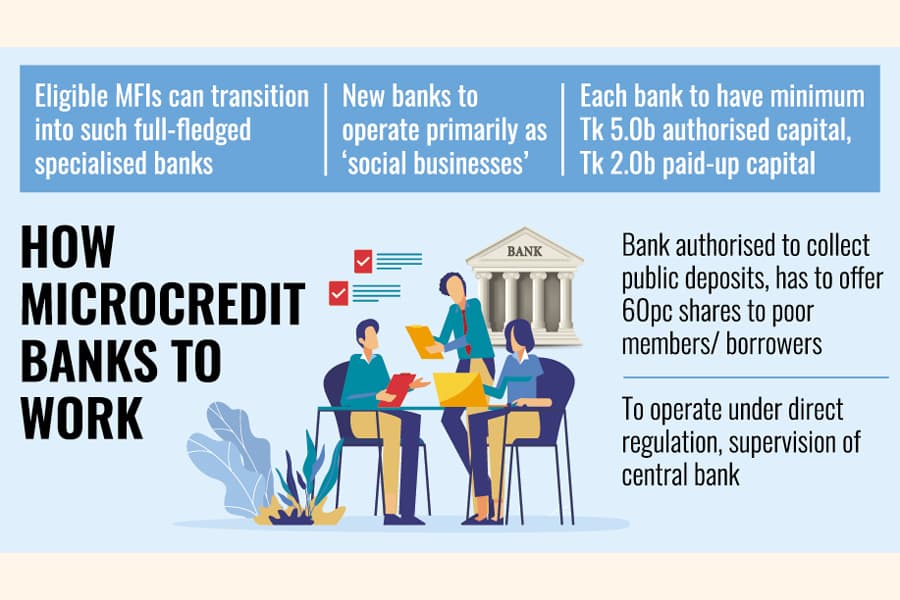
"This latest law is set to revolutionise the microcredit sector by allowing eligible micro-finance institutions (MFIs) to transition into full-fledged specialised banks," says one official.
With Chief Adviser of the Interim Government Professor Muhammad Yunus, the council meeting approved the ordinance broadly aimed at "deepening financial inclusion and providing the unbanked population with more sophisticated financial tools beyond simple credit".
The Nobel-laureate head of interim government is a longtime proponent of switching to 'social business' dedicated to advancing social-uplift goals instead of aggrandizing commercial interests.
Earlier, the Financial Institutions Division (FID) had drafted the law and consulted stakeholders before making the final version of the draft. After completion all the formalities, the draft law was placed before the cabinet meeting Thursday.
The law introduces a structured framework for evolution of the microfinance sector, which currently serves over 40 million clients. The new banks will operate primarily as "social businesses", officials said.
Each of the potential microfinance banks will have to have minimum Tk 5.0 billion as authorised capital while Tk 2.0 billion as paid-up capital.
Under provisions of the law, investors can recover their initial capital but profits beyond that must be reinvested into the bank to "further social goals rather than being distributed as traditional dividends".
The ordinance ensures that 60 per cent of the shares in the new banks would be held by the poor members (borrowers) themselves aimed at ensuring the empowerment of the down-and-outs at grassroots levels.
While MFIs currently operate under the Microcredit Regulatory Authority (MRA), the newly formed microfinance banks will fall under direct regulation and supervision of the central bank (Bangladesh Bank).
Unlike traditional MFIs, these banks will be authorised to accept public deposits, offer insurance products and remittance services, access domestic and foreign grants and loans more easily, provide specialised credits for microenterprises and cottage industry.
A senior official says the microfinance-bank ordinance does not force all NGOs to become banks. "NGOs can choose to convert entirely or only transfer specific branches into the new banking structure, while their remaining operations continue under the MRA," he told The Financial Express.
Meanwhile, the approval for the ordinance comes amid debate within the development sector-some liking, some loathing.
The Credit and Development Forum (CDF) hails the move as a "landmark step" to eliminate high-interest borrowings from commercial banks. Some critics express concern about the potential "commercialization" of a sector built on social mobilisation.
However, the government maintains that the "Social Business" clause is a robust safeguard against profit-seeking motives, ensuring the mission remains focused on poverty alleviation.
By allowing these institutions to collect deposits, the government hopes to reduce the cost of capital for micro-loans, which has historically been high due to MFIs' reliance on commercial bank loans.
This shift is expected to provide a significant boost to the rural economy and small-scale entrepreneurs ahead of the upcoming fiscal year, the authorities say, on an upbeat note on the emergent financial derivation.