

Published :
Updated :
 For all latest news, follow The Financial Express Google News channel.
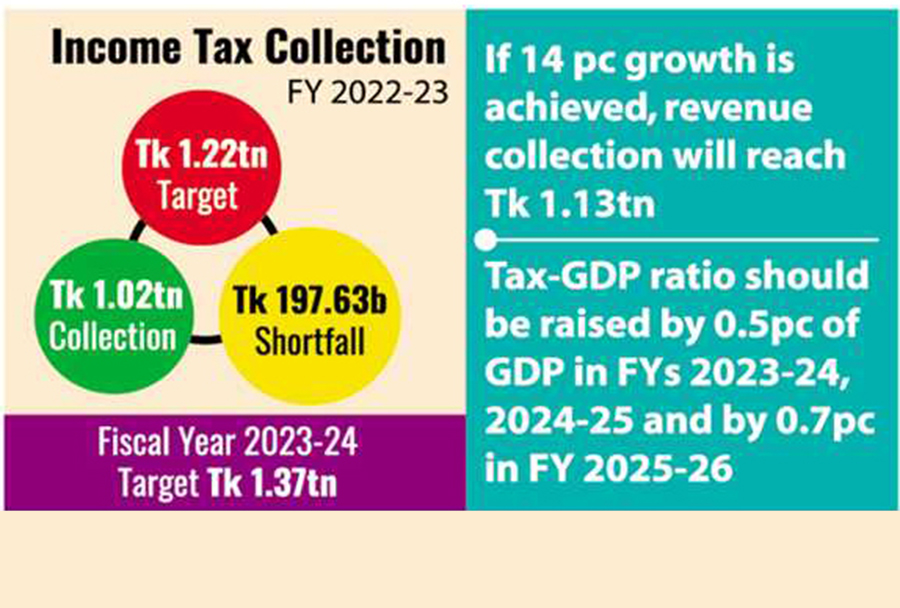
The National Board of Revenue (NBR) failed to meet its income tax collection target by Tk 197.63 billion in the just-concluded fiscal year 2022-23, according to official data.
The income tax collection target for the current financial year was set at Tk 1.22 trillion, but only Tk 1.02 trillion was collected.
Revenue board officials attributed this collection shortfall to the lingering effects of the pandemic, which have hindered many businesses from reaching pre-pandemic operational levels.
Statistical analysis shows that until May, the income tax collected amounted to Tk 889.59 billion, leaving a whopping Tk 331.41 billion to be collected to meet the target. However, in June, taxmen managed to collect only Tk 239.61 billion.
Looking ahead, NBR officials are now focusing on increasing revenue collection in FY 2023-24.
They underscored achieving tax targets, as they noted failure could lead to jeopardising the receipt of the next tranche of the International Monetary Fund (IMF) loan.
As part of the recommendations for granting a $4.70 billion loan package to Bangladesh, the IMF has asked for information on NBR steps to streamline collection.
According to sources, the IMF has prescribed a Tk 1.37 trillion income tax target in the financial year 2023-24.
NBR has presented a plan to achieve this goal, considering the 14.11 per cent average income tax growth in previous years, except for the pandemic-hit 2019-20.
If a similar growth rate is achieved, the revenue would amount to around Tk 1.13 trillion. NBR has devised additional measures to collect the remaining Tk 55.47 billion.
The plan outlines collecting Tk 30 billion through land registration, Tk 5 billion from the tourism sector, Tk 3 billion from the tobacco sector, Tk 1.5 billion from environmental surcharges and Tk 2.5 billion by expanding the scope of taxes.
Besides, NBR aims to gradually increase tax collection through measures such as reducing exemptions, increasing tax rates, implementing the Coronet and Document Verification System (DVS) and digitising NBR.
Revenue officials also called for shaping mass awareness to increase collection and achieve substantial goals. Experts suggest implementing extensive tax reforms rather than making marginal adjustments.
To improve the tax-GDP ratio, economists say the government must collect an additional tax equivalent to 10.5 per cent of the gross domestic product (GDP) from the next financial year onwards.
The tax-GDP ratio should be raised to 0.5 per cent of GDP in fiscal years 2023-24 and 2024-25 and further increased to 0.7 per cent in fiscal year 2025-26.
bdsmile@gmail.com