Government's revenue authority launches an extensive drive to recoup domestic revenue shortfall by tapping potential sectors as limited scope left for a last-quarter boost in taxing development-project spending.
Field-level officials say implementation of the Annual Development Programme (ADP) is traditionally a major source of domestic revenue, contributing significantly -- particularly in the final quarter of a fiscal year -- with taxes deducted at source from government payments.
However, fiscal constraints and ongoing global uncertainties have forced the government to scale down development spending, weakening this key revenue stream.
Government expenditure dropped significantly, to approximately Tk 122.80 billion in March of FY26, down from around Tk 153.41 billion in the same month of the fiscal year 2024-25. The monthly utilisation rate also declined from 6.78 per cent to 5.88 per cent.
A recent report by the General Economics Division (GED) indicates that the usual end-of-quarter spending surge would be subdued this year due to below-average ADP implementation.
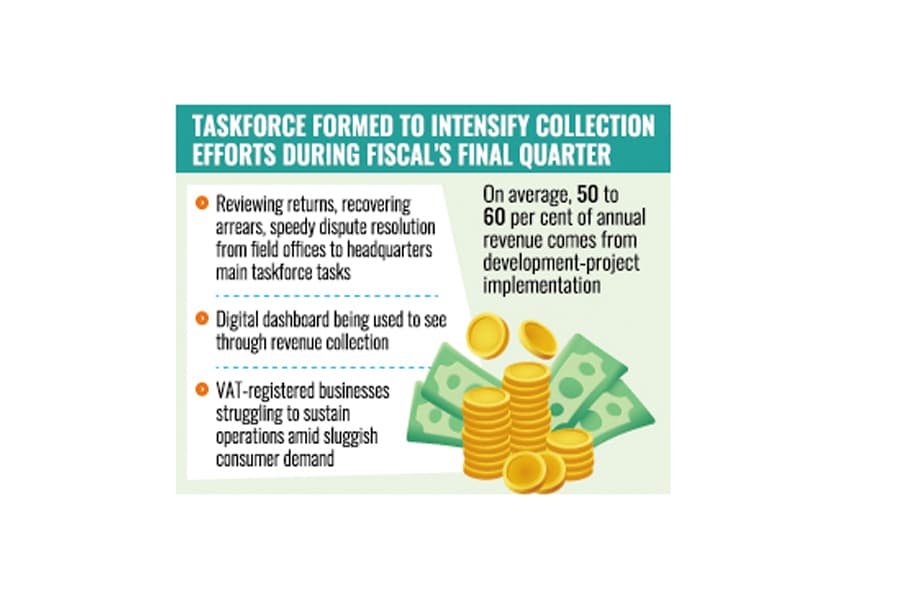
To offset the expected revenue gap, the National Board of Revenue (NBR) has formed a taskforce to intensify collection efforts during April-June, the final quarter of the fiscal year.
The taskforce is conducting daily monitoring of revenue performance across field offices.
The must-dos includes reviewing income-tax and VAT returns, recovering arrears, and expediting dispute resolution from field offices to the headquarters under close supervision.
Three senior officials from the income tax, customs, and VAT wings are leading the taskforce crusade for revenue netting.
A taskforce member told The Financial Express that a digital dashboard has been introduced to closely monitor revenue-collection activities.
"On average, 50 to 60 per cent of annual revenue comes from development-project implementation. This year, however, collection from this source is expected to be weak, potentially leading to a significant shortfall," says the official.
Field-level data show challenges mounting as a major part of revenue comes from government bills -- typically cleared in the final quarter -- for development-project works.
Roads and Highways Department and Civil Aviation sector alone account for around Tk 3.0 billion in outstanding payments in a value-added tax (VAT) zone, officials say.
Meanwhile, recent tax waivers in sectors such as LPG -- previously a major revenue contributor -- have further narrowed the revenue base.
Officials also note that generating additional revenue from sectors like restaurants remains difficult. For instance, collecting an additional Tk 500 million in VAT would require an estimated Tk 10 billion in sales turnover, which appears unrealistic under current economic conditions. Macroeconomic pressures are compounding the challenge.
While inflation remains elevated, wage growth has been inconsistent, eroding consumers' purchasing power and reducing their capacity to pay taxes.
Currently, around 0.8 million businesses are registered under the VAT system, but many are struggling to sustain operations amid declining demand.
doulotakter11@gmail.com
Loading...