
A long-dormant major project for building Padma Barrage, under consideration for over six decades amid debates over feasibility, financing and policy, is now set to be placed before the new government's highest economic policy-making body shortly.
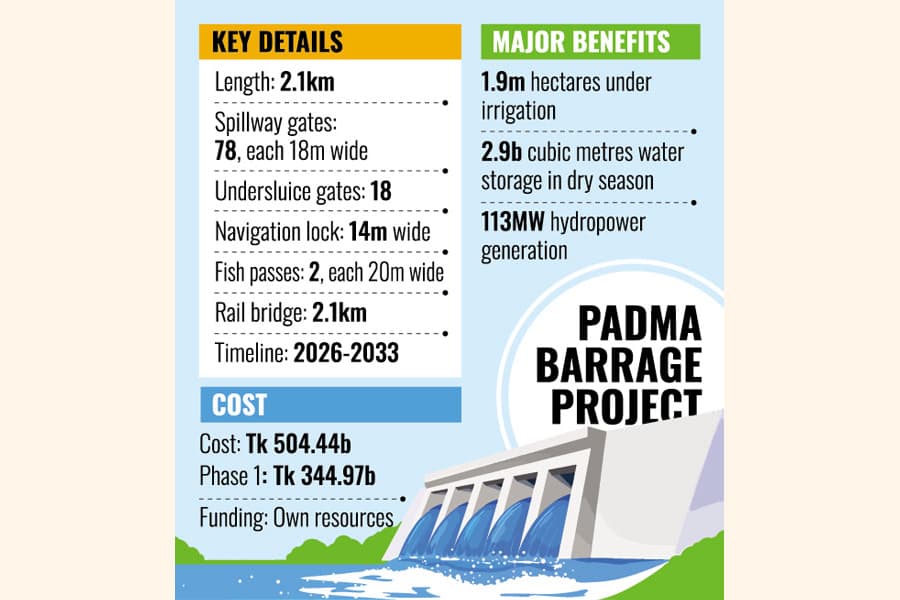
Officials say the project is expected to bring around 1.9 million hectares of land under irrigation, boosting agricultural output in Kushtia, Faridpur, Jashore, Khulna, Barishal, Pabna and Rajshahi.
The proposal, involving an estimated Tk 344.97 billion for the first phase, is likely to be tabled at the first Executive Committee of the National Economic Council (ECNEC) meeting of the BNP-led government scheduled for April 6, according to officials at the Planning Commission.
They have said State Minister for Planning Zonayed Saki has given a positive indication regarding placing the project at the meeting, and the file is currently awaiting approval from Planning Minister Amir Khosru Mahmud Chowdhury.
According to the project proposal, the 2.1-km barrage will include 78 spillway gates, each 18- metre wide, along with 18 undersluice gates.
It will also feature a 14-metre-wide navigation lock, two 20-metre-wide fish passes to support aquatic ecosystems, and a 2.1-km railway bridge over the structure.
The megaproject is expected to generate around 113 megawatts of hydropower and ensure water supply to key installations, including the Rooppur Nuclear Power Plant.
"At least two dozen projects, including the Padma Barrage, have been readied for placement at the ECNEC meeting," says a senior official of the NEC, ECNEC and Coordination Wing of the Planning Division.
Officials have added that all summaries and documentation have been finalised, and the meeting will be held once the government gives formal approval, with April 6 already receiving a preliminary green signal.
Earlier in January, towards the end of the interim government's tenure, the project was sent to the Planning Commission with plans to place it before the ECNEC on January 25.
However, then planning adviser Wahiduddin Mahmud cautioned against rushing approval for such a high-cost project without thorough scrutiny.
Initially proposed at Tk 504.44 billion, the project was reviewed by the Project Evaluation Committee (PEC), which recommended implementing it in two phases due to financing and implementation risks.
The first phase has been estimated at Tk 34.497 billion.
Bangladesh Water Development Board (BWDB), under the Ministry of Water Resources, will implement the project from the current year through June 2033, subject to ECNEC approval.
Although development partners, including China, had earlier shown interest in financing, uncertainty over external funding has led the government to opt for full financing from its own resources.
Under the first phase, the main barrage structure will be constructed alongside re-excavation of the Hisna-Mathabhanga and Gorai-Madhumati river systems. The second phase will include additional infrastructure and restoration of remaining river systems.
The proposal estimates Tk 186.02 billion for barrage construction and related infrastructure, Tk 7.43 billion for electrical works and hydropower generation, and Tk 4.18 billion for Gorai offtake-related facilities.
The idea of a Ganges or Padma Barrage dates back to the pre-independence period, with the then East Pakistan Water and Power Development Authority initiating the first study in 1961. Multiple pre-feasibility studies were conducted until 2000.
In 2002, the Water Resources Planning Organisation (WARPO) recommended constructing the barrage either at Thakurbari in Kushtia or Pangsha in Rajbari. Detailed feasibility studies and engineering designs were later carried out between 2009 and 2016.
Bangladesh and India also held technical-level discussions, including joint site visits and meetings in Dhaka in October 2016, followed by the formation of a joint technical subcommittee for data sharing.
The project aims to store monsoon water in the Padma to ensure year-round supply in the south-western and north-western regions.
Around 2.9 billion cubic metres of water could be stored during the dry season, helping restore flows in several river systems, including the Hisna-Mathabhanga, Gorai-Madhumati, Chandana-Barashia, Ichamati and Boral.
It is expected to reduce salinity, ensure freshwater availability, protect the Sundarbans ecosystem, support dredging, improve drainage in polders, and expand irrigation coverage.
Officials note that Padma-dependent areas account for nearly 37 per cent of the country and are home to about one-third of the population.
jahid.rn@gmail.com