


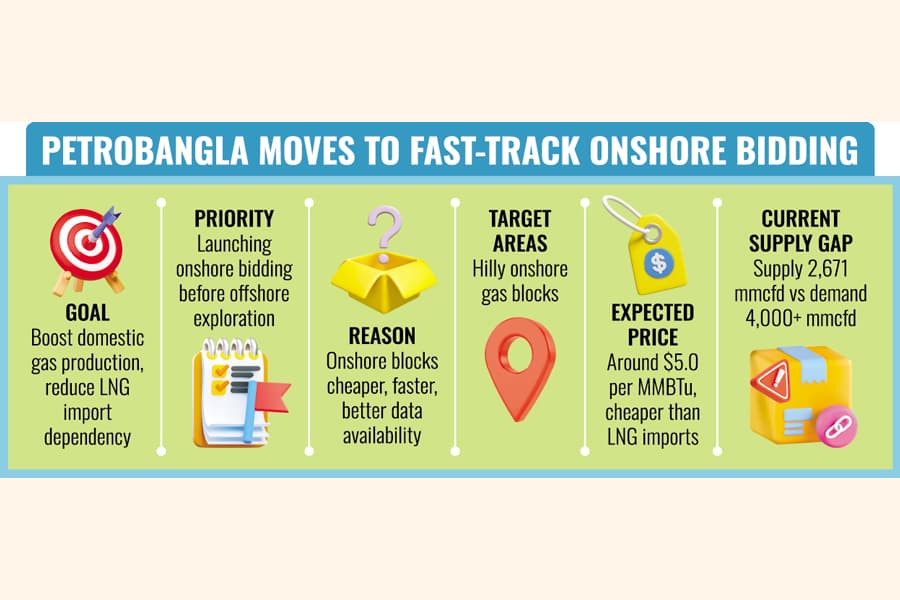
State-run Petrobangla has prioritised launching an onshore bidding round ahead of an offshore one to ramp up the country's overall natural gas output from local fields.
"We are now concentrating on inviting an international tender to carry out oil and gas exploration in onshore gas blocks, especially in hilly areas," Petrobangla chairman Md Rezanur Rahman has told The Financial Express.
Raising gas production from domestic fields has become essential amid dwindling output and rising demand across industries, power plants and other major consumers, he said.
"We are keen to float the tender soon for the onshore gas blocks," he added. "The bid round for offshore gas blocks will come later."
Lower investment requirements and shorter exploration periods in onshore blocks have prompted Petrobangla to prioritise the onshore round first, according to market insiders. Offshore exploration requires significantly higher investment and longer lead times, they added.
Bangladesh's offshore blocks also lack sufficient data for potential global oil and gas companies to make investment decisions, they said.
Sources noted that Bangladesh has not launched an onshore bid round for hydrocarbon exploration in the past 28 years.
The energy ministry is currently evaluating a draft of the Model Production Sharing Contract (MPSC) for the onshore bidding round, said the Petrobangla chairman.
Petrobangla prepared the draft and submitted it to the Energy and Mineral Resources Division (EMRD) under the Ministry of Power, Energy and Mineral Resources (MPEMR) for final approval, he added.
The terms have been made more attractive to international oil companies (IOCs) in line with recommendations from global consultant Wood Mackenzie.
Mr Rahman did not disclose the number of blocks to be offered or the expected pricing.
Sources said Petrobangla is also working on a draft MPSC for a separate offshore bidding round. Under the new MPSC for onshore blocks, the gas purchase price from IOCs will be linked to the dated Brent crude price on a three-month rolling average. The previous 1997 MPSC terms were linked to high sulphur fuel oil (HSFO) with a price floor and ceiling.
"We are working to fix the new formula so the price can be linked to around 8.0 per cent of the dated Brent crude, with a cap," said another Petrobangla official.
Based on the current Brent price of US$65 per tonne, the gas price is expected to be around $5.0 per million British thermal unit (MMBtu), he said.
This would make locally produced gas significantly cheaper -- about half the cost of LNG imported from the spot market and two-thirds of LNG imported under long-term contracts, industry insiders said.
Bangladesh currently pays around $11 per MMBTu for spot LNG and $7.5 per MMBTu under long-term deals.
If adopted, the new formula would make the gas price for onshore blocks nearly double the highest rate under existing model PSCs, which is $2.76 per MMBTu.
Chevron currently receives about $2.76 per MMBTu for its gas sold to Petrobangla, while KrisEnergy receives around $2.31 per MMBTu under HSFO-linked pricing.
Petrobangla also buys natural gas from three of its state-owned subsidiaries: Sylhet Gas Fields Ltd (SGFL) and Bangladesh Gas Fields Ltd (BGFCL) at Tk 28 per Mcf, and Bangladesh Petroleum Exploration and Production Company Ltd (BAPEX) at Tk 112 per Mcf.
The corporation has also narrowed down differences in exploration benefits to attract IOCs to the upcoming onshore round, the official added.
During the last onshore bidding round in 1997, four blocks -- Block 5, Block 7, Block 9 and Block 10 -- were awarded.
Currently, four IOCs have active PSCs, individually or jointly, for three shallow-water offshore blocks. Chevron is operating in three onshore fields under Blocks 12, 13 and 14, while KrisEnergy produces from the Bangora field under Block 9.
Petrobangla's most recent offshore bid round, which offered 24 sea blocks under the Model PSC 2023, saw no response from IOCs.
Bangladesh is currently importing lean LNG from RasGas of Qatar and Oman Trading International (OTI) under long-term contracts, as well as from several suppliers under spot arrangements, to meet rising demand.
The country's total gas supply is around 2,671 mmcfd -- including 892 mmcfd of re-gasified LNG -- against a demand exceeding 4,000 mmcfd, according to official data as of December 5 this year.
azizjst@yahoo.com