


Bangladesh Bank has yet again decided to be clenched-fist on money supply.


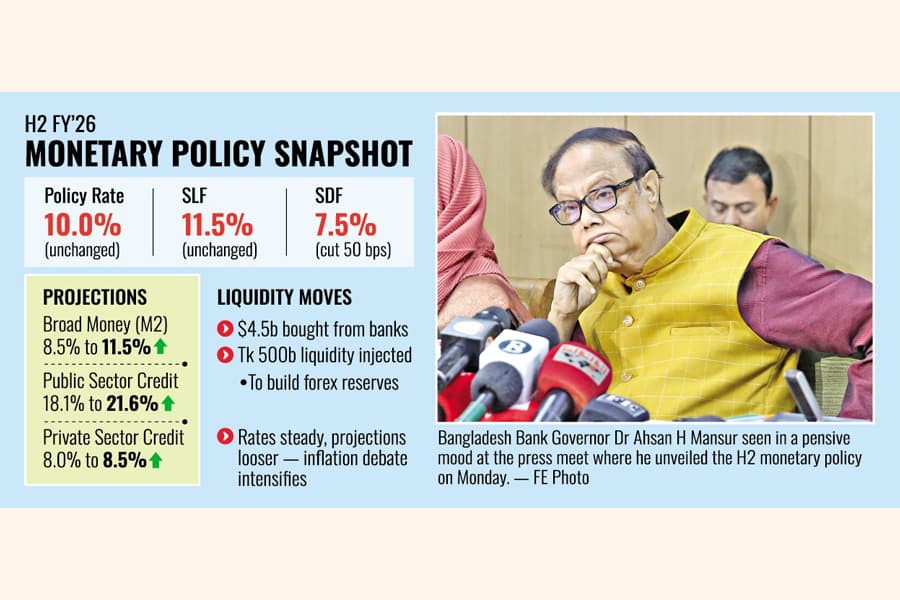
During the second half of this fiscal year, according to monetary policy statement (MPS), the policy rate will remain unchanged at 10 per cent as inflation frowns.
In the new MPS unveiled Monday, the central bank, however, takes into cognizance concerns vented by economists and businesses over investment stagnation and announces some stimuli like higher credit supply to private sector.
But monetary experts opine differently about the inflation-control strategy, saying that the Bangladesh Bank (BB) brings some changes in the projections of monetary policy statement that might further feed into inflation, driven largely by supply-side factors.
According to the latest MPS for January-June period, the disinflation process is currently showing some inconsistencies, but remains at a relatively elevated level, suggesting that a policy-rate reduction may not be prudent at this time.
"It's essential to anchor the exchange-rate stability. As this helps contain imported inflation, lowering the policy rate could unintentionally create depreciation pressure on the exchange rate," it is stated in the policy document.
There are also several near-term inflation risks, including the upcoming national elections, the approaching holy month of Ramadan, and the possible announcement of a new national pay scale.
"These elements typically stimulate demand and consumer spending, underscoring the need for a careful, balanced monetary policy."
Accordingly, BB will maintain the policy rate at 10.0 per cent and continue its tighter stance in the second half of the fiscal 2025-26, the regulator says to justify the carryover contractionary policy.
The Standing Lending Facility (SLF) will be held at 11.5 per cent. However, BB decided to lower Standing Deposit Facility (SDF) by 50 basis points from 8.0 per cent to 7.5 per cent.
The lowering of SDF is aimed at encouraging interbank money market as well as private-sector investment, loan and advances activities.
Under the MPS, the broad money or M2 is projected at 7.8 per cent until December 2025 but the money-supply growth actually reached 9.60 per cent. The initial broad money projection was 8.50 per cent by end of June next. Now the projection is revised upward to 11.50 per cent.
In terms of credit to the public sector, the projection has been enhanced to 21.60 per cent by June next in place of prior projection of 18.10 per cent.
Simultaneously, the projection of private-sector credit growth has also been expanded to 8.50 per cent until June next from the initial projection of 8.0 per cent, in accordance with the latest MPS.
Bangladesh Bank Governor Dr Ahsan H. Mansur said they ought to concentrate on building up foreign-exchange reserves. In the process, they have purchased more than US$4.50 billion from the banks in the last seven months and injected liquidity worth over Tk 500 billion into the market.
"Yes, it has a cost but we don't see it as cost because the broad money projection (11.50 per cent) is still lower if we consider the nominal GDP and inflation target (over 12 per cent)," he told the policy-presentation function.
Talking about the nature of the MPS, the central bank governor said it is tightened but not as tight as it used to be. "The reality is we're easing up within the tighter framework."
Responding to a question over possible impact of the government bank- borrowing pressure if the proposed pay scale is implemented, the governor said it would certainly push up government bank borrowings if it is not met by increasing revenues.
He said the credit growth to the public sector had already climbed as high as 28.9 per cent by December last. "If it increases further, it will have negative impact on private sector. So, we need to make the government understand the consequences. We want the government will meet a portion of the funding requirement through revenue mobilisation so that presser is lesser."
Dr Mansur thinks it will cause two problems: interest rate will not decrease or rise further and fuel inflationary pressure. "These are unpleasant tradeoffs. We cannot deny it."
Regarding the lowering of SDF rate by 50 basis points, he said there are banks having surplus liquidity but they did not invest in the money market. Instead, they keep the funds into the BB at 8.0 per cent.
"The BB does not need money. We want banks invest the money in interbank market or in the private sector. That's why we cut the SDF rate to discourage it," he added.
Contacted for his view, former lead economist of World Bank's Dhaka Office Dr Zahid Hussain said the monetary-policy regime shifted to interest-rate targeting from monetary targeting. Under the policy shift, there is no target but projections.
He says the central bank can contain inflation through controlling demand-side factors but the latest inflation spikes largely driven by the supply-side factors where the central bank has almost no control.
In this MPS, the economist says, some sort of easiness has been observed. "If demand side loses, it will create additional fuel to the fire. With this strategy, bringing down inflation at the expected level is not realistic."
About the SDF-rate cut, he says the rate is lowered mainly because of public-sector-borrowing pressure. "It may be a mild measure to prevent crowding-out effect." The economist was suggesting the central bank to mention the future path of reforms like Bangladesh Bank Order, Bank Company Act, Distressed Asset Management Act and AQR (asset quality review) in the MPS, which is missing.
In an immediate reaction, Dhaka Chamber of Commerce and Industry (DCCI) expressed grave concern and disappointment over central bank's decision to maintain contractionary monetary policy solely in the name of controlling inflation.
"Despite prolonged tight monetary conditions," it says, "inflation has not been effectively contained, proving that this tool has largely failed while inflicting serious damage on productive economic activities."
The trade body believes growth, employment and investment cannot be revived under an excessively restrictive monetary regime. "We look forward to the next elected government adopting a more pragmatic and growth-supportive policy framework coordinating the fiscal and monetary policy," it says, as the election is barely three days away now.
jubairfe1980@gmail.com