


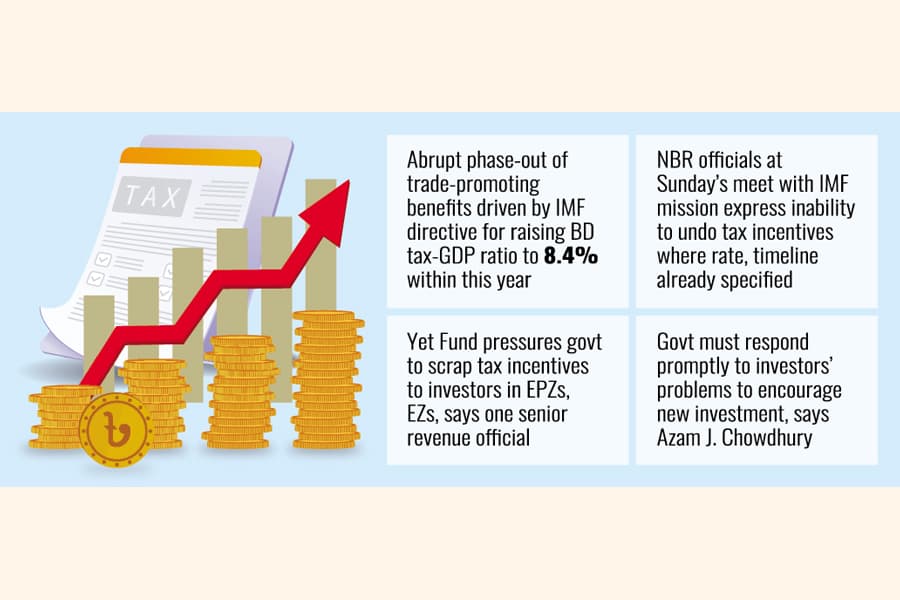
A willy-nilly government action undoing time-bound tax-breaks falters as investors lodge multiple objections and take the matter up with court on alleged breach of commitment.


Tax officials say the abrupt phasing out of these exemptions - the first of its kind - follows the International Monetary Fund (IMF) directive to raise Bangladesh's tax-to-GDP ratio to 8.4 per cent within this year.
They see such a sudden retraction of promise on tax benefits as unprecedented in the history of the National Board of Revenue (NBR).
In December and January, the NBR withdrew income-tax benefits for oceangoing ships, which were originally valid until 2030. Also revoked were tax reductions for local manufacturers of electrical goods, previously set to continue until 2032, through imposing a regular 20- percent tax instead.
However, both of these withdrawal orders-statutory regulatory order (SROs)--have faced multiple writ petitions in court. Eventually, the High Court stayed the implementation of the SRO that scrapped tax incentives for local investors.
Speaking to The Financial Express, a senior tax official has said IMF pressure is now mounting on the government to withdraw tax incentives offered to investors in export-processing zones (EPZs) and economic zones (EZs).
"These are time-bound tax privileges aimed at attracting investment," says the official. "Phasing out such facilities prematurely is making the government appear hostile to local investors rather than generating additional revenue."
An NBR team held a meeting Sunday with the visiting IMF mission, here to make a spot check of progress on the Fund's strings-tied lending package for Bangladesh.
"We have expressed our inability to cancel tax incentives where the tax rate and time period are already specified," says a senior NBR official who attended the meeting.
"As per the tax-expenditure policy, the NBR is supposed to gradually reduce tax exemptions. However, only open-ended facilities without time limits can be withdrawn."
Azam J. Chowdhury, President of the Oceangoing Ship Owners Association, mentions that the NBR reinstated VAT exemptions for the sector following investors' appeals.
"However, partial exemption will not help much as the income-tax issue remains pending with court," he says. "The government must respond promptly to investors' problems to encourage new investment."
Md Rabiul Islam Milton, Additional Executive Director of Walton Hi-Tech Industries, suggests the government should adopt predictable tax policies to help investors plan long-term expansions.
"Local investors can contribute more to employment generation and produce import substitutes if consistent policy support continues," he notes.
To encourage the growth of a domestic shipping fleet, reduce dependence on foreign vessels and bolster foreign-exchange reserves, the government in 2019 waived the 15-percent VAT on ship purchases and exempted freight income from Bangladesh-flagged oceangoing vessels from taxes until June 2030.
However, the facilities were revoked on December 15, 2024, when the NBR imposed 7.5-percent VAT on ship imports - which was, however, again withdrawn last September. On December 18, 2024, the revenue board also cancelled all freight-income-tax exemptions.
Later on January 7, 2025, it scrapped the pared-down 10-percent corporate-tax benefit for manufacturers of air conditioners and refrigerators--effectively doubling their tax rate to 20 per cent.
The facility was introduced in 2021 and scheduled to continue until 2032.
Several NBR officials have admitted in private that the abrupt pullout of these incentives was a "bad practice" that could harm investor confidence and make the tax authority appear inconsistent.
doulotakter11@gmail.com