


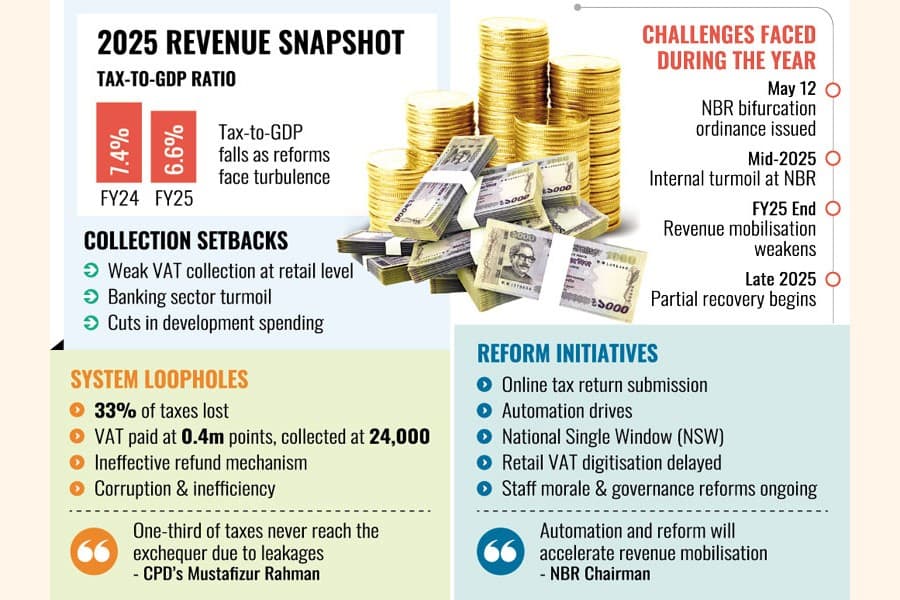
The year 2025 ended with deepening concern over Bangladesh's weakening domestic revenue mobilisation, prompting economists and policymakers to warn about the government's ability to meet rising public expenditure.


The National Board of Revenue (NBR) went through unprecedented turmoil at both its headquarters and field offices following the interim government's promulgation of the bifurcation ordinance on May 12, 2025.
Senior tax officials said they had never experienced such an internal divide and awkward working environment in the agency's history, noting that the situation had negatively affected revenue collection.
Bangladesh's tax-to-gross domestic product (GDP) ratio slipped to around 6.6 per cent in FY25 from 7.4 per cent in the previous fiscal year, although it started to show signs of recovery in recent months.
Despite the challenges, the interim government has, for the first time, scaled up the NBR's revenue collection target by Tk 540 billion, setting an ambitious goal for the current fiscal year.
Talking to The Financial Express, NBR Chairman Abdur Rahman Khan said a series of automation initiatives and reform efforts would help accelerate revenue mobilisation.
"I know there are several challenges in achieving the revised target, but the upward revision is justified to pursue higher goals," he said.
Automation drives, online submission of tax returns, and the launch of the National Single Window (NSW) had begun sending positive signals to taxpayers by reducing compliance hassles, he said.
The NBR was also working on restoring integrity and efficiency among its officials to address the widespread allegations against tax officials, he added.
Professor Mustafizur Rahman, a distinguished fellow at the Centre for Policy Dialogue (CPD), said the interim government should have prioritised digitising retail-level VAT collection through electronic fiscal devices (EFDs).
"The tax people pay and the amount the government actually receives are not the same. A significant portion is lost due to system leakage," he said.
On the NBR bifurcation issue, Professor Rahman said the initiative was good but it had been mishandled, demoralising revenue officials.
The NBR chairman pointed out that 2025 was a challenging year for the economy as the major revenue-generating sectors were hit by a combination of a smaller national budget, cuts in development expenditure, and continued turmoil in the banking sector - all of which weakened domestic revenue mobilisation.
However, he acknowledged some positive developments, including stronger efforts to curb tax evasion through digitalisation, narrowing compliance gaps, and improving governance.
According to the NBR data, revenue mobilisation growth exceeded 20 per cent during the July-September period and is expected to pick up further in the second quarter.
Tax return submission had become smoother, but ensuring the continuity of reform efforts remained the key challenge to achieving sustainable gains, the NBR chairman said.
While the upward revision of the revenue target posed risks, it could still be viewed positively as a signal of reform ambition even if the full target remained out of reach ultimately, he said.
"Achieving a 35 per cent growth rate, however, would be extremely difficult," he added.
Professor Rahman warned that the government was facing a "double whammy" as revenue expenditure continued to rise while mobilisation fell short of projections.
"One-third of the taxes paid by citizens do not reach the public exchequer due to leakage, corruption, and inefficiencies in the payment and collection system," he said, adding that no effective measures had yet been taken to plug these gaps.
Referring to the 2015 national budget speech by then finance minister AMA Muhith, he said Bangladesh officially collected VAT from around 24,000 points, while consumers paid VAT at nearly 0.4 million points - a situation that had worsened over time.
He also criticised the direct tax system for functioning more like a sales tax due to the absence of an effective refund mechanism.
"A functional and efficient tax refund system is essential to prevent over-taxation of taxpayers," he said.
Professor Rahman stressed that revenue reform and education expenditure must be treated as the top national priorities, warning that continued revenue weakness could put the country into a debt trap.
doulotakter11@gmail.com