


Bangladesh's slow-pace economic growth may be ramped up to 5.0 per cent by tailwinds before this fiscal year ends on June 30, 2026, as estimated by BMI, a unit of Fitch Ratings.


"We maintain our growth forecast of 5.0 per cent for FY2025/26," the global ratings agency's unit says in its latest report for Bangladesh.
This estimate is, however, lower than government's growth target at 5.5 per cent for the fiscal year.
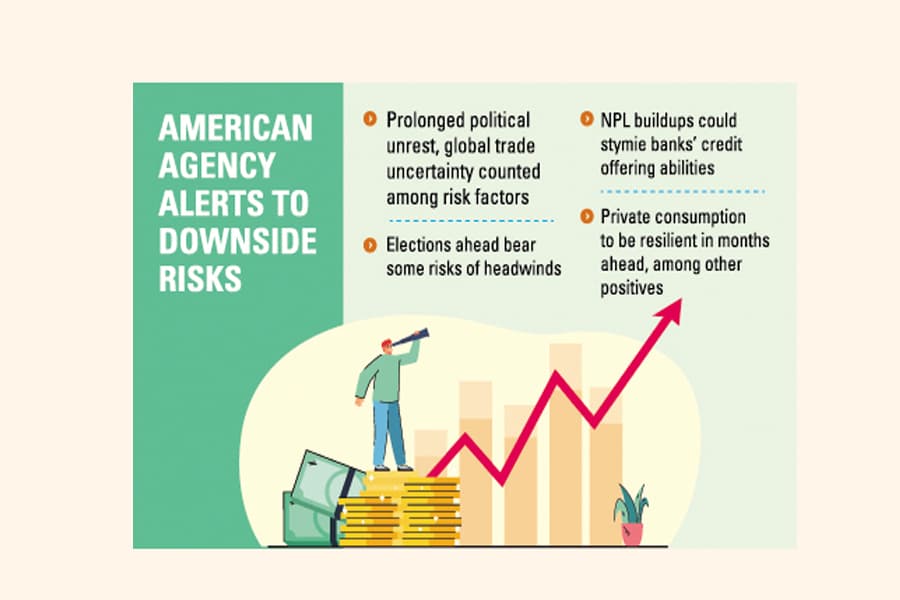
But the agency has identified some downside risks, too, for the economy during the fiscal year under review.
"Risks to our forecasts are tilted to the downside, based on prolonged political unrest posing a greater drag on growth and global trade uncertainty."
The Fitch's unit forecasts private consumption will likely be more resilient in the next few months in Bangladesh, possibly as the country is on the cusp of transition from political turmoil.
While inflation appears to be "sticky to the downside", real wages contracted by a much slower average of 0.7 per cent year on year over January-November 2025 compared to an average contraction of 2.4 per cent y-o-y in 2024.
"The risk here is that unemployment rises aggressively in the coming months, as US tariffs continue to negatively impact the garment industry," it notes.
"Any further upside for spending will be capped by the elevated risk of unrest associated with the upcoming elections," the agency alerts.
"That will also weigh on private investment. Historically, economic growth in Bangladesh has slowed during periods of political unrest."
The American credit-rating agency, however, does not expect the current situation to match the severity of the "July Revolution" yet forecasts "a modest acceleration in growth".
It recounts that GDP growth typically falls during periods of high political unrest
Bangladesh, it says, is facing another key downside risk that lies in the credit sector. Non-performing loans (NPLs) in Bangladesh have been rising at a significant rate, reflecting years of weak credit-risk assessment and lending practices.
The situation is further aggravated by slow and ineffective loan recovery through the judicial system and highlights the growing difficulties that businesses face in servicing their debt.
"Elevated NPL ratios may also discourage banks from extending new credit, which would further constrain investment and weigh on economic growth."
jasimharoon@yahoo.com