



An expert body has recommended radical restructuring of anomalous trade taxes for building a dynamic and trade-oriented economy capable of generating jobs and inclusive growth.


As of the last financial year, finished consumer goods enjoyed about 2.4 times higher tariff protection than intermediate goods in Bangladesh, perpetuating a structural imbalance in the trade regime, the taskforce finds and suggests restructuring the taxes.
 On average, final consumer goods in the last financial year got a total nominal protection rate of around 42 per cent, compared to 17.6 per cent for intermediate inputs -- a gap of nearly 25- percentage points.
The National Task Force for Tax Reforms (NTFTR), formed by the post-uprising reformist regime, has recommended a gradual reduction in the share of trade taxes in total revenue from the current 28 per cent to about 7.5 per cent by 2035, in line with international best practices.
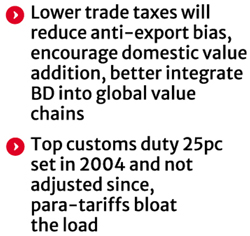
"Lower trade taxes will reduce anti-export bias, encourage domestic value addition, and better integrate Bangladesh into global value chains," the expert body says in its report.
However, local businesses have differences of opinion on reduction in protective tariffs to diversify export as they feel the need to enhance competitive advantage to create a new export market.
The taskforce submitted its findings to the Chief Adviser of the interim government earlier this year. The Financial Express has obtained a copy of the report, which is yet to be made public.
As a developing economy, Bangladesh faces a fundamental contradiction in its fiscal stance.
Trade taxes are widely regarded as among the most distorted tax instruments, yet the country continues to rely heavily on them because they are comparatively easy to administer and collect.
This creates a difficult trade-off between economic efficiency and administrative feasibility, the report notes.
Trade-economist Zaidi Sattar, who headed the committee, has observed that Bangladesh now exhibits one of the widest tariff escalations among peer countries.
"The top customs duty (CD) rate of 25 per cent was set in 2004 and has not been adjusted since. Meanwhile, Regulatory Duty (RD), effectively an additional customs duty, has been layered on," the report reads.
In most cases, protected consumer goods face CD plus RD, followed by Supplementary Duty (SD).
"To reduce protection over time, a balanced approach is required -- output tariffs must fall in tandem with input tariffs. By 2035, the two average rates should converge within five- percentage points as Bangladesh graduates to upper-middle-income-country status," Dr Sattar suggests.
In recent years, effective protection for many consumer-goods industries has increased due to ad hoc duty adjustments that kept final-goods tariffs high while lowering input tariffs.
The trend, the taskforce report argues, must be reversed if firms are to become export-competitive.
Dhaka Chamber of Commerce and Industry (DCCI) president Taskeen Ahmed has says sector-based focus to diversify export basket is necessary.
"It is not that the local business is making hefty profit for protective tariffs," he says, pointing out the manufacturing of biscuits that is completely dependent on imported sugar and wheat.
Kamruzzaman Kamal, Director, Marketing, of Pran-RFL group, also expresses different opinion as the local industries just started flourishing based on protective tariffs and already developed capacity to manufacture import-substituting goods.
The taskforce in its report opines Bangladesh's trade-tax structure has become archaic and obsolete.
"The time has come for a radical change," the report states.
The study was led by Dr Sattar with contributions from Dr M. Zahid Hossain, Dr Syed M. Ahsan, Dr Sultan Hafeez Rahman, Syed Nasim Manzur, Shah Md Abdul Khaleque and Snehasish Barua, and research support from PRI Research Associates.
"Reforming the structure of trade taxes has become a national imperative for building a dynamic, trade-oriented economy capable of generating jobs and inclusive growth," the report says.
Bangladesh currently derives about 28 per cent of its total tax revenue from import duties and other trade taxes -- down sharply from around 70 per cent in the 1970s, but still far above the global average of roughly 1.0 per cent. Lower-middle-income countries collect only about 5-15 per cent of revenue from trade taxes, on average.
High tariffs raise domestic prices, distort consumer and producer decisions, and shield inefficient industries at the expense of consumers and exporters.
While higher tariff rates may provide greater protection for domestic enterprises, the revenue outcome is not straightforward. Historical experience suggests tariff reductions can, in some cases, enhance revenue -- as seen during the 1990s reform period -- by expanding the tax base and reducing evasion.
Given Bangladesh's current fiscal position, customs revenue remains important. However, the report argues that trade taxes can be phased down without risking fiscal shortfalls, provided domestic revenue mobilisation -- particularly income tax and VAT collection -- is strengthened.
Although Bangladesh officially maintains seven basic customs-duty slabs -- 0, 1, 3, 5, 10, 15 and 25 per cent -- the extensive use of para-tariffs such as Regulatory Duty and Supplementary Duty has created an intricate web of more than 50 effective rates.
Average customs duties declined from over 21 per cent in FY01 to about 14 per cent in recent years, reflecting an earlier phase of tariff liberalisation. However, this progress was offset by a steady rise in para-tariffs. Supplementary and Regulatory Duties climbed from 7.1 per cent in FY01 to around 13 per cent by FY25 and remained elevated.
Currently, only about 19 per cent of Bangladesh's tariff lines are bound at the World Trade Organisation, mostly in agriculture and at very high ceilings. The average gap between bound and applied tariffs -- known as the "binding overhang" -- stands at roughly 148.5 percentage points, undermining predictability and raising concerns for investors and trading partners.
The report says decisive reform of trade taxation is essential if Bangladesh is to move towards a more competitive, export-led and sustainable growth trajectory.
doulotakter11@gmail.com