

Khalilur promises to protect national interest through principled, balanced diplomacy
Published :
Updated :
 For all latest news, follow The Financial Express Google News channel.
Foreign Minister Khalilur Rahman has said the new government will conduct its foreign policy by firmly defending Bangladesh’s national interest, guided by five “core principles”.
Those principles, he said, are sovereign equality, respect for mutual independence, non-interference in internal affairs, national dignity, and mutual benefit.
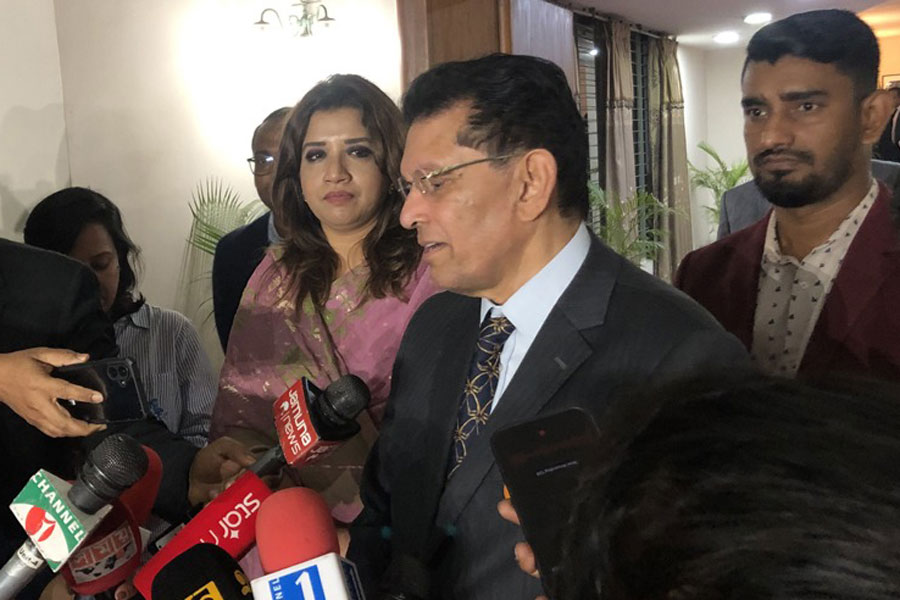
Speaking at a briefing on Wednesday evening at the State Guest House Padma, Khalil said: “We will defend our national interest inch by inch in our foreign engagements. This is our red line.”
Prime Minister Tarique Rahman launched the new government on Tuesday under the slogan “Bangladesh First”, appointing Khalilur, a career diplomat, as foreign minister -- a decision that surprised many, given his key roles during the interim administration.
During that period, Khalilur served as Muhammad Yunus’s high representative on the Rohingya issue and other priority matters, including as the national security advisor.
On the first day of the new government, after attending official programmes and cabinet-related meetings, Khalilur met Nepali Foreign Minister Bala Nanda Sharma at Padma in the evening.
Sharma was in Dhaka to attend Tuesday’s swearing-in of the new government.
Responding to a question on the government’s foreign policy direction, Khalilur said: “I am deeply grateful to the prime minister for entrusting me with this responsibility.
“I began my public service career 46 years ago at the Ministry of Foreign Affairs, and at this stage of my life, I have returned to the same ministry. This is a profound responsibility.
“During the interim government, we gave serious thought to our foreign policy and its orientation, and took steps to rebalance it. The prime minister has repeatedly said in his speeches, ‘Bangladesh First’. That will be the motto of our foreign policy.”
He added: “We will fully protect our interests while conducting our foreign relations, and I am clearly laying out the principles behind that approach.”
Elaborating on the five principles, he said: “There is nothing unilateral in this.”
Recalling Bangladesh’s foreign policy under the former president Ziaur Rahman, Khalilur said: “In one sense, we are returning to president Ziaur Rahman’s foreign policy. That is what we tried to do during the interim government.”
He cited three “bold steps” taken during that era, including Bangladesh’s UN membership in 1974, its election to the UN Security Council within four years -- defeating Japan -- and initiatives on regional connectivity, SAARC, and global peace through the Al-Quds Committee.
“Our foreign policy was not only positive; it was expanded and very bold. We want to return to that place,” he said.
On relations with India, Khalilur said Bangladesh wanted good relations with all countries while safeguarding its own interests.
On Myanmar and regional security, he said: “Our focus on the Rohingya issue will not diminish; it will increase.
“During the interim administration, we engaged both the Myanmar government and the Arakan Army -- the first to do so -- and those contacts will continue. We will try for an urgent solution, and I am hopeful.”
Responding to allegations that he played a “referee’s role” during the election process, Khalilur said: “If people are talking about election engineering, that means the counting was wrong, right? Count again. It’s not difficult to understand.”
Addressing past BNP criticism branding him a “foreign national”, he said: “I didn’t force my way in. People can have initial perceptions about someone, but perceptions change, don’t they?”
Pledging regular engagement with journalists, Khalil added: “We conduct foreign policy on behalf of the people of Bangladesh, and you carry that message.
“I only ask that the media maintain objectivity and not become a factory of rumours. Foreign policy is extremely sensitive -- one misplaced word can damage relationships.”
State Minister for Foreign Affairs Shama Obaed said the new foreign policy would be both “challenging and interesting”.
“Our foreign policy will reflect the will and aspirations of the people after 17 years. We will protect Bangladesh’s interests while maintaining good relations with all.”
Asked whether there would be any shift from a balanced foreign policy, she said: “We will do whatever is necessary to protect the interests of the people of Bangladesh.”