


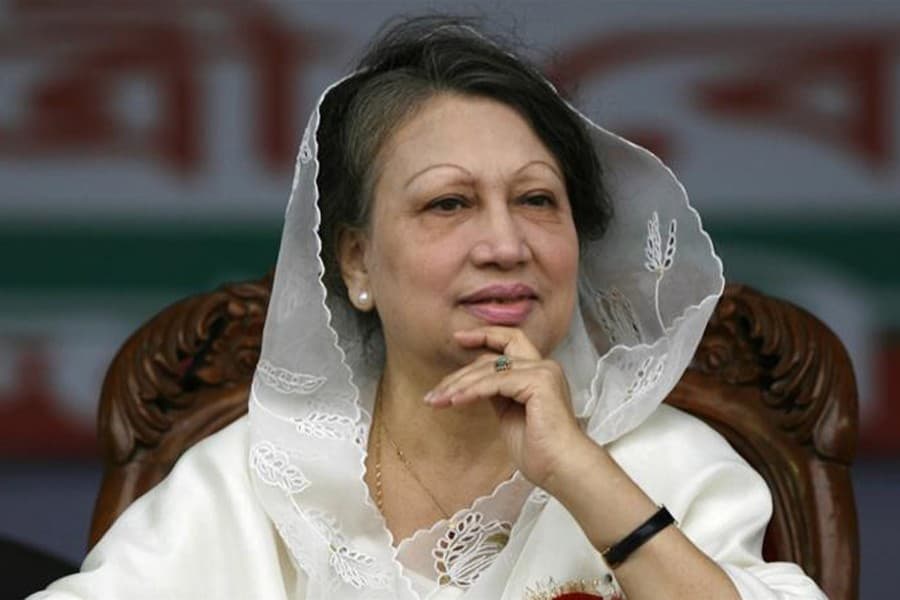
The death of Begum Khaleda Zia yesterday, December 30, is an irreparable loss to the nation at a moment when it is at a critical juncture. In fact, this is no eulogy to her memory to say that Khaleda Zia was the first elected female prime minister of the country or that she was elected prime minister three times. To be frank, she was the first leader of post-independence Bangladesh who never bowed to any pressure whether from within or without the country. She had the courage of conviction, a virtue she was perhaps born with. This she proved time and again during her four decades long political career since she took the Bangladesh Nationalist Party (BNP)'s helm in 1984, about three years after his husband President Ziaur Rahman's assassination in a failed military coup on May 30, 1981.Then she was purely a housewife and party politics should have been quite a strange world to her. Surprisingly though, it did take long for her to take the helm of the Bangladesh Nationalist (BNP), which was founded about a year and half before by her late husband. Evidently, the BNP was in disarray and many political observers predicted that the party might not last long. But they were proved wrong as she not only saved it from the brink, but also reorganised it in the face of formidable barriers to her political career created by the then-military dictator Hussain Muhammad Ershad as well as the leader of then-opposition Sheikh Hasina. But she took the challenge and successfully led the BNP to win the first-ever free and fair election held in the country under a caretaker government headed by Justice Shahabuddin Ahmed in 1991.
Her life, especially as the wife of a military officer cannot be said to have been a peaceful one, especially since her husband revolted in 1971 against the Pakistan Army, and started the struggle to wrest the country's freedom from the occupation army. Obviously, she suffered with her two children throughout the gruelling months of the Liberation War as she was the spouse of a rebel military officer. But uncertainties and the attendant anxieties never left her even after the country's independence. Her days of peace and happiness with her family and friends were short-lived with the country's political situation turning dicey as the army was jolted by a wave of bloody internecine conflicts. As a hero of the Liberation War, her husband took the centre stage in these intra-military feuds.
Political leaders often try to win the public's sympathy by playing the victim card. But she never made a political issue out of president Zia's assassination and used it as a subject of crude electioneering. Unlike some of her political contemporaries, she did not believe in the politics of revenge, nor vendetta, nor practised any during her political life. Being the main adversary of the vengeful Sheikh Hasina, who ruled the country for more than one and a half decades, her sufferings knew no bound. She was imprisoned on a flimsy ground and was denied bail so she could not go abroad for better treatment. Thank the Almighty that the July revolution of 2024 led by students and masses created the right condition for her to breathe freely.
During her last days, Khaleda Zia served as a beacon of hope. It is not to say that Khaleda Zia was faultless or that she did never commit any political blunder. Of course, a dispassionate scrutiny might discover lapses in her political career. Despite everything, she was one of the best practitioners of political pluralism and democracy in Bangladesh. Let the nation turn the grief of her loss into strength and learn not to lose hope when difficulties seem impossible to overcome.