


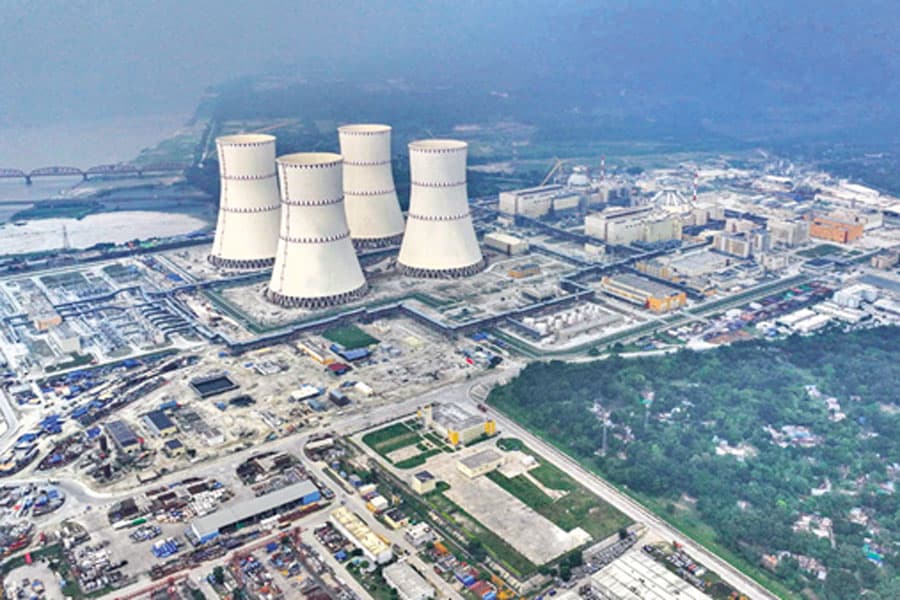
Bangladesh is well set to transition to the operational phase of the nuclear power plant at Rooppur with the start of loading of fuel into the core reactor of unit-1 on Tuesday. However, fuel loading does not mean generation of power would begin right away. The loading will continue for about 45 days and then the core of the reactor would be warmed up for about three months before starting generation of power on a trial basis. Unit-1 of the n-power plant was scheduled for completion in 2022 but several unavoidable factors including the Covid-19 pandemic were responsible for the long delay. A sensitive and highly advanced scientific and technological process is involved across the construction to operation phases of a nuclear power plant. Although the trial generation of power can immediately be transmitted to the special power grid constructed for the purpose, it will take between six months to a year for commissioning the unit-1 for its capacity generation of power.


Clearly, the wait is not over yet but nevertheless the uranium loading is a milestone in the country's history of harnessing nuclear energy. Initially, 300 megawatts (MWs) of power will be generated and if things go well, production will be increased 10-15 per cent until the unit-1 runs full capacity at 1,200 MW. The unit-2 is still under construction and once that also comes into operation, this relatively more eco-friendly power plant will be able to add 2,400 MW to the national grid. So the output is expected to help Bangladesh reduce its dependence on fossil fuels to some extent. When the plant becomes fully operational, it will generate 10 per cent of the total installed capacity of all power plants. It will be quite a big step towards generating relatively cleaner power.
However, the status of n-plants as a source of clean energy is debatable because mostly for the disposal of spent fuel. The waste management is a crucial issue and reportedly Russia will take back the uranium waste. Whether the agreement in this respect is clear or not is yet to be ascertained. Built in compliance with the post-Fukushima safety standards, the Rooppur power plant has, according to official claims, some advanced feature to avoid accidents like that of Chernobyl. Yet safety and security concerns should be at the top of the priority list.
Finally, as a source of energy, power plants including n-plants are an extension of economic development goal of a country. Bangladesh has an installed capacity of 28,919 MW from 136 power plants, 95 per cent of which are fossil fuel-based. But the power output is more on paper than a reality. Right now, those power plants cannot meet the current demand of nearly 18,000 MW due to crisis of fuels. This is why renewable sources of power generation are a priority option. If the Rooppur N-plant proves a success, the country may opt for one or more such plants. But that would face a tricky situation simply because of the US-Bangladesh reciprocal trade agreement signed on February 9 this year. Bangladesh cannot receive uranium from a country blacklisted by the US. Here the hint is clear: Russia and China are those countries. Bangladesh has surrendered too much to retain the concessionary RMG deals. Even the country's energy options have been limited by that agreement.