
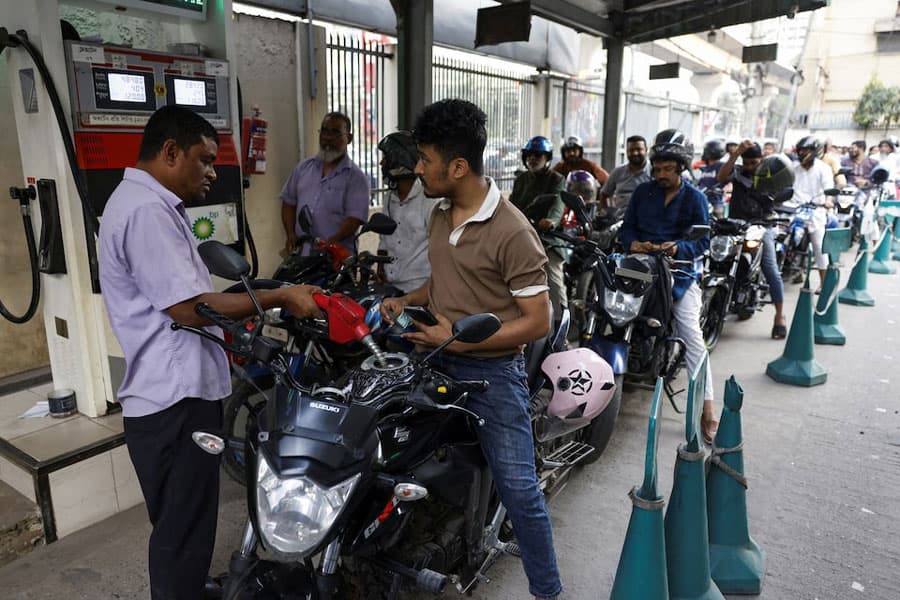
The war between Iran on one side and the United States and Israel on the other is wreaking havoc on the global energy market. With the Strait of Hormuz facing disruption, the ripple effects are being felt far beyond the Middle East since this narrow passage carries a third of the world's liquefied natural gas and a significant share of its crude oil. Countries heavily dependent on imported energy are particularly vulnerable and Bangladesh is no exception. Nearly all of the petroleum used in the country is brought in from abroad, much of it passing through the very waters now threatened by conflict. Brent crude has already climbed past $90 per barrel as traders respond to the growing risk of supply disruption and analysts warn it could soon breach the $100 threshold. The result has been a sudden surge of anxiety among consumers that is already surfacing in visible ways. Long queues at filling stations and a rush by motorists to refill their tanks show how quickly uncertainty can turn into panic buying. Such behaviour is understandable in times of uncertainty, yet it can quickly create the very scarcity that people fear.
It is within this context that the authorities have introduced limits on fuel purchases at filling stations. Motorcycles are allowed only a small quantity of petrol each day, private cars a slightly larger amount while public transport vehicles and freight carriers are allocated higher limits based on their operational needs. Understandably, controlled distribution ensures that fuel reaches the largest number of users and prevents a small group of consumers from monopolising supply through hoarding. It also helps preserve fairness in access to a resource that is essential for transportation, agriculture and commerce. The rationing system is not a solution to the underlying problem but a necessary bridge to get through a period when supply cannot keep pace with demand.
The scale of the squeeze becomes clear when tracking what each spike in global oil prices does to the national treasury. Every time prices climb by $10 a barrel, Bangladesh ends up paying roughly $80 million more each month for fuel imports. The liquefied natural gas situation is even more unsettling. Spot market prices have nearly doubled lately and the government is set to spend over Tk 23 billion on just two cargoes, more than double what those same shipments would have cost only a month ago. When prices rise this sharply the burden inevitably filters through the economy in the form of higher operating costs for industry, increased transport fares and more expensive food. The strain on energy supplies is already forcing difficult trade-offs. Five fertiliser factories have been temporarily shut down so that gas can be diverted to power generation. Soon enough, the government may have little choice but to consider additional conservation measures such as distance learning and work from home arrangements to further reduce fuel consumption.
If this crisis has revealed anything, it is how vulnerable the country remains. Bangladesh built its growth model on imported fossil fuels assuming the global supply chains would always stay open and the fuel would always keep flowing. Any economy that relies on other countries for something as basic as energy will always be vulnerable to trouble brewing somewhere far away. Right now, the urgent tasks are making rationing work, scouring markets for alternative supply options and calming public nerves. But there is also a longer-term lesson that cannot be ignored. Real energy security means being able to generate power from sources that cannot be blockaded. The sooner the country turns toward what it can control at home the less it will dread whatever crisis comes next.