

Published :
Updated :
 For all latest news, follow The Financial Express Google News channel.
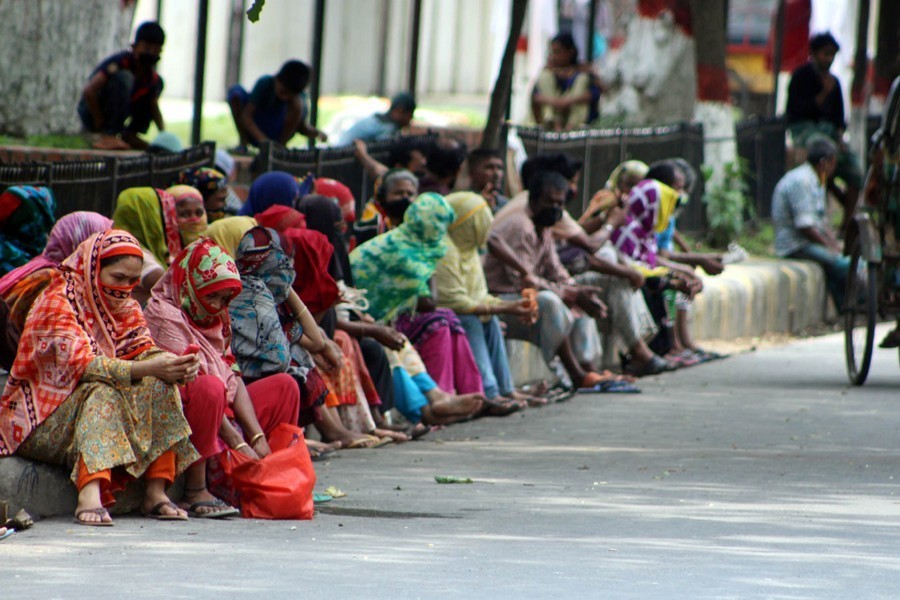
So far as economic growth is concerned, Bangladesh has come a long way off. But this is based more on oligarchy than on equalitarianism. In fact, all capitalist society suffers from unequal distribution of wealth largely because of the privileged individual ownership of means of production and profit. Behind the creation of Bangladesh, the overriding concern was to narrow the wide gap between the rich and the poor. But how the country has deviated from that constitutionally recognised principle hardly bothers policymakers today. But apart from academic discussions held from time to time on the subject, hardly anything substantial is done. One such erudite parley titled 'Bangladesh Development Narratives and Parallel Realities: Perspective of Backward Communities' organised by the Citizen's Platform for Sustainable Development Goals, Bangladesh, in the city once again drew the policymakers' attention to this disturbing socio-economic development. An increase in income inequality, measured by Gini coefficient, by 9.0 per cent from 2010 to 2022 does not quite reflect the hardship the low-income people suffer.
It is highly revealing that the rich are getting richer even when economies are contracting. The world's leading capitalist country America has seen the world's top rich band of people accumulating wealth at fabulous rates. But there is a fundamental difference between the superrich and their counterparts in Bangladesh. All top US rich people are tech giants whose wealth creation has been made possible and spurred by investment and progress in artificial intelligence (AI). Here the accumulation of wealth has mostly been on businesses as against innovation and, it must be recorded, not always on commercial ethics and honesty. No doubt, expenditure of huge amounts on mega infrastructure facilitates communication, industrial production and movement of commodities but it only helps the privileged and moneyed people at the cost of the marginalised who are left out. Their travails have, of late, been exacerbated because of the lack of education and skill. Upskilling them is no less important than construction of infrastructure. There has been a mismatch between education and employment, between industrialisation and skilled sets of workers ---all of which call for addressing as early as possible.
Even within the limited scope of allocation of economic benefits, income inequality in villages has not gone from bad to worse while in cities and towns where the marginalised people have nothing to fall back upon it has worsened further. This would not be the case had there been good governance to arrest corruption, money laundering and aberration of democratic values. Some privileged coteries have abused their power, position and privileges to advance their personal interests at the cost of the multitudes.
Today, the marginalised and the low-income people have their backs to the wall. This is by no means a desirable development. After all, going ahead alone leaving the rest behind makes little sense in terms of sociological progress. The greater the disparities are the greater the backlash that waits in the wing. Now that the government is facing a crunch time, the rich who have become richer defying economic contraction following the pandemic and Russo-Ukraine war will not be of any help. Had the wealth been rationally, if not equally, distributed with no scope for resorting to intrigues for advancing undue self interests, social equilibrium would not get disrupted so viciously. It is better to scale down the socio-economic disparities in everyone's interests.