

Published :
Updated :
 For all latest news, follow The Financial Express Google News channel.
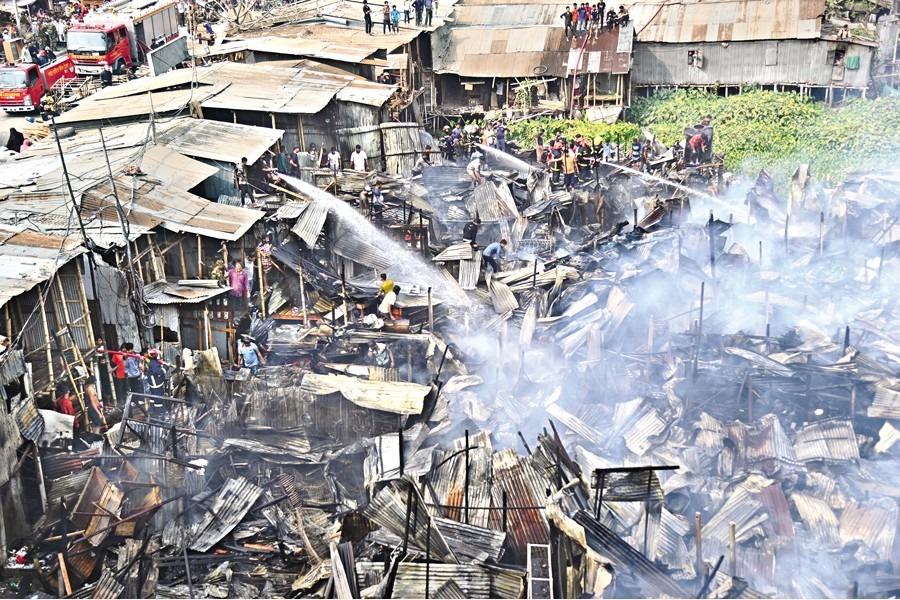
Once again a devastating fire originating from an unauthorised chemical warehouse has claimed at least 16 lives. This time the tragedy happened not in the infamous areas of old Dhaka but in Mirpur's Shialbari area. All 16 people died in a garment factory housed in a four-storey building next to the chemical godown. Fire and toxic fumes from the chemical warehouse spread to the garment factory and claimed the lives of some of its workers. It is the same old story that the workers could not escape the blaze because the doors leading to the roof of the building was locked. That the building has no emergency exit is clear because a few who could survive had to break window grills of the building on fire and jump on an adjacent tin-roofed house. Whether the building had approval for housing a garment factory is doubtful.
Bangladesh may have the highest number of Leadership in Energy and Design (LEED)-certified RMG factories but there are smaller units operated in buildings unsuitable for the purpose. In this Mirpur case, the fire did not originate from the garment factory but if the unit had a safe emergency exit route, its workers would not have to die so helplessly. The fact that the episode of frequent fire tragedies has been a thing of the past courtesy of Alliance and Accord---a consortium of North American buyers and a platform of European and global buyer-led initiative respectively--- must be acknowledged by all, particularly by the owners of garment factories in Bangladesh. The two buying platforms' intervention involving retrofitting and other improvements in RMG factories has reduced the chances of fire incidents in the industry. But the smaller units often acting as sub-contractors do not comply with the rigorous safety measures enforced in the sector. There is a need for bringing such RMG units under the safety protocol.
As for the storing of inflammable chemicals, there are designated areas. These cannot be stored anywhere and everywhere. The Shialbari warehouse did it illegally and has ended up with tragic consequences. Such incidents are a symptom of underdevelopment. People carrying out businesses must as well be aware of the risks involved in their particular types. When they operate illegally and clandestinely, they are unlikely to be guided by the government agencies responsible for guiding operators of risky businesses. There are methods and rules for storing inflammable chemicals and any laxity can cause explosion.
So, the message from the Shialbari garment tragedy is that residential areas and business ventures must be separated from each other. There may be hidden dangers in innocuous enterprises operated in a residential area. The risky businesses of chemicals should not be operated from warehouses in areas other than the designated areas. Chemical warehouses are like ticking bombs without supervision and monitoring. This has been proved time and again but yet the initiative to relocate about 500 chemical warehouses from old Dhaka to Shyampur industrial area has failed to materialise. After each of the 2010 Nimtoli and Chawkbazar Churihatta infernos accounting for 124 and 71 lives, the urgency of relocation of chemical warehouses was underscored. But with time the urgency dissipates and may not draw further attention before another such tragedy strikes.