

Published :
Updated :
 For all latest news, follow The Financial Express Google News channel.
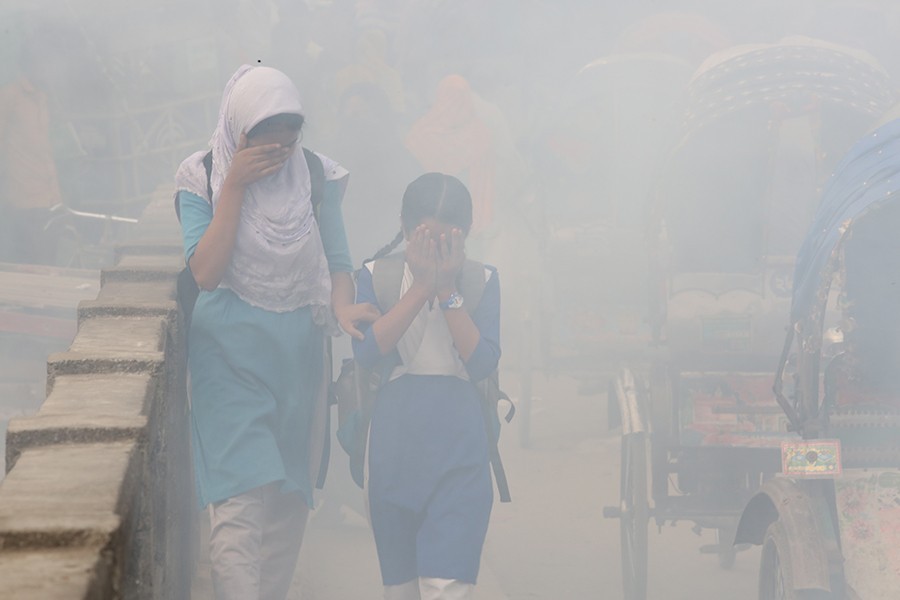
Bangladesh is one of the 10 most climate vulnerable nations in the world. And the prime mover of the climate vulnerability is human action. In fact, human-induced climate change is intensifying the phenomenon of extreme heat across the country. In Dhaka, rising temperatures aggravate air pollution, creating severe health and environmental challenges. Between 1980 and 2023, Dhaka warmed significantly faster than the national average. The city's heat index surged 60 per cent more than the national trend, turning Dhaka into an urban heat island where pollutants accumulate. This concentrated heat traps pollutants close to the ground, further exacerbating the deterioration of air quality. How does such deterioration of air quality affect life and the economy? According a World Bank (WB) report, inhalable particulate matter (PM2.5), which are 2.5 micrometers across, shortens average life expectancy by 6.8 years. Another WB study says that due to air pollution, the country in 2019, sustained economic losses ranging between USD11.5 billion and USD 13 billion.
Understandably, these issues of worsening pollution and environmental degradation are no more confined to the seminars of the academics or demands of pro-environment NGOs. Those are now among the hot topics in the manifestos of political parties vying for power across the globe. Against this backdrop, the Bangladesh Nationalist Party (BNP), which has got a massive mandate through the recent (February 12) elections to rule the country for the next five years, has environmental and social issues as a major focus area in its future development strategies. Accordingly, the new government's promises include expansion of renewable energy, afforestation, green jobs, and climate resilience. As part of that policy, the new government's environmental policy has a 'National Green Recovery Plan' that prioritizes massive reforestation through an extensive tree plantation and thus create a large number of green jobs. And through adopting a 3R (Reduce, Reuse, Recycle) policy, it plans to reduce plastic waste by 30 per cent in five years. It also plans to use GIS technology to identify suitable tree planting sites, while a 'Tree Monitoring App' would track the growth and health of new trees. Similarly, its waste management plans include developing a circular waste economy, expanding e-waste recycling, formalizing informal waste workers and implementing waste to energy projects. It also wants to use water-saving technology in rice production and add 20 per cent of power to the national grid from renewable sources by 2030.`
On climate policy, the party has proposed launching a centralised carbon trading market targeting one billion US dollar per year in revenue. Obviously, it is an ambitious plan to improve the overall environmental condition and address the broader issue of climate change. But having a big plan on paper is one thing, materializing it in practice is quite another. To be frank, successive governments in the past had never any shortage of ideas and plans to boost trade, construct physical infrastructures, generate power, build digital economy, you name it, they had among their policies. But few of their ideas could ever see the light of day when their respective terms in power came to a close.
So, to avoid any failure while implementing its ambitious green dream, the incumbent BNP government would be well-advised to learn from the mistakes its predecessors committed. Undeniably, the new government has opportunity to address Bangladesh's growing energy needs, environmental challenges and climate risks. However, successful implementation will require transparency, planning and sustained governance. Therefore, the ruling BNP will have to come up with an effective method to implement its climate adaptation policy, meet loss and damage and a phase out strategy to reduce fossil fuel dependency. Also, it should have clear environmental and social risk assessment mechanism in place for large dams and mega projects and so on. Most importantly, it should have transparent citizen monitoring mechanisms. The climate condition is worsening every moment. So, the work for its addressing by the incumbent government cannot also wait.