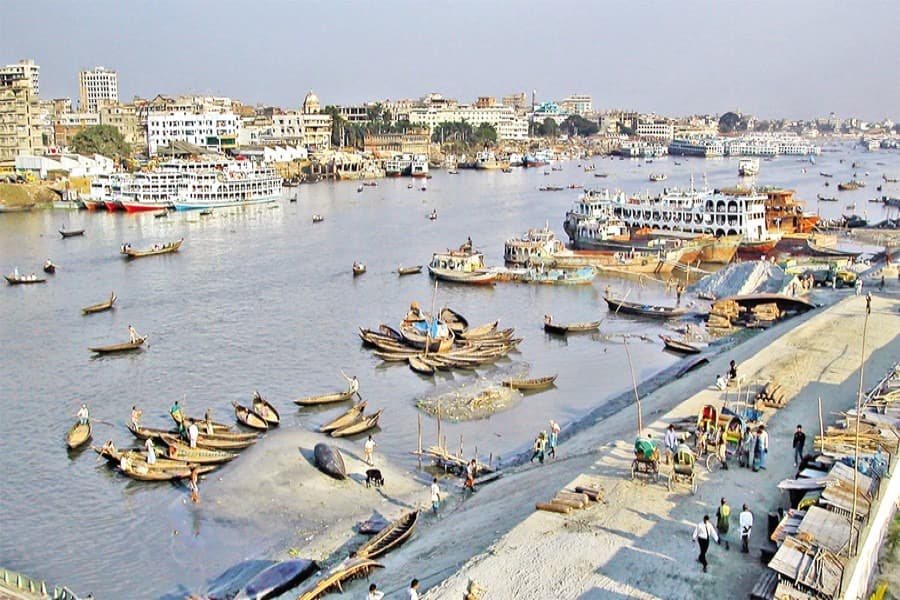
As part of river and canal restoration in and around the capital city, a programme is on the move with the World Bank (WB) committing a loan to the tune of $370 million. A report carried in this newspaper on Sunday claims that the fund may be approved by the WB Board within this month. The interim government has no time to execute the programme but its successful negotiation for clinching the deal is quite a positive development. In the past, several attempts made to restore the health of the four rivers out of the five ultimately fizzled out due to fund constraint and, more importantly, a lack of political will. When the High Court (HC) declared all rivers 'living entities' or 'legal persons' in its landmark verdict in 2019, there was hope that the conservation of rivers would gain pace. The National River Conservation Commission (NRCC) created also on the directive of the HC in 2013 through the passage of a legislature in parliament was made the legal guardian of all the rivers by the 2019 verdict.
Apart from conducting a river census and some eviction drive on the banks of Buriganga, Turag and Sitalakhya along with posting of demarcation pillars on the banks of the first two rivers, nothing substantial was achieved from the drives. Then there was a lull with the NRCC proving a toothless tiger. There was no fund for the guardian of rivers. The chairman of the NRCC expressed his exasperation because of a lack of fund and manpower to carry out programmes he envisioned. It is exactly against this background, the fund negotiated now should be considered. Meanwhile, both encroachment and pollution have increased and the rivers are gasping for breath. Even the few canals that were cleaned, restoring unhindered water flow have reverted to cesspools with the indiscriminate dumping of solid garbage and liquid waste and effluent.
Indifference on the part of both city corporations and the public to the rivers and canals tells the story. Whereas city corporations and governments in the developed world treat rivers that girdle or run through cities reverently, people in this part of the world use these natural gifts mindlessly. Now the question is if the money coming from the WB will be spent judiciously. Any project of this order demands dedication and engineering excellence for the restoration job. Even half-hearted dredging that was carried out during the past regime showed how layers of polythene and plastic deposition into the Buriganga's bed choked the river's flow and destroyed the habitat of aquatic living organisms.
This WB fund is unlikely to solve the problems facing the five rivers around the city. But considering the importance of these rivers including Dhaleswari, now being polluted by effluent from Savar leather park, a comprehensive package programme should be taken up. No industry should be allowed to release untreated effluent into the rivers. The malfunctioning central effluent treatment plant at Savar leather industrial park should either be rectified or a new one established in case the existing one defies retrofitting. If the rivers are not allowed to regain their flow and water quality, the city's existence will be imperilled at some point. To that end, the NRCC should be empowered as outlined in the legislature and made accountable for conservation of rivers and other water bodies.