


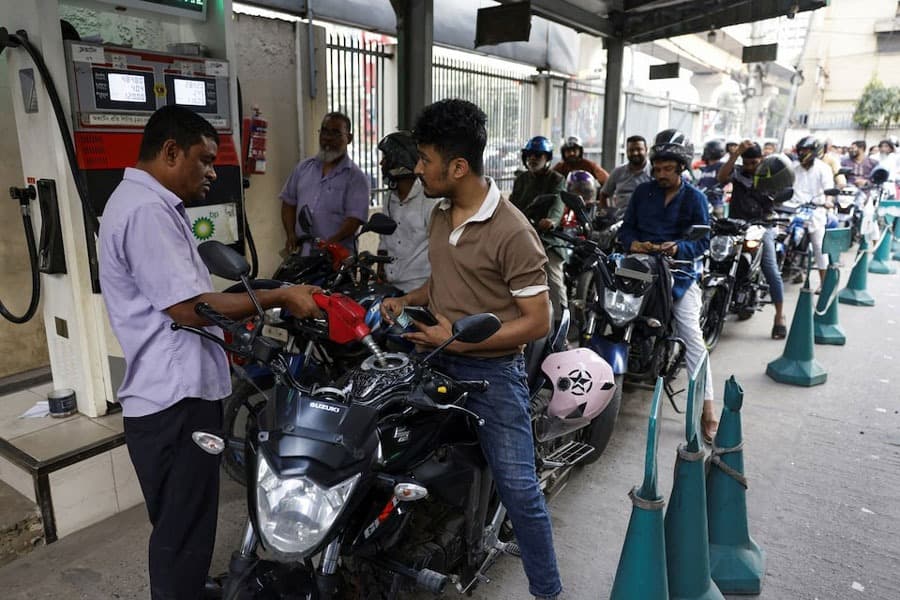
The war is unfolding thousands of miles away in the Middle East, but its ripple effects are becoming increasingly ominous for Bangladesh. Volatility in global financial markets and a sharp rise in energy prices are threatening to trigger a new cost-of-living crisis. Bangladesh has already purchased two cargoes of liquefied natural gas (LNG) from the spot market at prices about 2.5 times higher than the pre-war level, while the cost of fuel oil in the international market continues to climb. Although domestic fuel prices have not been hiked yet, the uncertainty in global markets has already sparked panic buying, with filling stations reportedly running out of their daily stock within hours. A dispute over fuel purchases cost the life of a young man in Jhenaidah on Saturday night. Consumers are also beginning to feel the strain in their grocery bills with traders increasing prices of different items citing rising freight costs and disrupted trade routes, particularly those linked to the Middle East and the Strait of Hormuz.


The timing of this external shock could hardly be worse for Bangladesh's economy. Persistent inflationary pressures have already been eroding household purchasing power, with the cost of living rising faster than wages. According to the latest Economic Update and Outlook released by the General Economics Division (GED) of the Planning Commission, headline inflation in January edged up to 8.58 per cent from 8.49 per cent in the previous month. In contrast, wage growth remained almost stagnant at 8.08 per cent, widening the gap between income and expenditure. The report warned that this sustained mismatch is placing mounting pressure on real incomes, particularly for lower-income households whose spending is largely concentrated on essential goods and services. Food prices alone accounted for 43.06 per cent of overall inflation in January, up from 40 per cent in December, indicating that price pressures are increasingly centred around basic consumption items. In such a fragile economic environment, a prolonged crisis in the Middle East could quickly translate into higher domestic prices, further burdening the consumers and the economy alike.
Meanwhile, the Middle East crisis could hardly have come at a more difficult time for the newly elected government led by the Bangladesh Nationalist Party. For millions of households battered by high inflation, the early success of the government will largely be judged by its ability to keep the market stable. Containing inflation is therefore one of the government's most immediate challenges even though many of the pressures now stem from factors beyond its control. Nonetheless, it will have to take prudent decisions to ensure adequate supplies of fuel oil, gas and essential goods while maintaining stability in the country's foreign exchange reserves.
At the same time, stabilising the domestic market will require firm action from the government. It must send a clear message to businesses that the crisis cannot be used as a pretext for unjustified price hikes. Hoarding intended to create artificial shortages and drive up prices has long been a serious problem. Recent reports of fuel oil hoarding lays bare the moral depravity of a section of traders. The authorities therefore must keep a strict vigil on the market to prevent unscrupulous traders from exploiting the situation. The government has inherited an economy already grappling with a myriad of challenges and the Middle East war has only aggravated these difficulties. It will need to navigate this precarious situation with prudence to safeguard both the people and the economy.