


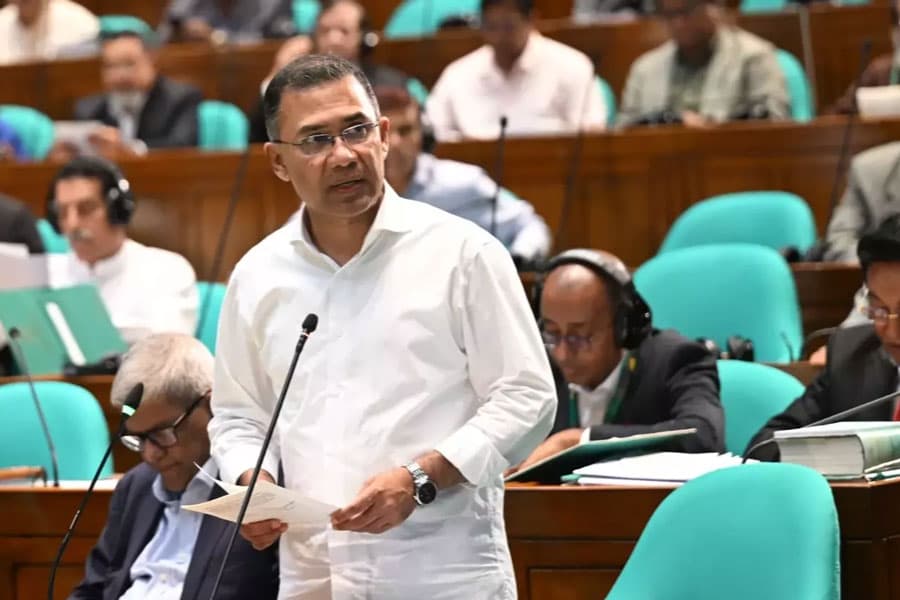
The National Parliament has recently witnessed something that has no precedent in the country's parliamentary history. Prime Minister Tarique Rahman rose on the floor of the House to propose the formation of a joint committee comprising members from both the treasury bench and the opposition to address the country's worsening energy crisis, and Leader of the Opposition Shafiqur Rahman not only welcomed the initiative but promptly nominated five members from his side to complete the ten member body. Headed by Power and Energy Minister Iqbal Hassan Mahmood Tuku, this bipartisan panel breaks from the adversarial culture that has long defined parliamentary politics in Bangladesh. That a sitting prime minister reached across the aisle, acknowledged the value of opposition input, and publicly committed to implementing workable recommendations shows a level of political maturity that deserves recognition. That the opposition responded in equal spirit, without conditions or posturing, makes the development all the more significant. In a country where both sides have often treated national challenges as opportunities for point-scoring, this joint mechanism stands as a quiet but meaningful assertion that governance need not be a zero-sum contest.


Given the severity of the current energy crisis, cooperation of this kind is indispensable. The joint committee that is being formed will obviously not find its work easy. Extreme heat of this summer has already driven electricity demand to levels that generation simply cannot match. On peak evenings, the deficit exceeds 2,000 megawatts, with demand reaching roughly 16,000 megawatts while generation has failed to climb above 14,000. Load shedding has spread into Dhaka itself, turning the capital's summer discomfort into something far more oppressive while rural communities endure between five and six hours of daily blackouts. The crisis is simultaneously a generation problem and a fuel problem. The country requires approximately 3,800 million cubic feet of gas each day, yet domestic production and imports together fall short by over 1000 million cubic feet. Fuel oil prices have also reached historic highs with diesel at Tk 115 per litre and petrol at Tk 135. These prices are largely a consequence of the conflict in the Middle East where fighting between Iran and the US-Israel has disrupted regional fuel infrastructure and left import-dependent economies with diminishing control over what they pay. Bangladesh is among them, and no government, however capable, could fully protect its citizens from disruptions of this magnitude.
Severe as it is, global volatility alone however cannot account for the persistent gap between installed capacity and actual generation. Bangladesh has spent the better part of a decade expanding its power infrastructure, with official figures repeatedly citing dramatic increases in that capacity over time. Why, then, does even a moderately harsh April produce a shortfall of nearly 2,000 megawatts?
The joint parliamentary committee now carries a responsibility that extends well beyond the immediate crisis. It must investigate where the crisis stems from and then produce recommendations that are specific, measurable and sound. The government has already taken some credible steps in that direction, releasing substantial subsidies to clear outstanding bills owed to private power plants and planning to bring major facilities back online after maintenance. Durable energy security, however, requires going further still, reducing dangerous dependence on volatile global fuel markets, strengthening gas infrastructure and commissioning the two 1,200-megawatt units at the Rooppur Nuclear Power Plant whose combined 2,400 megawatts of fuel-independent generation could materially ease the country's chronic import exposure. Bangladesh has rarely seen parliament function as a genuine problem-solving institution on matters of this complexity, and the opportunity to establish that precedent should not be wasted.