

National Rooftop Solar Project
Realities for educational and healthcare institutions
Published :
Updated :
 For all latest news, follow The Financial Express Google News channel.
Korno Jyoti Tripura lives in Matiranga, an upazila of Khagrachari district. He is currently a student in the Department of Bangla at the University of Dhaka. His journey from a remote hill upazila to one of the country's leading universities reflects not just personal struggle, but a structural inequality that continues to define rural Bangladesh, the lack of electricity.
"My neighbourhood, my school still don't have electricity," he said. "In my childhood, I never got to see many things I read in textbooks because there was no electricity. Nothing has changed—we are still systematically left behind."
For many like Korno, the promise of national development programmes often remains distant. Even under Bangladesh's ambitious National Rooftop Solar Project, large sections of rural institutions remain outside its reach.
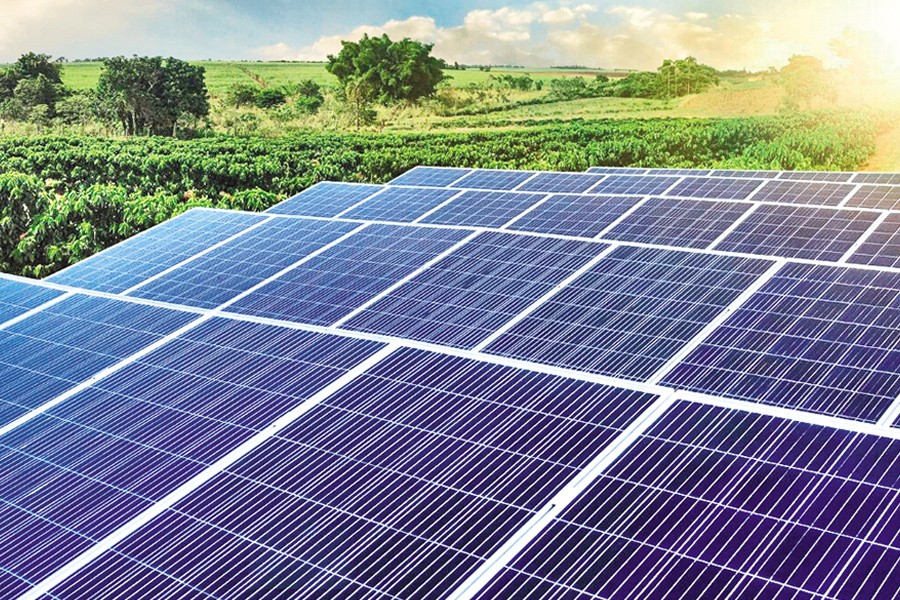
The National Rooftop Solar Project has been introduced as a large-scale initiative to expand renewable energy use across government institutions. It consists of two main components.
First, solar panels are being installed on the rooftops of government-funded institutions using public financing.
Second, educational and healthcare institutions are being equipped with rooftop solar systems through tender-based models involving private participation.
The government has approved rooftop solar installations in approximately 46,000 educational institutions and hospital complexes nationwide.
Bangladesh has set ambitious renewable energy targets of 20 per cent of total electricity generation by 2030 and 30 per cent by 2040; up from the current share of around 5.6 per cent. The rooftop solar programme, approved in June 2025, is central to achieving these goals.
Under this framework, institutions will be able to generate electricity from solar panels, while net metering will allow them to offset their electricity bills by balancing solar generation with consumption.
Net metering lowers costs by offsetting grid use, crediting excess solar generation, reducing peak demand, and minimising infrastructure and transmission expenses.
Initially, the government aimed to install 3,000 MW of rooftop solar capacity in public buildings, schools, and hospitals by December 2025. However, that target was not achieved, reflecting the gap between planning and implementation.
After 8 months of the project, the plan is still struggling due to a mix of technical, financial and administrative barriers.
Farzana Momtaz, Secretary of the Power Division, acknowledged the limitations. Focusing on realistic implementation, she said, "Around 50 megawatts of solar power is already under implementation across nearly 400 facilities, and we expect the remaining rollout to begin soon. With an extended timeline to December 2026, we are aiming to add between 2,000 and 3,000 megawatts to the national grid."
Farzana Momtaz said, "We are prioritising buildings where solar is most feasible, rather than a blanket approach. However, we are working to create future provisions for that, alongside upgrades such as enabling transitions from single-phase to three-phase connections."
The implementation in educational and healthcare institutions will be operationalised by following the Operating Expenditure (OpEx) model. An OpEx model is a business approach in which a company covers the costs of using assets or services through recurring, ongoing payments rather than making large upfront investments. The service provider owns, maintains and operates the equipment, and the customer pays only for the service or utility consumed.
No electricity, no solar system
A fundamental concern with the current project design is eligibility. The rooftop solar initiative primarily includes institutions already connected to electricity distribution networks.
This automatically excludes schools, colleges, and healthcare facilities without access to electricity. Ironically, these are often the institutions that would benefit most from solar energy.
Officials from the Sustainable and Renewable Energy Development Authority (SREDA) explain that under the OpEx model, private investors install and maintain solar systems, recovering costs through electricity generation.
Urban–rural divide, policy constraints
Bangladesh's educational and healthcare infrastructure is deeply uneven. Rural and remote areas, especially flood-prone regions and hill tracts, often lack stable electricity access and adequate building infrastructure.
Many schools operate in tin-shed structures or small, fragile buildings that are not structurally suitable for large rooftop solar installations.
Technical barriers: Single-phase limitations
A major technical constraint is the widespread use of single-phase electricity connections in rural institutions. However, rooftop solar systems often require higher load capacity. A school that could physically accommodate a 30–50 kW solar system may be unable to support it due to electrical limitations.
Installing large systems on single-phase connections can cause voltage instability, overload risks, and safety hazards.
The project primarily promotes battery-less, grid-tied solar systems. While cost-effective, this model has significant limitations.
For rural hospitals and schools, this undermines one of the key promises of solar energy, reliable backup power during outages.
Senior Assistant Secretary Tahmilur Rahman acknowledged that large-scale infrastructure upgrades, such as converting single-phase connections to three-phase systems, were intentionally avoided.
He noted that such upgrades would increase demand charges and place additional financial burdens on both institutions and investors. The Bangladesh Rural Electrification Board is expected to face operational challenges in implementing such changes.
Maintenance and long-term sustainability
A previous survey by Dhaka Electric Supply Company Limited found that nearly 90 per cent of rooftop solar systems in certain areas were non-functional due to poor maintenance and lack of oversight.
This raises questions about long-term viability, especially in institutions with limited technical capacity.
Eng. Md. Rashedul Alam, an Assistant Director of renewable energy (solar) from Sustainable and Renewable Energy Development Authority (SREDA), said, "In an OpEx project, the consumers don't have to ensure quality. The investors will earn only by generating electricity, so that they will ensure quality for their own sake. The same goes for operational maintenance."
According to the experts, without targeted inclusion strategies, flexible technical models, and stronger institutional support, the solar transition risks reinforcing existing inequalities, powering those already connected, while leaving the most vulnerable still in the dark.
Mohammad Tamim, an Energy Expert and Advisor of the former Caretaker Government of Bangladesh in the Energy and Mineral Resources Department and the Power Department in 2008-2009, thinks the project was "too ambitious". He said, "There are many bureaucratic difficulties that made the project too ambitious. There are many loopholes in the policy. What would you do to those institutions that have infrastructural difficulties? They are systematically excluded from the project."
Mr Tamim also said, "The government should take bigger projects instead of smaller-scale projects like this because there will be more bureaucratic difficulties. However, in this project, maintenance should be the prime priority for the success of this project."
Khandaker Golam Moazzem, Senior Research Director at the Centre for Policy Dialogue (CPD), a private research organisation, said, "The government needs to ensure the quality and maintenance of the solar project."
"We need to be flexible for all. The schools are closed during vacations, and the authorities have to ensure payments to the investors. Our schools, madrassas, have an infrastructure problem; most of them are tin sheds. These infrastructural issues need to be addressed by the government and better solutions found for them," he further added.
nourinsultana534@gmail.com