


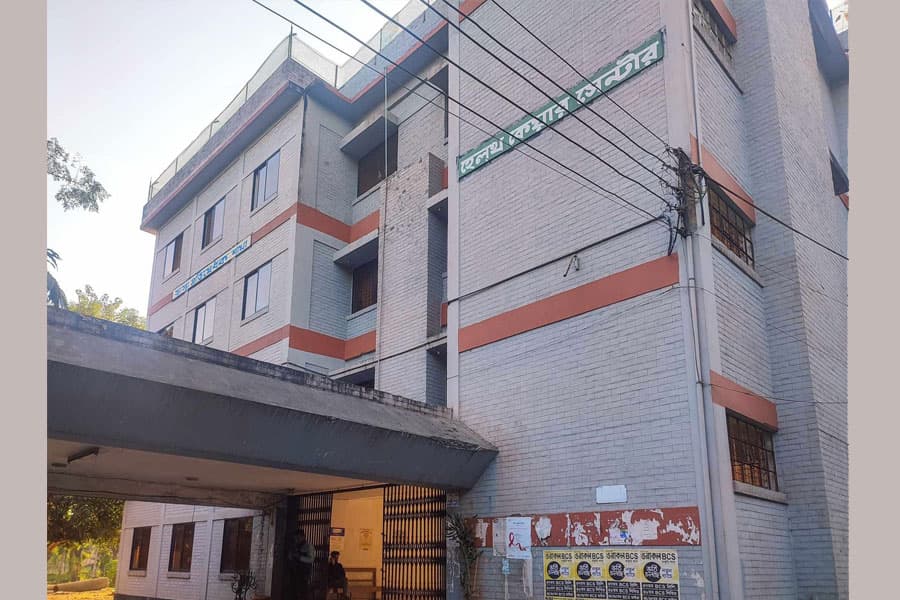
Bangladesh Agricultural University (BAU) students have voiced their frustration over the poor quality of healthcare services provided by the university's healthcare centre.


Their complaints include a lack of essential medical resources, the 14-year-long closure of the dental unit, and the absence of nurses.
Many students have taken to social media to criticize the dire state of the healthcare system on campus.
According to university sources, the healthcare centre operates with only eight doctors to serve nearly 10 thousand individuals, including students, teachers, officers, and staff.
Of these, six are regular doctors, including the Chief Medical Officer, and two are part-timers. However, five medical officer positions remain vacant, leading to inadequate services.
The healthcare centre also lacks posts for nurses and specialized units.
The dental department has been non-operational since the departure of its part-time dentist in 2011. The equipment in the dental unit has since fallen into disrepair.
Currently, the healthcare centre employs 10 officers and 16 staff members.
Of these, six are regular employees, seven are on master roll, and three are temporarily reassigned from other departments. While the centre provides seven types of antibiotics, gas medicines, skin ointments, and paracetamol free of charge, the supply is insufficient to meet the demand.
During a visit to the facility, it was observed that the ground-floor toilet was unhygienic, with a broken door.
Outside the healthcare center, a garbage dump created an unpleasant environment. Additionally, the balcony often doubles as a parking lot for motorcycles, and the third and fourth floors of the building have been used as temporary housing for female students.
"I went there with breathing problems, but they asked me to go to Mymensingh Medical College Hospital instead," said Hasan Topu, a graduate student of BAU.
"The university’s healthcare should provide emergency medical facilities, but there are no doctors or medicines. The management is chaotic."
Another student, Mahiruzzaman Niloy, shared his frustrations about the ambulance service.
"Getting an ambulance is a complicated process involving multiple steps, including a doctor’s signature. The ambulances are in poor condition, with broken interiors and malfunctioning sirens. It feels like riding in a broken-down car."
In response, Dr. Md. Sydur Rahman, the Chief Medical Officer, stated, "We have prepared health cards for students, teachers, and officials, which will be distributed soon after discussions with the Vice-Chancellor and advisors. Medicines are procured following government policies to ensure quality and affordability. Currently, 28 types of tests are conducted, including 15 at nominal costs, while dengue and urine tests are entirely free. Test costs are 60-70 per cent lower for students compared to external hospitals."
Regarding ambulance issues, Dr. Rahman added, "All university vehicles, including ambulances, fall under the transport department. One ambulance is always on standby while the other is reserved. The transport department manages vehicle maintenance and fuel supply."
Professor Dr. Md. Shahidul Haque, the university's Students’ Affairs Advisor, acknowledged the healthcare shortcomings. "We are aware of the doctor shortage and have taken steps to address it. However, recruitment takes time. Immediate action will be taken to improve the availability of medicines, and the administration has already decided to appoint a cardiologist."
The students demanded swift action to resolve these long-standing issues.