

New Directions South Asia 2025
British Council’s flagship conference on language testing makes South Asia debut
Published :
Updated :
 For all latest news, follow The Financial Express Google News channel.
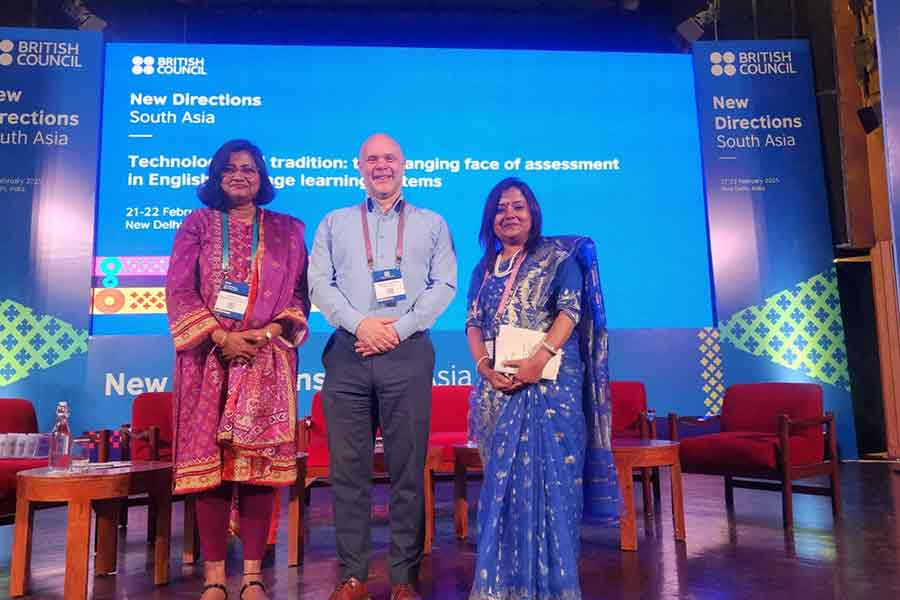
New Directions South Asia 2025, the British Council's flagship conference on language testing and assessment, made its South Asia debut on February 21, bringing together participants from Bangladesh, India, Nepal, Sri Lanka, and Pakistan.
The two-day conference commenced with a ceremony featuring senior representatives from the British Council. Professor Barry O'Sullivan OBE, Director of English Language Research at the British Council, delivered the keynote address on the conference theme ‘Technology and tradition: The changing face of assessment in English language learning systems.’
A press statement says English remains a vital global language driving both functional needs and aspirational goals in education and career advancement worldwide.
“The British Council, with its expertise in delivering high-quality English language services and examinations, is well-positioned to support South Asia’s knowledge ambitions. The first-ever South Asian edition of New Directions marks a significant step towards addressing the growing importance of English language assessment in the region.”
The conference brought together participants from across the region, offering a unique opportunity to address the evolving demands of multilingual and interconnected educational systems. Over these two days, regional and international leaders in education came together to create a collaborative platform for policymakers, educators, academics, teachers, and assessment experts.
From Bangladesh, two delegates attended the conference, including Jesmin Ara, Director and Project Manager with the Directorate of Women’s Affairs, and Shilu Ara, Assistant Director at the National Skills Development Authority. Jesmin was interested in understanding ways to improve accessibility to English communication training and assessment for women across the country, especially at the subdistrict level.
Shilu’s focus was on improving and proving English communication skills for Bangladeshis moving abroad for work. Shilu participated in a thought-provoking panel discussion on the role of English language training in skills development and employability.
Maxim Raimann, Country Exams Director of British Council Bangladesh, British Council, said, "It was inspiring to see this landmark conference come to life, bringing together such diverse expertise from across the region and beyond to address the evolving landscape of English language assessment. By hosting New Directions in South Asia, we convened the region's thought leaders to shape the future of English language assessment, empowering the wider South Asian region to compete, collaborate, and thrive on the world stage. With this, we continue to strengthen our mission of empowering learners, educators, and institutions to thrive in an increasingly multilingual and technology-driven world."
Professor Barry O’Sullivan OBE, Director, English Language Research, British Council, said, "The launch of New Directions in South Asia marks a significant milestone in our journey of driving innovation in English language assessment worldwide. The rich discussions that unfolded here demonstrate how bringing together thought leaders, educators, and policymakers under one roof creates meaningful dialogue on the intersection of technology and tradition. This collaborative platform ensures that our assessment practices continue to evolve in step with learners' needs in today's rapidly changing world."
Meanwhile, speaking on ‘Challenges and approaches in assessing language learning in young learners’, Victoria Murphy, Professor of Applied Linguistics and Director of the Department of Education, University of Oxford, shared, “The discussions at New Directions South Asia highlight our shared commitment to developing assessment approaches that respect young learners' developmental stages while preparing them for future success. By combining research-backed methodologies with emerging technologies, we can create assessment frameworks that are both rigorous and child-friendly, supporting the unique needs of young language learners across the region."
The conference took place over 21-22 February, featuring two plenary sessions, four panel discussions, and more than 30 parallel sessions. Bringing together 250 individuals, this two-day event emphasised enhancing employability through English language skills, harnessing AI to revolutionise English education, implementing effective assessment strategies for young learners and integrating English within diverse multilingual education contexts.
The discussions were centred around four key strands, including English for employability, artificial intelligence (AI) in English education, assessing young learners, and the role of English in multilingual education contexts.