


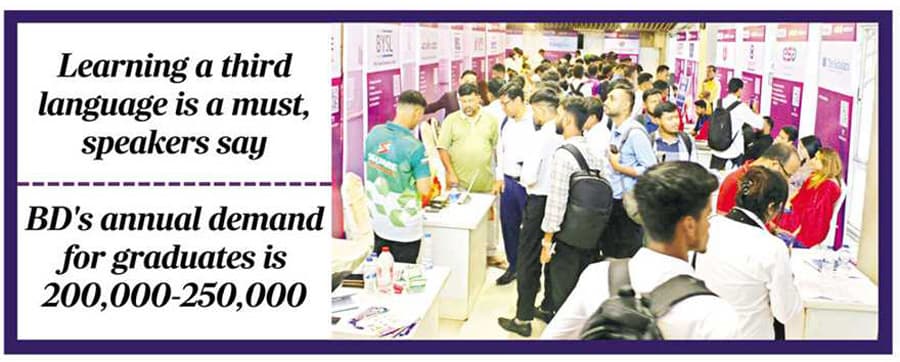
A couple of million people, including a significant number of general graduates, enter Bangladesh's job market each year. Still, employers struggle to recruit them, especially for technical jobs, due to structural mismatch in education systems, speakers said at a programme on Tuesday.


According to them, the primary solution lies in diversifying the education system towards vocational training as well as re-skilling graduates to meet the specific demands of manufacturing, agriculture, and global service sectors.
The speakers further said learning a third language - targeting the global job market - is also obligatory for all technical and non-technical jobseekers to provide a huge number of people with job opportunities.
They came up with the observations at the opening ceremony of daylong Technical Career Fair 2026 at the Krishibid Institution Bangladesh (KIB) Auditorium in the city's Farmgate area, hosted by Bdjobs.com.
Executive Director of UCEP Bangladesh Dr. Abdul Karim and Director (Programs) Dr. Abdul Mannan, Founder & CEO of Bdjobs.com Fahim Mashroor and Director Prokash Roy Chowdhury, and Deputy Director of TMSS Mamunur Rashid spoke on the occasion.
In his speech, Dr. Abdul Karim said in the developed countries, the ratio between general graduates and technical education graduates is roughly 20:80.
"In our country, it is the opposite - 80 per cent of our graduates come from general education background, while only 20 per cent come from technical streams, including BSc, diploma, and others. Whatever the case may be, this scenario must be reversed."
Indicating the imminent challenges with Bangladesh's LDC graduation, he said the country must compete in a world where tax-free access will vanish and costs will rise.
"Our large population can only become a resource, if we prioritise skill training, as is seen in the developed nations," he added.
Fahim Mashroor said around 700,000 students in Bangladesh graduate every year, while approximately 2.1-2.2 million new individuals enter the labour market.
"The largest sectors of our economy are manufacturing and agriculture, which do not inherently require a high volume of university graduates."
The country's actual annual demand for graduates does not exceed 200,000-250,000. It is a basic principle of economics that when supply outstrips demand, the value drops, he added.
Prokash Roy Chowdhury informed that 20,000 job seekers have applied online to visit the daylong event. It is expected to help the employers find their suitable candidates, as the biggest pain point nowadays is finding skilled 'blue-collar' or 'gray-collar' workers.
Around 100 local and multinational companies and skill training providers participated in the career expo, aiming to recruit over 2,000 professionals. Alongside direct job applications, the event also featured more than 20 skill development and training institutes, dedicated to enhancing the employability of young jobseekers.
A visit to the event revealed that jobseekers were visiting stalls to learn about scopes, while recruiters were seen guiding them.
Kazi Shaiful Arif, Head of HR and Admin of Solaric, a group of renewable energy development companies, told the FE that he conducted some on-spot interviews to recruit manpower for the organisation.
"Here at the event, we look to shortlist candidates having adequate basics of their respective academic fields. After recruitment, we'll train them as per our requirement," he said.
saif.febd@gmail.com