

Experts at PEB and BHRF seminar
Modern alternatives could sharply cut tobacco harm
 For all latest news, follow The Financial Express Google News channel.
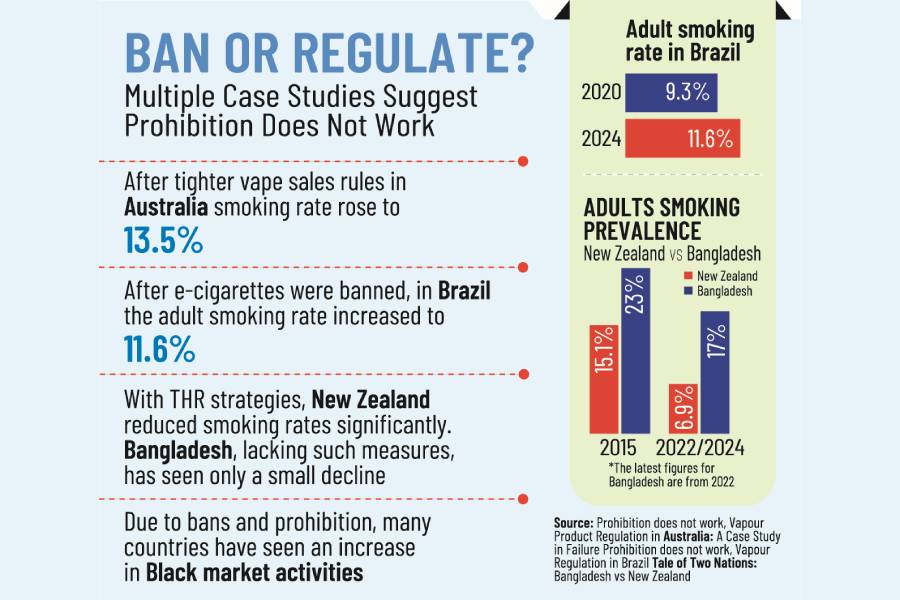
Safer alternatives to smoking could substantially reduce the harm caused by tobacco use, subject matter experts have mentioned. They argued that products such as vaping devices, nicotine pouches, and snus have helped millions of smokers around the world to quit. Countries that adopted harm reduction strategies have seen rapid declines in smoking, while those that banned these products including India, Brazil Australia have witnessed the rise of black markets and unregulated goods - often accompanied by little or no improvement in public health outcomes. Bangladesh still lacks a coherent harm reduction framework. Therefore, despite strict regulations over the safer alternative to tobacco, smoking remains widespread and continues to exact a heavy toll on public health.
Speakers recently made these points at a seminar titled 'Policy for Progress: Towards Harm Reduction 2.0,' jointly organized by Policy Exchange Bangladesh (PEB) and the Bangladesh Harm Reduction Foundation (BHRF) in Dhaka.
Dr. Delon Human, former Secretary General of the World Medical Association, said New Zealand had sharply reduced its smoking rate by adopting a pragmatic, science-based strategy that recognized vaping as a legitimate alternative.
"By accepting alternatives such as vaping, New Zealand gave smokers a realistic path to quit," he said. "As a result, the smoking rate dropped by almost 50 percent in just a few years."
Citing his recent report "Tale of Two Nations: Bangladesh versus New Zealand," co-authored with Bangladeshi researcher Dr. Md. Shariful Islam Dulu, Dr. Human noted that adult smoking in New Zealand fell from 13.3 percent in 2015 to 6.9 percent recently, while in Bangladesh it declined from 23 percent to 17 percent. "The difference," he said, "is that New Zealand integrated harm reduction into its tobacco control strategy - Bangladesh did not."
He outlined three major categories of harm reduction products: e-cigarettes (vapes), oral nicotine pouches, and heated tobacco products. "These were not initially accessible in New Zealand, but policy changes later made them widely available and that has resulted into smoking decline," he said.
Dr. Md. Shariful Islam Dulu, founding trustee and chairman of the Bangladesh Harm Reduction Foundation, said New Zealand's success was rooted in its pragmatic approach and its inclusion of harm reduction in tobacco policy. "Despite clear scientific evidence, Bangladesh has not adopted such measures," he said. "Strict restrictions - such as the ban on e-cigarette imports - have only worsened the problem, fueling smuggling, depriving the government of revenue, and preventing smokers from accessing safer alternatives."
Joining online, Timothy Andrews, Director of Consumer Issues at the Tholos Foundation, emphasized the importance of regulating - not banning - alternative nicotine products. He cited Australia as a cautionary example: "Banning vaping there has led to a surge in black market activity, rising crime, and increased youth smoking. Today, the rate of youth smoking in Australia is nearly 50 percent higher than in New Zealand," he said.
Andrews pointed to Brazil, where e-cigarettes remain illegal but about 2.9 million people use them through black market channels. "The ban has failed - it's made things worse," he said. "The black market has grown, unsafe products are everywhere, and health risks have increased. Adult smoking rose from 9.3 percent in 2020 to 11.6 percent in 2024, with a similar rise among youth."
He also mentioned Germany, where nicotine pouches are banned but used by an estimated 1.4 million people via illicit sources. "Because the products are unregulated, black-market activity and health risks have risen," he said. "Yet Germany's own Federal Institute for Risk Assessment acknowledges that nicotine pouches are far safer than cigarettes and could benefit public health."
Referring to Sweden, Andrews noted that over the past three decades, large numbers of Swedes have switched from cigarettes to snus, a much less harmful smokeless tobacco. "By lowering taxes on these alternatives, Sweden has seen a sharp decline in smoking-related deaths and diseases," he said.
Schumann Zaman, president of the Bangladesh Electronic Nicotine Delivery System Traders Association (BENDSTA), said nicotine replacement systems are among the most effective tools for quitting smoking. "Studies show vaping, heated tobacco, nicotine pouches, and nicotine gums are 90 to 95 percent less harmful than cigarettes," he said. "These products have successfully reduced smoking harm in many countries."
Zaman added that in Bangladesh, instead of restricting the import and sale of such products - which allows the illicit market to grow - the government should legalize and regulate vaping products. Proper policy would help lower smoking rates while supporting legitimate businesses.
Hasnat Alam, Economist and Senior Manager at Policy Exchange Bangladesh, said that the concept of tobacco harm reduction has been recognized by the World Health Organization and various international organizations. It promotes safer alternatives to cigarettes. First, we must acknowledge that these products exist worldwide and are less harmful than conventional tobacco products. Bans or excessively high taxes may send the wrong message and could further encourage black market activity. Regulations should be forward-looking and based on scientific evidence. If a product is less harmful than traditional tobacco products and can help reduce tobacco use, then it should be given special consideration.