


The woes of kidney patients are deepening in Bangladesh amid poor service management in government hospitals and costly treatment in private facilities.


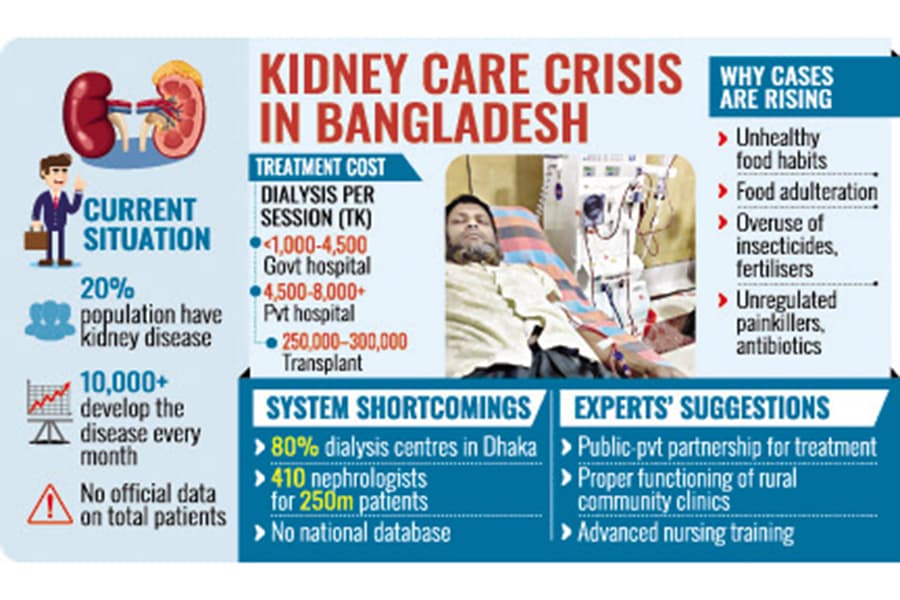
On the other hand, the number of such patients, including those who are young, is rising due to unhealthy food habits, food adulteration, the overuse of insecticides and fertilisers in food production, and the unregulated consumption of medicines and antibiotics, according to health specialists.
Shumi, 44, has been undergoing kidney dialysis since July last year. Her first kidney malfunction was detected in 2014 during her third pregnancy. She was around 32 at the time.
A lawyer by profession, she now has to regularly receive dialysis treatments at United Medical College Hospital in the capital.
"Private hospitals are costlier than government ones. However, the unclean environment and poor management at government facilities forced me to seek treatment at a private hospital," she tells The Financial Express.
For each dialysis session, she has to spend Tk 4,500.
Depending on the condition, a dialysis patient needs one or two sessions every month.
A session in government hospitals costs from less than Tk 1,000 to Tk 4,500, while it is between Tk 4,500 and Tk 8,000 or more in private ones.
The government amended the kidney transplant act last year, easing the process to donate and transplant kidneys.
However, there are still difficulties as a transplant surgery costs around Tk 250,000-300,000 in the country.
"My doctors have already suggested a transplant as my health has worsened. I have visited several hospitals but have not found any solution," Shumi says frustratingly.
She is among the large number of kidney patients who are struggling to access better health services.
This struggle is also contributing to the rise of the new poor, health specialists say, calling for a public-private partnership to ease the burden of treatment costs.
There is no government data on the number of kidney patients in the country.
Health specialists say 10,000 or more people develop kidney disease every month. About 20 per cent of the whole population have this disease.
Dr Muhammad Arif Anwar, an assistant professor in the department of Nephrology at United Medical College Hospital, tells The Financial Express that patients seek treatment when they have already reached the fourth or fifth stage of the disease.
The disease has five stages. When patients come at the later stage, doctors have fewer options to help them return to normal life, he explains.
"Doctors at the time have to suggest dialysis or transplant, which is a costly and complex process that puts patients under additional financial burden," he says.
Furthermore, the centralised, Dhaka-based treatment and diagnosis is a major problem. There are about 2,000 kidney dialysis centres in the country and most of them are in Dhaka, according to the specialist.
"Doctors and advanced facilities are available mainly in some major government and corporate tertiary hospitals. So people cannot go for a diagnosis until the disease reaches a critical stage," he explains.
Echoing him, senior health specialist Prof Dr Muhammad Nazrul Islam in the Department of Nephrology at Bangladesh Medical University (BMU) says there are 410 nephrologists in the country, which is insufficient against an estimated 250 million patients.
Dr Islam, also the convener of the Bangladesh Renal Association, tells The Financial Express that faulty food habits, as well as eating processed and refined food, are among the main causes of kidney damage.
Moreover, inadequate water intake causes less blood circulation in the kidney. On top of that, arbitrary medicine consumption, particularly painkillers and antibiotics, is among the major causes of kidney disease, he explains.
He also cautions about the use of insecticides and fertilisers in agricultural products.
The National Institute of Kidney Diseases and Urology (NIKDU), Dhaka Medical College Hospital, and BMU are among the top government hospitals providing treatment, including dialysis and transplant.
They also keep partial data.
"We still do not have a database system. For proper treatment, we need that," Dr Islam says.
"The main treatment of kidney disease is a transplant. The old law has been amended and the new one has been enacted, widening the path for treatment.
"Now, apart from relatives, emotional donors can give kidneys for transplant. However, we have to be careful about illegal trade," he also says.
The senior specialist recommends advanced training for government nurses and other staff members as there is a serious shortage of skilled manpower in the sector, especially for treatment.
As the treatment cost is higher in private facilities and there are only a limited number of government facilities, a public-private partnership could ease the crisis, he says.
"Many seats are available in private hospitals, while the government ones are overburdened. Under a public-private partnership, the government can use private facilities and patients can get affordable treatment," Dr Islam says.
To expand health services, as well as the early detection and treatment of kidney disease, he suggests proper functioning of the government community clinics in rural areas.
Directorate General of Health Services (DGHS) Deputy Director (Planning & Research) Dr Md Sekendar Ali Mollah tells The Financial Express the government has taken multiple initiatives, including two separate projects at divisional and district levels.
"We have a project. Under it, arrangements are being made for dialysis patients and early detection of the disease," he says.
The government is also working on addressing some major diseases, including kidney, diabetes, and heart problems, widely. Furthermore, as the law has been amended, people can now transplant a kidney with less hassle, he also says.
NIKDU is working on developing a public-private partnership and a database, he adds.
nsrafsanju@gmail.com