

Bangladesh targets recovery of $200b ‘stolen funds’ as banks face liquidity stress
Published :
Updated :
 For all latest news, follow The Financial Express Google News channel.
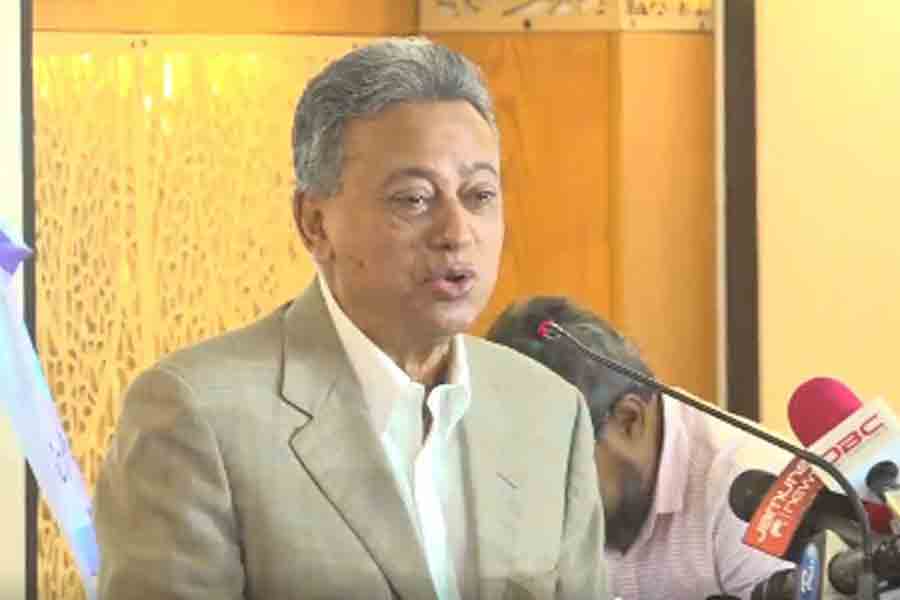
Finance Minister Amir Khosru Mahmud Chowdhury has put the recovery of an estimated $200 billion in stolen assets at the centre of efforts to stabilise the economy, warning that years of capital flight have hollowed out the banking system and left the private sector starved of liquidity.
Speaking in a featured interview aired during the Atlantic Council’s coverage of the IMF-World Bank Spring Meetings, Khosru laid out what he described as the scale of financial “looting” that has weakened the domestic economy.
“The stolen money that came out of Bangladesh is over $200 billion,” Khosru asserted.
He identified this outflow as the central driver of the country’s current liquidity crisis, arguing that the loss of such a vast volume of capital has eroded the foundations of the financial system.
According to him, the sustained drainage of resources “has created a capital deficit that is there in the private sector”.
The consequences, he suggested, are already visible across the banking sector.
Offering a stark assessment, Khosru said: “A lot of banks are practically bankrupt.”
He linked the fragility of financial institutions directly to the missing capital, noting that the depletion of funds has triggered a severe liquidity crunch while also eroding public confidence in the system.
For the government, the recovery of these funds is not merely desirable but essential.
“Without this, talk about any other reforms is not going to get us anywhere,” he said, underlining that broader economic restructuring would be ineffective unless the lost wealth is brought back into the system.
Khosru also pointed to mounting external pressures that are compounding the crisis, particularly the impact of geopolitical instability in the Middle East on global energy markets.
Bangladesh, heavily reliant on imported fuel, has been forced to absorb rising costs.
“We are out of pocket by nearly $2 billion already,” Khosru said, referring to the additional burden of securing energy supplies from the spot market amid disruption.
This dual strain -- internal capital erosion and external price shocks -- has intensified what he described as “business stress”, leaving the private sector constrained and unable to operate at full capacity.
Khosru framed the recovery of stolen assets as a national priority that would require sustained international cooperation.
He called for coordinated efforts to identify and repatriate offshore holdings, arguing that the “bleeding of the exchequer” must be halted if economic stability is to be restored.
The challenge, he suggested, goes beyond fiscal repair.
By replenishing lost capital, the government hopes to revive the private sector, which Khosru described as being in urgent need of support. “The private sector now needs to be salvaged,” he said.
Without such intervention, the capital deficit would continue to suppress growth, weaken investment and hinder efforts to improve the country’s tax-to-GDP ratio, he added.
Despite the scale of the problem, Khosru struck a tone of measured determination.
He acknowledged the difficulty of tracing and recovering funds dispersed across jurisdictions, conceding that “this is a big challenge” for the government.
Yet he maintained that transparency, accountability and a sustained recovery drive are the only viable path forward.