

Published :
Updated :
 For all latest news, follow The Financial Express Google News channel.
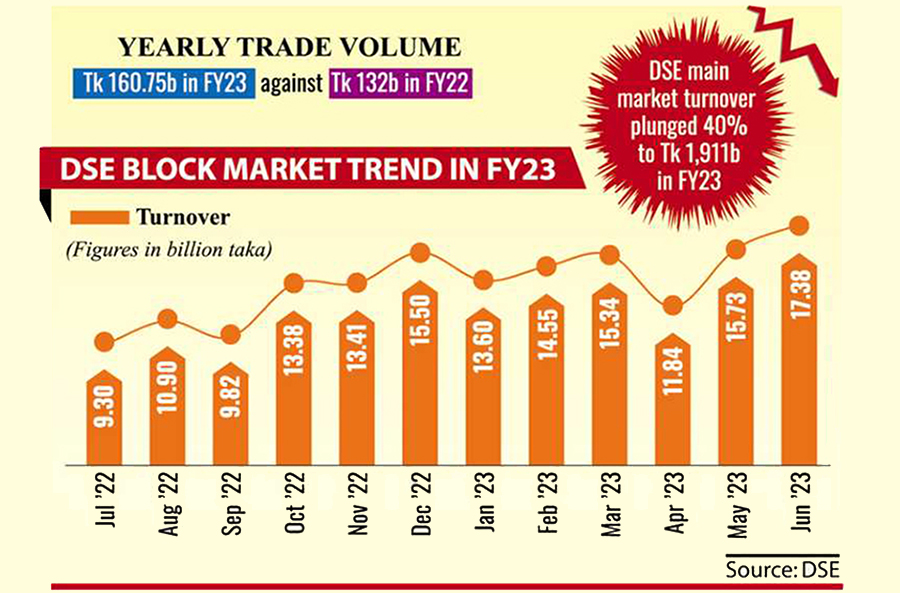
Trading on the block board has got a boost since mid-November after the bourses allowed share transactions at prices up to 10 per cent lower than the floor price set for the main market.
As a result, turnover in the block market was up 22 per cent in FY23, compared to the previous year, while the total volume of transactions in the main market fell 40 per cent year-on-year to Tk 1,911 billion in the fiscal year.
The data indicates that the relaxed rule for block transactions drove away big and institutional investors from the main market to the block market at a time when buyers were reluctant to trade shares at floor prices.
Small investors cannot buy-sell shares on the block board as each transaction should be worth at least Tk 0.5 million.
"The decision [allowing trades at below the floor price] gave some relief to big investors but it does not mean anything for small investors because the main market is still illiquid due to the floor price," said Prof Abu Ahmed, a former chairman of the economics department of the University of Dhaka.
Moreover, the relaxed rule created an opportunity for big investors to make capital gains even in the bearish market; they could buy shares in a big lot at a discounted price up to 10 per cent on the block board and then sell them in the main market, he added.
The block market is meant for trading in large volumes of shares in single transactions at a negotiated price without affecting the index.
That is what has happened. The higher block market turnover has helped increase turnover of the stock market as a whole, but it has not dragged the index upward.
The Chittagong Stock Exchange registered the biggest-single day turnover of Tk 5.30 billion on June 27, when Tk 5.15 billion came from block market transactions.
The market remained in the bear grip for most of the time of FY23, as a majority of the stocks witnessed a lack of buyers after the imposition of the price movement restriction at the end of July last year.
The Bangladesh Securities and Exchange Commission (BSEC) set the floor price of all stocks by calculating their average price in the five days to July 28 to avert free fall of the index amid the war-induced gloomy economic outlook.
Most stocks, including the fundamentally-strong stocks, endured illiquidity throughout the year. Many institutional investors criticised the regulator for making the move as they were unable to sell shares even in the block market.
Amid a mounting pressure, the regulator ordered the stock exchanges to push the bar down further for share transactions in the block market.
That led to a rise in trades on the platform created for big investors.
Meanwhile, small investors continued suffering.
"The stock market has given me nothing in the past one year," said Md Kamal Hossain, an employee of a private company, emphasizing that he could not sell his holdings to get cash for urgent need, which is not expected from the stock market.
Another investor, Ashraful Alam said he had a good number of blue chip shares but could not trade those as buyers did not show interest in purchasing stocks at even floor prices.
In the main market, any individual can participate by buying or selling one stock, the value of shares is irrelevant, but the price restriction drove investors away.
"The problems of small investors would not be solved until the floor price is lifted from the main market," said Prof Ahmed.
So, the rising turnover in the block market brings no cheer to investors in the main market.
DSEX, the benchmark index of the DSE, slid 0.52 per cent to settle at 6,344 at the end of FY23, while the blue chip index DS30 dropped 4.43 per cent.
The market movement was limited to ups and downs of a handful of stocks almost throughout the financial year, said Md Sajedul Islam, senior vice-president of the DSE Brokers Association of Bangladesh.
He blamed it on the price restriction.
Meanwhile, block trades accounted for 9 per cent of the total turnover in the DSE's main market. Islami Bank Bangladesh, Social Islami Bank, Emerald Oil Industries, and Unilever Consumer Care, among others, dominated trading on the block board.
babulfexpress@gmail.com