

 For all latest news, follow The Financial Express Google News channel.
Chairman of the Civil Aviation Authority of Bangladesh (CAAB), Air Vice-Marshal Md Monjur Kabir Bhuiyan, has reaffirmed that CAAB is taking all necessary measures to uphold the highest safety standards in the country’s airspace.
“Last week of the previous year witnessed a series of tragic aviation disasters, reminding us of the critical need to remain vigilant against the risks we face daily,” he stated.
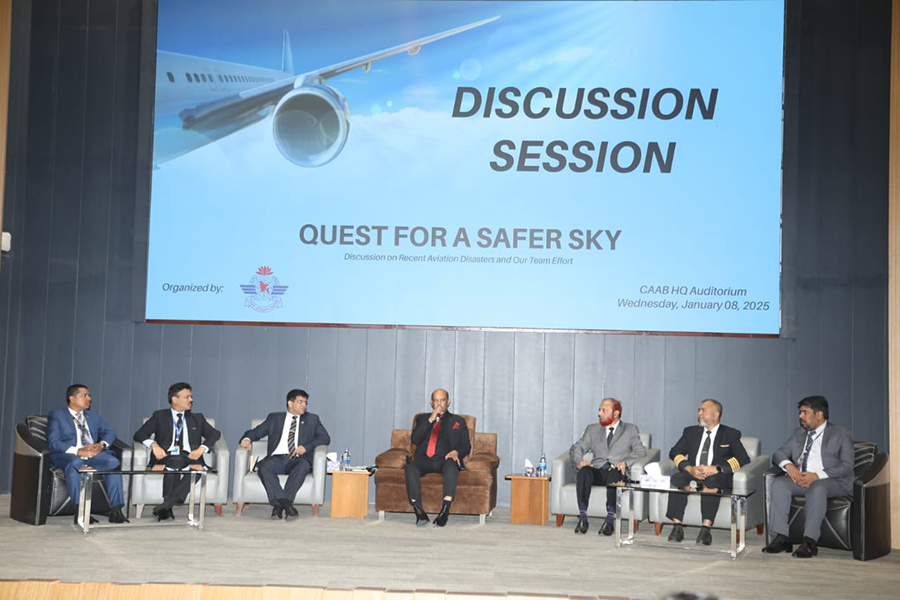
The chairman made these remarks during a discussion session titled “Recent Aviation Disasters and Our Team Effort,” held at the CAAB headquarters auditorium in the capital on Wednesday, BSS reports.
The workshop, the first of its kind in recent years, was organized in response to recent aviation accidents, including the fatal Jeju Air crash in South Korea on December 29, which claimed 179 lives.
“We understand the public's concerns and anxieties. I assure you that every possible step is being taken to maintain the highest standards of airspace safety,” the chairman said.
He urged airlines to promote a "just culture" to support the implementation of the Safety Management System (SMS).
“Aviation safety remains a top priority. In a rapidly growing industry, addressing aviation risks is becoming increasingly challenging,” he noted.
The chairman stressed the importance of addressing safety risks proactively to ensure the industry's expansion is managed effectively with strategic regulation and infrastructure.
“We believe our collective efforts will positively contribute to achieving the goal of Zero Fatalities in commercial operations by 2030 and beyond, aligning with ICAO’s Global Aspirational Safety Goal,” he added.
As the Accountable Executive of the State Safety Programme (SSP), he encouraged stakeholders to report safety incidents without fear, enabling proactive measures.
Bird Strikes and Operational Challenges
During the discussion, safety officials from Biman Bangladesh Airlines, US-Bangla Airlines, Novoair, and Air Astra voiced concerns about recurring bird strikes at Hazrat Shahjalal International Airport (HSIA).
Bird strikes, especially during take-offs and landings, can cause engine failures and catastrophic accidents, the officials highlighted.
Referring to the Jeju Air crash, officials cited an Al Jazeera report stating that the pilot had reported a bird strike moments before the aircraft belly-flopped on the runway after failing to deploy its landing gear and overshooting the landing zone.
Capt Intekhab Hossain, Deputy Chief of Flight Safety at Biman Bangladesh Airlines, reported 10 major bird strike incidents between May 2023 and May 2024.
Although no fatalities have occurred due to bird strikes at HSIA, they have caused significant damage to aircraft, leading to substantial financial losses, he said.
Capt AAMA Shahsuzzaman, Head of Safety Management at US-Bangla Airlines, noted that HSIA’s bird strike rate—1.73 per 1,000 flights—is three times higher than the global average of 0.5, according to International Air Transport Association (IATA) data from January 2023 to October 2024.
Low Visibility Challenges
Airline safety officials also raised concerns about low visibility at HSIA during winter, which often disrupts operations due to dense fog.
To address this, they recommended upgrading the airport’s Instrument Landing Systems (ILS) from Category 1 to Category 2.