

Civil Society demands scrapping of ‘Microcredit Bank Ordinance–2025’
Published :
Updated :
 For all latest news, follow The Financial Express Google News channel.
Civil society groups on Tuesday demanded the scrapping of the proposed 'Microcredit Bank Ordinance–2025', introduced by the interim government to bring microfinance institutions under a banking framework in the name of regulation.
They argued that the ordinance represents a clear blueprint to dismantle the microfinance sector under the guise of banking reform.
Questioning the feasibility of the move, they noted that managing the country’s existing 67 banks already poses significant challenges for the central bank.
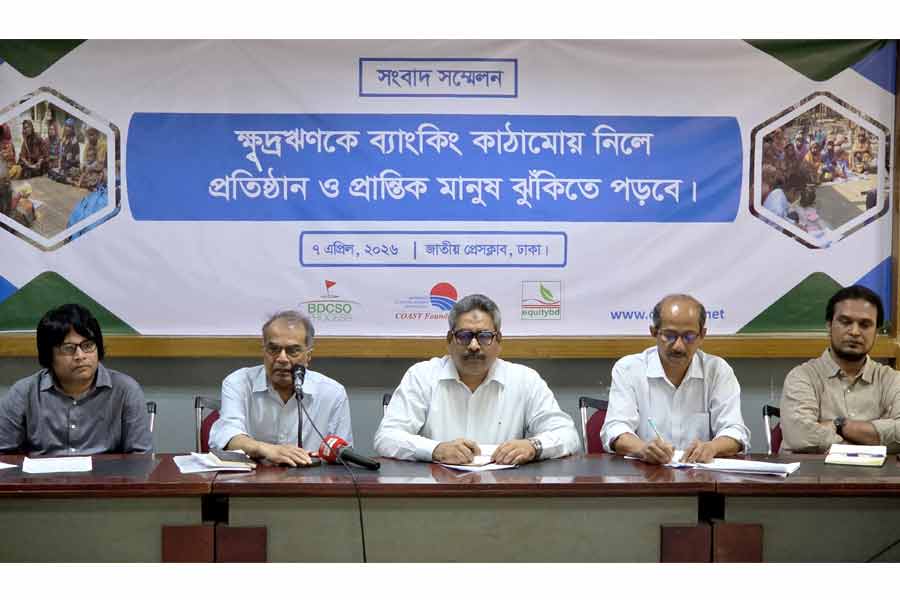
These observations were made at a press conference titled “Risks of Transforming Microcredit into a Banking Framework,” held at the National Press Club in the city.
The event was jointly organised by COAST Foundation, EquityBD, and the BDCSO Process. It was chaired by Rezaul Karim Chowdhury, Executive Director of COAST Foundation.
Instead of creating new risks through the ordinance, speakers recommended strengthening microfinance institutions financially by expanding savings opportunities. They also called for provisions to allow the filing of certificate cases under the Public Demand Recovery Act-91 to prevent the misappropriation of funds.
The experts also emphasised that regulatory oversight of the microfinance sector should not be transferred to Bangladesh Bank.
Rather, existing institutions such as the Microcredit Regulatory Authority (MRA), Palli Karma-Sahayak Foundation (PKSF), and the NGO Affairs Bureau should be strengthened and allowed to operate within their respective mandates.
Among the speakers were Syed Aminul Haque, Director of Microfinance at COAST Foundation; Omar Faruk Bhuiyan, Coordinator of EquityBD; and M. A. Hasan of the BDCSO Process, among others. The keynote paper was presented by Mostafa Kamal Akand of the BDCSO Process.
Rezaul Karim Chowdhury said development is not merely about infrastructure or increasing bank balances; rather, it is about empowering people, ensuring dignity, and securing livelihoods.
He questioned whether banks could access foreign funds in the same way NGOs do for health, education, and climate-related programmes. He also noted that while commercial banks in Bangladesh have a non-performing loan (NPL) ratio of around 35 per cent, microfinance institutions maintain a much lower rate of 8.0–9.0 per cent.
He added that there is no record of microfinance funds being siphoned abroad, and banks now consider investing in microfinance institutions to be one of the safest options. He emphasized that the sector has strengthened self-reliance among millions, empowered women, and energised the rural economy.
Syed Aminul Haque said that with 67 banks already in operation, there is little justification for bringing microfinance institutions under a banking framework. He warned that banks are primarily profit-driven and often influenced by political considerations, which could create risks in the future.
He also noted that around 700 NGOs operate in the country, yet the ordinance was drafted without broad consultation, relying instead on input from a small number of large NGOs and corporate entities. He demanded the immediate repeal of the ordinance.
Mostafa Kamal Akand said that the core objective of microcredit—poverty alleviation and social development—could be undermined if it is transformed into a profit-driven banking model, potentially leaving marginalized communities underserved.
He added that banking regulations and procedural complexities could hinder timely and accessible service delivery. He also warned that NGOs’ work in education, health, and climate risk mitigation could lose priority under such a framework, negatively impacting rural development.
Omar Faruk Bhuiyan said that over the past three decades, microfinance institutions have operated largely on a self-sustaining basis without heavy reliance on foreign funding.
He noted that the sector contributes around 17 per cent to the country’s GDP, with daily transactions amounting to approximately Tk 440 billion, nearly 40 per cent of which comes from group members’ savings. Around 0.5 million people are employed in the sector.
He cautioned that such a large and vital sector should not be handed over to a small number of large NGOs or corporate entities.