

Dhaka University Central Students' Union goes to polls under shifting balance of power
Published :
Updated :
 For all latest news, follow The Financial Express Google News channel.
After the changeover of power in the July Uprising, the Dhaka University Central Students’ Union (DUCSU) will be held on Tuesday after a six-year gap. This time, no single student organisation is dominating the campus. The voters don’t seem to be favouring any single candidate or panel by a large margin, either.
Excitement surrounding the polls, which have sparked debate in the political arena ahead of the general election, has spread beyond the Dhaka University campus.
In a new twist, university authorities have designated polling stations outside the residence halls - an initiative taken to allow the ballot boxes to be sealed in front of the media and the counting of votes on LED screens.
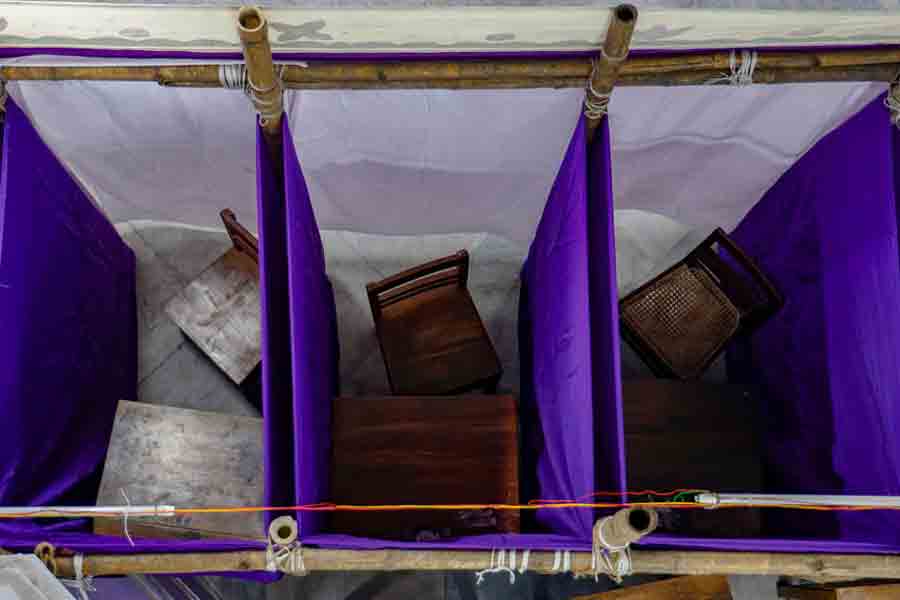
Students will elect their DUCSU and hall union representatives to the student union by casting their ballots at 810 booths at eight centres on the campus from 8am to 4pm.
The total number of voters in the election is 39,874, with 18,959 female students from five residential halls, and 20,915 male students from 13 residential halls.
An astonishing 471 candidates are running for the 28 DUCSU posts. Aside from the panels representing certain parties or groups, many are also competing as independents.
Each hall parliament has 13 posts for a total of 234 openings from the 18 halls. A total of 1,035 candidates are contesting these seats.
As before, DUCSU and hall union elections will use Optical Mark Recognition (OMR) sheet ballots. The ballots will contain the ballot number and candidates’ names, with the voter’s choice being represented with a cross mark.
For the first time in Bangladesh, the Dhaka University authorities have arranged Braille ballot papers for visually impaired students. They can also vote using OMR ballots with the help of others if they want to.
The DUCSU Election Commission made last-minute preparations for the polls on Monday, a day without formal election campaigning. Voting equipment went out to the different centres in the evening.
A large number of law-enforcing personnel have already been deployed on the campus. Armoured vehicles and water cannons have been kept ready at the TSC, and a temporary police control room has been set up as well.
At a briefing in front of the control room on Monday, Dhaka Metropolitan Police Commissioner Sheikh Md Sazzat Ali said Dhaka University is under tight security and there are no security concerns.
The security arrangements on the campus have been good for the past 10 days, and will be good tomorrow as well, he said. The security measures will remain in place until 6:30pm on Sept 10, with the time frame being extended if necessary.
Chief Returning Officer Md Jasim Uddin also dismissed any concerns about the law and order surrounding the election.
At a press conference in front of the DUCSU Election Commission office at the Senate Bhaban on Monday afternoon, he said: “The law-and-order situation is very good. We do not see any kind of threat. Voting will continue from 8am to 4pm without interruption. If anyone is waiting in front of the polling station at 4 pm, they will also be given a chance to cast their ballot.”
He was confident about the election.
“This time the election will be a model election,” Jasim said. “DU students will set an example for students of other universities in Bangladesh to follow.”
He added that all procedures had been followed properly. “We promised to follow every step, and we have reached this stage by maintaining each one.
“[On Tuesday] from 8am, voting will begin. Students are participating with great enthusiasm, which is reflected in the number of candidates.”
Jasim urged all students -- both hall residents and day scholars -- to come out and vote.
“We’ve set up 810 booths across eight centres. We request complete cooperation from all involved so that we can conduct a free and fair election,” he said.
WIDER POLITICAL IMPLICATIONS OF DUCSU POLLS
Author and political analyst Mohiuddin Ahmed believes that the new reality surrounding the DUCSU election will give hints regarding the general election that is to come in five-and-a-half months.
Describing the DUCSU election as a “rehearsal” ahead of the national polls in February, he told bdnews24.com, "With the national elections scheduled in five and a half months, how will this DUCSU election go? It generates interest.
"Panels of candidates from affiliate organisations of various political parties are taking part in this election. So, the results of this election will give us an idea.”
He said, "The DUCSU election is being held after many years, which is why everyone is interested. Secondly, this time the DUCSU election is being held in a slightly different situation after the 2024 uprising. Many are curious about what will happen as a result."
"[It gives an idea] of what the state of the political parties is ahead of the general election. If you consider these points, the DUCSU election is also very important for our politics in general. It is also important that the election remains transparent and impartial."
When asked how transparent and impartial he thinks this election will be, Mohiuddin said: "It is difficult to say in advance what will happen tomorrow. However, I hope that there will be no incidents such as the ballot snatching in the 1973 election."
However, Prof Kazi Mahbobor Rahman of the Dhaka University Department of Political Science says, despite the widespread interest the DUCSU polls have drawn, he does not believe that it will have a major impact on national politics.
"Dhaka University has been involved in various parts of Bangladesh's history at different times. That is why people across the country are also interested in the DUCSU election,” he said.
"However, I do not think this election will have a major impact on national politics in Bangladesh. This is an election among the university students themselves. However, many people may be interested in this election because of the historical significance of Dhaka University."
Just because people are interested in something does not mean that it will have an influence on something else, Mahbobor said. "DUCSU has been irregular for many years. DUCSU elections are being held, that is why everyone may be a little more interested."
Jatiya Samajtantrik Dal (JaSaD) Standing Committee Member Mushtuq Husain believes a democratic atmosphere have prevailed over the DUCSU polls so far and it will be conducted in a transparent and impartial manner.
Mushtuq was elected the general secretary of DUCSU in the 1989-90 academic year.
He believes that whoever wins the election should be in a position to challenge or question those in power.
Mushtuq said, "The atmosphere of the election seems good so far. It remains to be seen whether many of our national politicians will learn from this election."
WHO IS COMPETING WITH WHOM
In the post-July uprising reality, no single student organisation now holds dominance on the Dhaka University campus.
Control over seat allocation in the residential halls for regular students has also largely been established by the university administration.
This time, at least 10 panels are contesting the DUCSU polls, either in full or partial form, alongside a number of independent candidates.
With the banned Bangladesh Chhatra League and its allies absent, the contest is now between their rivals -- the groups who stood shoulder to shoulder in last year’s movement that brought down Sheikh Hasina’s government.
The panels include Jatiyatabadi Chhatra Dal, the Bangladesh Ganatantrik Chhatra Sangshad (BGCS) founded on the spirit of the July Uprising, the Protirodh Parshad of seven left-leaning organisations, the Independent Students Unity led by July movement figure Umama Fatema, Islami Chhatra Shibir, “Aparajeyo 71, Adommo 24” representing three left groups, Chhatra Odhikar Parishad, and Islami Chhatra Andolan.
The panels have largely selected candidates who played an active role in the Uprising, often favouring younger leaders over senior figures.
Chhatra Dal, for example, has nominated Abidul Islam Khan, joint general secretary of its Dhaka University chapter, for VP; Shaikh Tanvir Baree Hamim, convenor of Kabi Jasimuddin Hall unit, for GS; and Thanbir Al Hadi Mayod, convenor of Bijoy Ekattor Hall unit, for AGS.
BGCS has fielded Abdul Kader for VP and Abu Baker Mojumder for AGS, both of whom were coordinators of the Students Against Discrimination.
Its AGS candidate Ashrefa Khatun, now the panel’s spokesperson, was also active in the July protests.
Due to internal rifts over the DUCSU election, several members left BGCS to contest independently.
NCP leader Mahin Sarker lost his position after deciding to run for GS against the party's choice.
Although Mahin later withdrew to support BGCS candidate Baker, several independents are still running for different posts.
The Protirodh Parishad, representing seven left-leaning organisations, has nominated Sheikh Tasnim Afroz Emi for VP.
Emi, who played a leading role during the July Uprising, was elected VP of Shamsun Nahar Hall in the 2019 DUCSU and hall elections.
The Protirodh Parishad’s GS candidate is Meghmallar Bosu, president of the DU unit of one faction of Bangladesh Chhatra Union.
Their AGS candidate is Jabir Ahmed Jubel, central general secretary of Biplobi Chhatra Moitree.
These candidates have remained active not only in the July Uprising but also in other student movements.
Umama Fatema, a former coordinator of the Students Against Discrimination and previously member secretary of the DU unit of Bangladesh hhatra Federation, has formed the Independent Students Unity panel by selecting candidates from among the independents.
Her panel’s GS candidate Al Sadi Bhuiyan is a former president of the Dhaka University Journalists’ Association (DUJA).
He was also elected literary secretary of Masterda’ Surja Sen Hall in the 2019 DUCSU elections.
Known for his journalism on campus, Al Sadi was also actively involved in the July movement.
Before the anti-government protests in July, he was one of two students who appealed against the High Court’s verdict reinstating the quota system.
AGS candidate of Umama’s panel is Jahed Ahmed, organiser of the study circle platform “Gurubhar Adda”.
Abu Shadik Kayem, who was an active participant in the Uprising, was later revealed to be the president of Dhaka University’s unit of Chhatra Shibir -- a fact unknown to many of the movement’s organisers.
His identity shocked many when it became public. Shadik, currently Shibir’s central publication secretary, is now running for VP.
Shibir’s GS candidate is SM Farhad, now president of the Dhaka University unit.
He previously held leadership positions in both the Jasimuddin Hall Debating Society and the Social Welfare Institute Debating Society.
Farhad's name once circulated in connection with the Chhatra League, with even a photo identifying him as a former unit secretary.
This led to a case that reached the High Court. Farhad has since denied any affiliation with the Chhatra League.
The AGS candidate of the Shibir-backed United Students’ Alliance panel is Md Mohiuddin Khan, general secretary of the organisation’s university chapter.
The “Aparajeyo 71, Adommo 24” panel consists of one faction each from Chhatra Union, Socialist Student Front, and Bangladesh Chhatra League (BCL – Bangladesh JaSaD).
The panel has managed to field 13 candidates.
VP candidate Nayem Hasan Hridoy is president of the university unit of BCL-JaSaD.
GS candidate Anamul Hasan Onoy is central education and research secretary of one faction of Chhatra Union.
AGS candidate Adite Islam is the Dhaka University chapter’s member secretary of the Socialist Student Front.
VP candidate Shamim Hossen, an English department student from Bijoy Ekattor Hall, has gained attention for his eloquent speaking style and a unique manifesto.
In the past, he was spotted at a protest programme held by JaSaD Chhatra League -- once part of the Chhatra Sangram Parishad led by Chhatra League.
Chhatra Odhikar Parishad, which emerged as the runner-up in the 2019 DUCSU polls against the Chhatra League, has now nominated its central president Bin Yamin Mollah for VP.
The panel has nominated Sabina Yasmin for GS and Rakibul Islam, member secretary of the university chapter, for AGS.
‘CONCERN’ AMID CELEBRATION
Amid widespread student enthusiasm, excitement, and a festive atmosphere, official campaigning for the DUCSU and hall elections took place from Aug 26 to Sept 7.
During the 13-day campaign period, candidates engaged in mutual accusations and counter-accusations, participating in both formal and informal debates.
Even leaders from ideologically opposing student organisations were seen joining hands and walking shoulder to shoulder in a spirit of camaraderie.
When violations of the electoral code occurred, the DUCSU Election Commission attempted to take corrective measures.
Despite the barrage of allegations, no untoward incidents have been reported so far.
However, a court-ordered stay issued during this period temporarily disrupted campaign activities for a few hours.
Following the stay order, there was a strong backlash from students, with candidates from all panels expressing unity in demanding the election be held on Sept 9 as scheduled.
Subsequently, a Supreme Court order paved the way for the vote to proceed on the originally announced date.
On the eve of the election, the university administration imposed a ban on the entry of outsiders into the campus from Monday evening.
The Dhaka Metropolitan Police commissioner also announced that the entire campus would be placed under a tight security blanket on polling day, a Tuesday.
Despite these assurances, several candidates -- both from panels and running independently -- expressed concern over election-day irregularities.
Sadi, GS candidate from the Independent Students Unity panel, alleged that one group was attempting to buy votes by offering food and cash.
“I believe Dhaka University students will not sell their votes in exchange for food or money,” he said.
Addressing fellow students, he warned: “Those who try to win your vote with food or money will later seize your hall seat and strip you of your rights and safety on campus. I urge all students to stay vigilant.”
Baker voiced concerns about the impartiality of the Election Commission.
“We have been expressing our doubts from the very beginning. The commission has failed to take any action against panels that breached the code of conduct.”
“In that context, there is legitimate concern among students about how fair [Tuesday’s] election will be.
However, I believe we are heading towards a free and fair election.”
Tanvir, GS candidate from the Chhatra Dal-backed panel, alleged cyber-attacks targeting popular candidates. “A certain group, fearing defeat [on Tuesday], is launching cyber-attacks out of fear of the popularity of student leaders.
“They’re worried because students stand by these candidates,” he said. “They may continue these cyber-attacks -- so be it. But I call on Dhaka University students to respond with ballot attacks. We believe students will answer their cyber-attacks with ballots.”
Meghmallar also expressed doubts about the election process. “We’ve been submitting several demands from the start, but the Election Commission has ignored all of them. Naturally, that leaves us with concerns about the overall election process.”
GS candidate Farhad said efforts were still under way to disrupt the election. “There are attempts to provoke clashes among candidates.
“We’re alert to these tactics and will not allow DUCSU, a platform to protect student rights, to be sabotaged,” he added.