

National
4 months ago
Mitigation setback at COP30 triggers warning from Bangladesh climate advocates
Published :
Updated :
 For all latest news, follow The Financial Express Google News channel.
Mitigation ambitions suffered a setback at COP30 as negotiators pushed the Fossil Fuel Phaseout Roadmap further into the future, prompting climate justice advocates in Bangladesh to warn of widening gaps between political promises and real action.
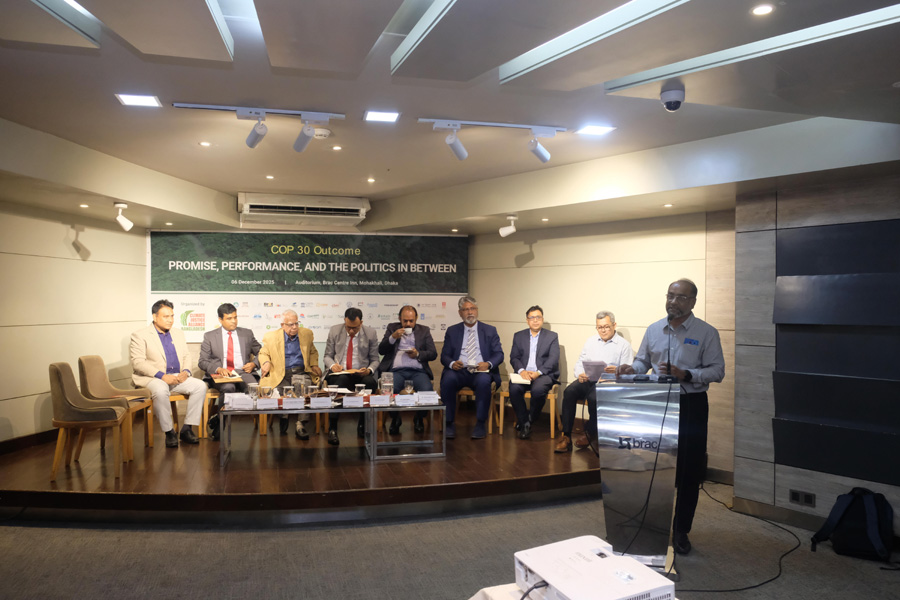
These concerns came into sharp focus at a national event titled “COP 30 Outcomes: Promise, Performance and the Politics In Between,” hosted on Saturday by the Climate Justice Alliance Bangladesh (CJA-B), a platform of more than 50 organisations led by the Centre for Participatory Research and Development (CPRD).
The discussion critically unpacked the much-debated ‘Belem Political Package’, which experts said is laden with optimism but light on concrete decisions, and examined how procedural complexities and political disagreements continue to shape the global climate negotiation process.
This event enabled policymakers, civil society organisations, and the media to engage with the future climate debate and discourses with a comprehensive understanding of the procedural complexities and political disagreement in the COP negotiation process.
Md Shamsuddoha, Chief Executive-CPRD and National Coordinator of CJA-B, facilitated the discussion while Sheikh Nur Ataya Rabbi, Assistant Manager-Research & Advocacy, CPRD, presented the key COP30 outcomes on behalf of the CJA-B.
Expert Remarks were delivered by Adv. Hafijul Islam Khan Executive Director, CCJ-B Co-Chair (WIM), Prof Md Hafizur Rahman Professor and Head, Dept. of Environmental Science and Management, Independent University, Bangladesh; Sharif Jamil, Member, Board of Directors at Waterkeeper Alliance, Member Secretary DHORA; Dr. Shah Abdul Saadi, Deputy Secretary, Economic Relations Division, Ministry of Finance; Mr. Md Ziaul Haque, Additional Director General, Department of Environment; Mr. A K M Sohel, Additional Secretary, Economic Relations Division, Ministry of Finance; Dr. Fazle Rabbi Sadek Ahmed, Deputy Managing Director, PKSF, LDC Lead Negotiator for Climate Finance; Dr. M Asaduzzaman, Former Research Director, Bangladesh Institute of Development Studies (BIDS). Reflection from the Expert Discussants was delivered by the representatives of the Alliance member organisations, government officials, and other non-government officials, and CSOs representatives.
In the keynote presentation, Mr Sheikh Nur Ataya Rabbi brought forth a brief picture of achievements and gaps in the COP30 outcome.
Speaking at the seminar, Md. Shamsuddoha, Chief Executive of CPRD, provided a political overview of COP30 outcomes, drawing on years of engagement in global climate negotiations.
He mentioned, while the Loss and Damage Report is a positive step, COP30 failed to encourage developed countries to pay more into the FRLD.
Doha also delivered a critical overview on ‘Climate-Related Trade Policies’, he mentioned, the institutionalisation of dialogues is a positive step.
He further reiterated the importance of media engagement and CSO coordination, underlining that Bangladesh should build a stronger, better-informed advocacy front for COP31.
Mr Md. Shamsuddoha also mentioned, COP30 also fails to reinforce GST-1’s call for transitioning away from fossil fuels, omitting any explicit phase-out language– seen as a major missed opportunity, given the time available to prepare such a strengthening. COP30 also does not operationalise GST-1’s message on aligning finance flows with low-emission, climate-resilient pathways, issuing only general encouragements without mechanisms.
Dr Shah Abdul Saadi highlighted the urgent need for aligning the UNFCCC COP efforts with other conventions under the UN—UNCBD and UNCCD, while also underscoring the importance of capacity building support towards the developing countries to utilise the Article 6 mechanism for NDC implementation.
Mr A K M Sohel criticised the staggering presence of the fossil fuel lobbyists—over 1600— and referred it as a strong catalyst for sidestepping the fossil fuel phaseout roadmap.
Dr M Asaduzzaman pointed out that multilateralism faces a challenge to bring all parties on the same page. Yet, it needs to be sustained for longer-term global outcomes. He further highlighted the need to ensure net-zero emissions at the earliest to protect the earth for the generations to come.
Dr Fazle Rabbi Sadek Ahmed said, “Developed countries must be pushed for domestic mitigation commensurate with their historical responsibility.”
sajibur@gmail.com