
We Bengalis can't imagine having our favourite daal-bhat without dipping our wrists into it, almost as if it wouldn't taste as good as it should. However, surely everything has its own place. Using our hands while eating at the family dining table is fine, but we carry these mannerisms everywhere, like in high-end restaurants where using silverware, and more importantly, correctly using them, is highly appreciated.
If you ever find yourself in an upscale restaurant for an important business meeting with your colleagues and your boss, the last thing you want is to be confused about how to use your cutlery properly. But adapting to it isn't that difficult; just practice at home once or twice, and you'll be good to go.
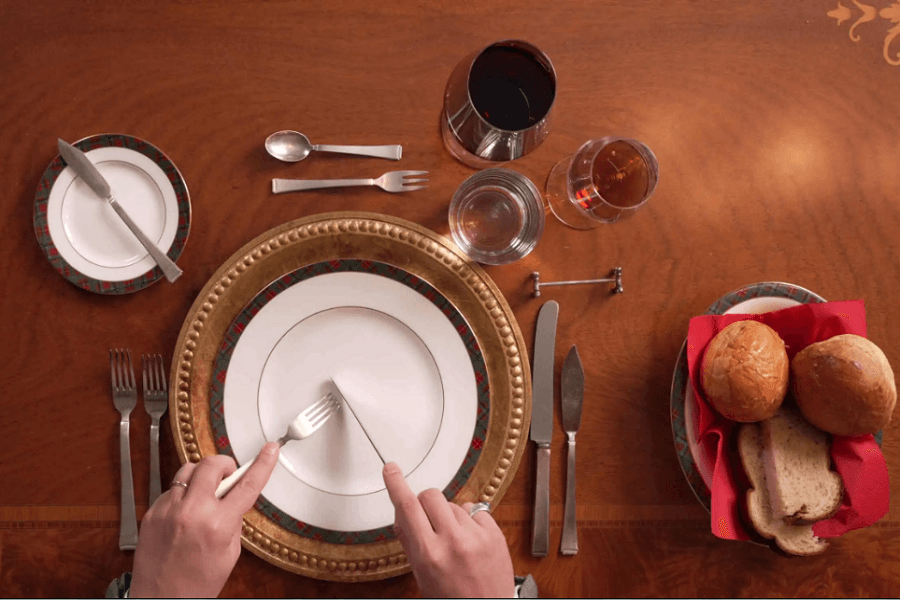
The first thing to learn is which silverware is for what use. In most table settings, the cutlery is organised so that one can start using utensils from the outside and work their way toward the centre, where their plate sits. So, the cutlery for the appetiser is in the outermost corner, followed by that for the main course, and finally, the dessert spoon is in the innermost part.
In a typical table setting, forks are kept on the left-hand side, and knives and spoons on the right. The dinner fork is larger with broader tines for the main course, whereas the salad fork is smaller and more delicate. A fish fork is a large, short-handled fork that is used with an individual fish knife to eat fish. Dessert forks usually have a slightly sharper edge for cutting through the crust.
Knives have a variety of them, too. The butter knife is short and blunt; the table knife is larger than the butter knife and is used for general purposes. On the other hand, a steak knife has a sharp edge for cutting through meat.
There are several ways to use forks and knives. There is the continental style, which dominates in Europe; their adoption in the U.K. and other parts of the world; and the U.S. or North American style, which is somewhat different. In the 1946 spy film O.S.S., an American agent is detected by their table manners and how they eat. So, it is clear how this style is closely associated with the U.S.
In American style, one eats most of their food with their dominant hand and fork only, while the other hand rests underneath the table on their lap. While holding the fork, the only movement is to the non-dominant hand while cutting. After cutting, one switches to the fork in their dominant hand and eats from it. So, it is often referred to as the Zig-Zag style.
While cutting the food, one should lightly pierce the food with the fork and cut in slow, steady strokes. When finished cutting, one should place the knife on top of the plate, the blade facing inward.
Remember to move the fork to the mouth, not the other way around. Also, not somewhere in between. That's why one should always sit up straight and not slouch. One should make sure to put their utensils down when in a conversation and use their hand to gesture.
Continental style, where one uses both hands throughout the meal, is more widely used. The fork is held by the non-dominant offhand, while the other holds the knife. The continental style looks more elegant because one always has a fork and a knife in one's hand, and switching hands is not necessary like in the American style.
If someone is new to using silverware, they should focus on getting a grip on only one style and try to be comfortable with it. This way, they don't have to be intensely focused on their fork and knife skills, and they can focus their attention on the people at their table.
If someone is temporarily pausing, whether to talk or to go to the restroom, they should place their fork and knife diagonally on the plate with the blade facing inward towards you. It means they are not done eating yet.
If they are done eating, one should put their fork and knife together at 4:20 o'clock position. The handles should hang slightly over the edge of the plate and not be completely shoved down into the plate. Once cutlery is used, it should never go back to the table. Also, one should never leave food pierced into their fork or knife after eating.
One should not cut all their food first and then eat it with a spoon. It is okay to do it for a two-year-old, but not for grown people. Also, cutting the food into bite-sized pieces is important. Cutting a big piece of meat and then biting it looks very unpleasant.
Eating with one's mouth open and making too much noise should also be avoided at all costs. Always ask for extra utensils if one falls down or gets taken away with the plate. Never use a used fork to take food from a communal platter.
In the end, it's all about being confident in yourself and comfortable with your surroundings. So turn off your phone and try to have a good time with your company.
asmaulhusnapushon@gmail.com