

Published :
Updated :
 For all latest news, follow The Financial Express Google News channel.
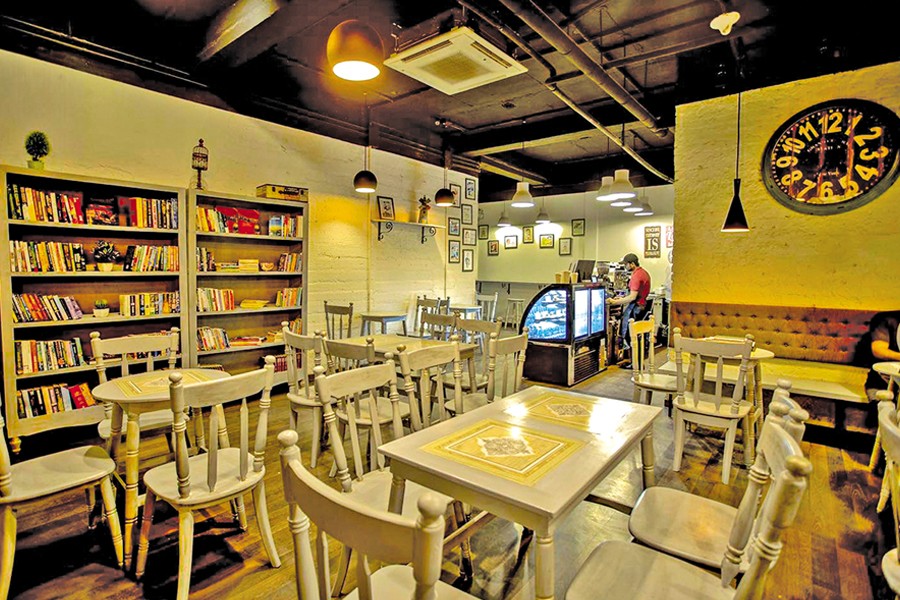
The spirit of Eid in Dhaka has always been about togetherness. Traditionally, the first three days are a whirlwind of family visits, heavy meals, and the exchange of crisp banknotes known as Salami. However, as the city evolves, so does its youth. For college and university students, the desire to step out of the house and reconnect with friends becomes a priority by the tail end of the holidays. This year, a significant cultural shift was evident. Instead of the usual crowded malls or expensive eateries, young Dhakaites flocked to book cafes on their third and fourth days of Eid.
Today's students are no longer content to spend the entire day in one living room. They crave a 'third place'--somewhere that isn't home or the classroom, where they can relax without the pressure of a high price tag--especially the college goer who doesn't have any formal jobs or heavy income. While restaurants are plentiful in Dhaka, they are often prohibitively expensive for those living on pocket money. Book cafes have stepped in to fill this gap, offering books, coffe and an environment in 'affordable' price.
Book cafes provide a middle ground
The gap between a student's budget and the cost of socialising in Dhaka is wide. Most decent restaurants in the city now cost upwards of 1,000 taka for a single meal. For a group of friends, this can be an impossible expense. Book cafes, however, offer a refreshing alternative. At 250 taka, these spaces offer a calm, quiet environment that a loud, busy restaurant cannot match.
Nahiyan Rakib, a twenty-year-old university student, perfectly summarised the financial appeal. "The utility of a 500 taka note is much more at the book cafe than at any restaurant," he noted. For the price of one appetiser at a fancy diner, a student can enjoy a quality brew and hours of uninterrupted reading or conversation.
Beyond the cost, there are issues of proximity and permission. Many young people, particularly those still in college, face restrictions on how far they can travel during the busy holiday season. Nahfia Amzad Monami, a college student, visited a book cafe on the second day of Eid with four of her friends. She wanted to treat them using her newly acquired Salami. "Book cafes provide great ambience," she said. "Also, it is very near to my house." Her friend, Ishraque Ahmed Farabi, agreed that convenience was key. "We are not allowed to go far from our house. But we still want to have a meet-up. So we chose this place."
The crowd dynamics at these venues were dictated by their holiday schedules, resulting in a steady but manageable flow of visitors throughout the break. There have been several boofcafes in the capital providing space for the Eid holidays.
Nerdy Bean Coffee Haus, for instance, became an immediate draw by opening at 12:00 PM on the very day of Eid, catering to those eager for an early getaway. Meanwhile, residents of Mirpur relied on The Reading Cafe, which remained open throughout the holiday period.
As the focus shifted away from purely domestic celebrations on the second day of Eid, Baatighar Dhaka opened its ship-themed doors to a growing crowd of young bibliophiles ready to socialise in a more intellectual setting.
By the third and fourth days of the holiday, the surge of visitors reached its peak as stalwarts like Bookworm, Pathak Shamabesh, and Bengal Boi opened on March 24th. These late-week visitors were largely students, young couples, book lovers, artists, and writers who appreciated the proximity of these cafes to their homes, the ability to meet friends in a 'safe' and calm environment, and the enjoymented their holidays. Ultimately, these crowds chose book cafes because they bridge the gap between expensive luxury and mundane home life, providing a space where the joy of reading and the enhancement of knowledge are served alongside a great cup of coffee, making them the definitive hub for Dhaka's modern youth culture during the Eid holidays.
Because these venues opened gradually, the crowd levels remained moderate and manageable. Book readers are a niche category when it comes to business. Bookcafes utilises this niche market by attracting customers with offers and discounts. Unlike the chaotic scenes at popular fast-food chains, the atmosphere at these cafes stayed respectful of the 'reading culture,' even during the holiday rush.
More than just a meal
What is it that these spaces provide that a standard restaurant lacks? For many, it is the 'joy of discovery.' In a restaurant, the experience ends when the bill is paid. In a book cafe, the experience is enriched by the shelves surrounding the tables.
Nawar Nowrin, a third-semester university student, believes the value of a book cafe is multi-dimensional. "Book cafes provide what restaurants can't," she explained. "You can get expensive food and some good photographs at a restaurant. However, book cafes provide me with the joy of reading, enhance my knowledge, and offer a good environment and great coffee."
This sentiment is shared by many of her peers. The 'Instagrammable' nature of modern cafes remains, but it is secondary to intellectual stimulation. The quiet hum of a coffee machine mixed with the rustle of turning pages creates a sanctuary. It allows students to engage in 'slow socialising' -- a contrast to the fast-paced, high-decibel environment of Dhaka's mainstream food scene.
The cultural gap
As the Eid holidays came to a close, the success of these book cafes proved that there is a massive demand for affordable, high-quality social spaces in Dhaka. The 'gap' isn't just about money; it's about the quality of time spent.
Young Dhakaites are looking for more than just a place to eat; they are looking for a place to belong. By offering a 250-taka coffee alongside a world of literature, these cafes have successfully redefined what an evening out looks like for the city's students. They have turned the third and fourth days of Eid into a celebration of both friendship and the written word.
hasan.zahidwalkingtales@gmail.com