

Morning tradition that refuses to fade Dhaka's enduring newspaper culture
Published :
Updated :
 For all latest news, follow The Financial Express Google News channel.
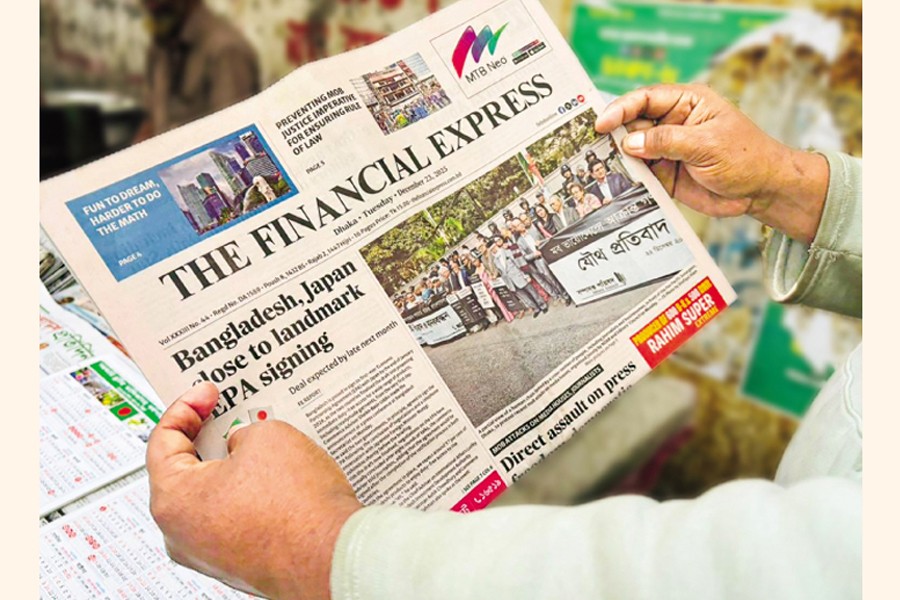
"People don't actually read newspapers. They step into them every morning like a hot bath." Marshall McLuhan's words drift easily into the first light over Dhaka. They capture a feeling many once knew well, when the newspaper was not just information but a way to settle into the day. That feeling has thinned with time, yet it has not vanished. It lives in the steps of those who wake before the city; those who fold the papers, carry them, sell them, and place them at doorways in silence. Their work holds the old rhythm together in an age where screens race ahead. However, love for the newspaper remains. Md Riazuddin Khan, Senior Management Consultant at the Financial Express, who has closely observed the bond between readers and the newspaper from both professional and readers' perspectives, shared, based on his decades of experience, that people read newspapers for credibility. "We already witnessed the shift towards the digital media, because people need instant updates, especially our younger generations; however, newspapers are known for their in-depth, research-based, credible stories, and therefore it exists," he said.
He hopes the newspaper will attracts reader even in the digital era. He said, "We have to build institutions, making it a career, it will attract more professionals in this field. Unbiased people-centric reports will attract more readers."
Dhaka is quiet before dawn. The streets that will later roar with buses and voices lie almost still. In that calm hour, the bundles of fresh newspapers arrive at familiar corners. Vendors gather around them. They cut the ropes in quick motions. They sort and count with steady hands. They speak in short exchanges, often without lifting their eyes from the piles. The day has not begun for most people, but for them, the news flow has already started.
Near New Market, Md. Jahir Hossain stands behind his stall. He has been there for 26 years. He knows the sound of each morning. He lifts newspapers from the bundle and taps the edges to align them. For him, the newspaper is not only a product. It is a part of life that shaped many days and many minds. As he puts it, "There was a time when we used to wake up and read the newspaper while having breakfast. It had to be the first activity of our day."
He adds that people should buy newspapers and read them if they can afford it. He believes they should choose paper over online news. He speaks without force. He talks like someone who has lived each word.
His stall is a reminder of a time when magazines filled many readers' hands.
The covers carried writers, artists, thinkers, and long stories. They came every week or every month. People waited for them. They traded them with friends. They stacked them on shelves. That culture sits at the edge of memory now. The screens took much of that space. But the old stalls still carry a few copies. They sit in small piles beside the daily papers. They hold the trace of a slower time.
While vendors open their stalls, newspaper couriers begin their own journey. Many of them ride old bicycles. Some walk through narrow lanes. They know each gate and door. They move fast because every house waits for the paper at almost the exact moment. The city learns the news through their hands. Their effort holds the link between the newsroom and the living room. Each paper they drop carries the weight of a long chain of people, from the reporter who wrote the story to the press that rolled through the night.
The online headlines refresh each minute. Social media pushes alerts without pause. Stories shorten. Images multiply. Many scroll through the news without reading more than a few lines. But the paper vendors and delivery men still believe in the slow turning of a page.
They think in the stillness of a printed story. They know that some readers want the space to think. They know some want to sit with the news rather than chase it.
The readers who still buy papers come from many walks of life. Some prefer the smell of ink. Some trust the printed text. Some want to keep a distance from online noise. The paper gives them a pause. It holds the news in one frame. It does not disappear with a swipe. For many families, the paper is still a shared item. One person reads the front page. Another reads the sports pages. Someone else takes the business pages to work. The newspaper becomes part of the morning flow.
At the end of the day, the vendors stack the unsold papers. The city shifts from day to night again. A new cycle waits. The vendors close their stalls. The delivery men go home after many hours of work. Most people do not see them. Yet their presence shapes the city's daily life. Their movement makes sure that printed news still reaches the hands that want it.
It is easy to think the digital tide has washed away the place of newspapers. But the streets of Dhaka tell another truth. The stalls still stand. The delivery men still ride. The papers still land on doorsteps with the same sound they made decades ago. The old habit persists because a part of the city still values slowing down. The printed page invites a kind of thought that does not hurry.
A newspaper may not move as fast as a screen, but it often speaks with more care. The vendors of Dhaka know this without having to state it. They live it each morning through the simple act of handing over a newspaper. They stand against the clock, not in protest but in persistence. Their work keeps a tradition alive, and they want their stories from credible sources.
And as long as one reader reaches for a paper from a stall or picks it up from the doorstep, the story of these people continues. It begins again before dawn and ends only when the city sleeps once more.
malihatasnim02215@gmail.com