

Published :
Updated :
 For all latest news, follow The Financial Express Google News channel.
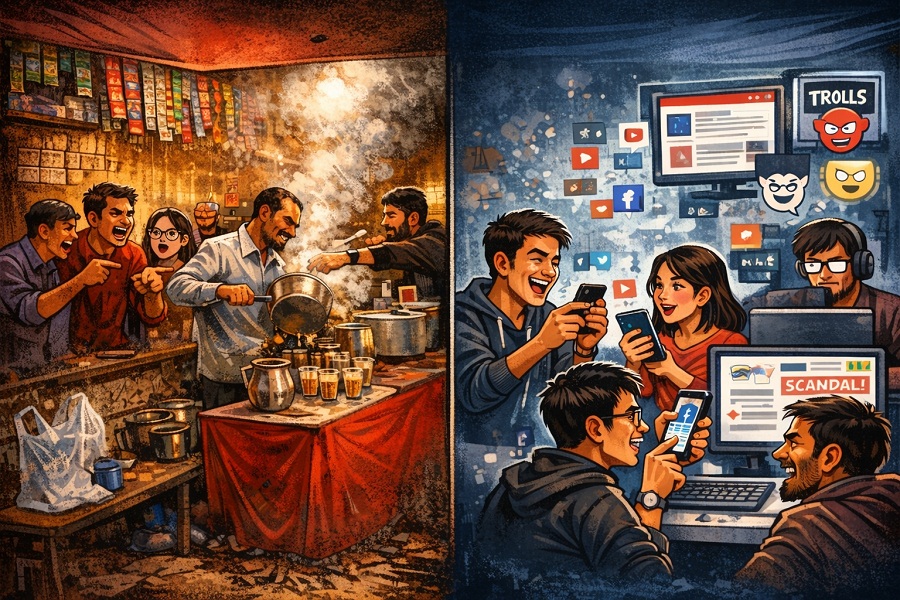
The tea stalls near Dhaka University's TSC never seem to run out of customers. The air is thick with the scent of tea's liquor and half-burnt cigarettes, and students and non-students keep arguing over national and international matters. Elections, war, and economic crises, fuel prices, sports events, anything and everything, people of all sectors gather there to share opinions, argue, and debate on what they believe and predict future outcomes. The phrase 'a storm in a cup of tea' feels especially true in Bangladesh in that sense, when arguing about politics often becomes intense.
For some years, those discussions have moved from teacups to phone screens. Political gossip now spreads online with the same energy, to some extent, more than it once was at the tea stalls or any public sphere. During the 2024 Student Movement, the slogan 'Chalai den', meaning 'spread it', went viral, showing how rumours travel faster than the truth. Short phrases and jokes now turn social media into a digital tea stall. People love these online debates, even though some just read rather than participate.
When gossip went digital
The shift did not happen overnight. One of the key reasons is 'affordable' mobile internet. It made political discussion widely accessible, especially among young people.
Social media became the new gathering spot during the COVID-19 lockdown.
We have seen how powerful viral content can be during the July movement. Satirical posts and memes poking fun at politicians entertained, spread information, and motivated people to challenge restrictions. It was like watching a spirited debate unfold at a tea stall where almost everyone was tasting tea, yet some were not visible.
Offline debate has grown risky. Discussing anything in pubic especially politics and religion, can be dangerous, because of mob violence. It pushed the conversation online. Even a few angry voices can spark tension in a crowd. Content creators like Salman Muqtadir and Rakin Absar highlight this with biting humour.
People gradually stop sharing opinions in public, and social media provides some king anobymity. This anonymity protects general users; however, empowers trolls and bullies.
Comment sections of journalists, activists, and public figures overflow with abuse. It was unheard of before. Words that are never spoken in public spaces are easily expressed on social media platforms. Female candidates are mostly the victims.
Mithila Tasnim, an NGO activist, notes that Facebook amplifies hostility. "Those who would never dare to voice such views in a public gathering now feel empowered by thousands of fake or anonymous accounts," she says.
Misinformation has also evolved. Even without high-tech tricks, misinformation content spreads fear and sparks outrage.
Bangladesh's digital tea stalls have so-called widened participation, giving many people a platform to share opinions. Still, at the same time, they have blurred the line between healthy debate and intimidation.
The challenge is no longer just who speaks, but how responsibly those voices shape the public sphere. As George Orwell wrote in 1984, "If liberty means anything at all, it means the right to tell people what they do not want to hear." In Bangladesh's digital tea stalls, whether that freedom survives depends on how users choose to speak.