


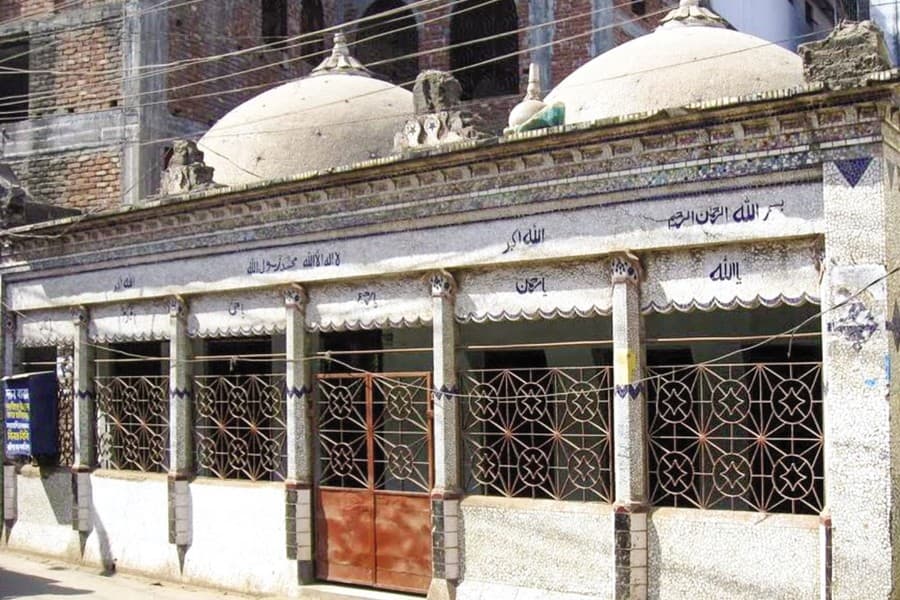
Narinda, an area in old Dhaka, is known for traffic jams, crowds, and pollution. Got its name from Narayoner dia, meaning the island of Narayan, now known as Narinda, is popular for its Jhunur morog polao. However, there is another fact that residents of Narinda should feel proud of. It is the Binant Bibi mosque, established some six centuries ago.


Across the city, the atmosphere changes dramatically. For example, Madani Avenue. It is a spacious road in Dhaka, home to planned housing complexes, modern infrastructure, and a skyline shaped by contemporary ambition.
The environment feels more structured, more forward-looking, shaped by economic growth and urban expansion. Rising prominently in this landscape is Masjid al-Mustafa, a large, architecturally striking mosque designed to accommodate thousands. Where Narinda reflects endurance and memory, this newer district reflects aspiration and confidence.
Six hundred years separate these two spaces, yet five times a day the same call to prayer echoes through both areas, connecting generations who will never meet but who share the same spiritual gestures.
In the Bengal Sultanate period, when the Binat Bibi Mosque was constructed in the 15th century, religious structures were often intimate and locally supported. Built primarily with brick and adapted to regional climate conditions, such mosques were deeply integrated into neighbourhood life. Worshippers did not arrive as strangers; they gathered as neighbours who knew one another's stories, struggles, and celebrations.
Even today, the environment surrounding the mosque reinforces that intimacy. Old Dhaka's density creates constant interaction in shared courtyards, closely spaced homes, and overlapping lives.
Within such a setting, a mosque becomes more than a place of ritual; it becomes a centre of emotional continuity. People return to the same space where their parents and grandparents once prayed, creating a sense of rootedness that transcends generations.
By contrast, Masjid al-Mustafa represents the realities of a rapidly urbanising city. Modern Dhaka faces population growth, rural-to-urban migration, and evolving lifestyles. Large congregational mosques are necessary to serve expanding communities, and architectural ambition often reflects civic pride.
Features such as multiple floors, accessibility systems, advanced acoustics, and climate control demonstrate how religious spaces adapt to contemporary needs.
Yet scale alone does not define spiritual experience. Architecture shapes emotion in subtle ways. Smaller mosques often evoke closeness -a sense of humility, familiarity, and personal reflection.
Large mosques can inspire awe and collective unity, reminding worshippers that they are part of something larger than themselves. Both environments fulfil psychological needs, but in different ways.
The emotional connection people develop with sacred spaces is profound. A mosque may hold memories of childhood prayers, family gatherings during Ramadan, or moments of personal crisis when individuals sought comfort and reassurance. These experiences create attachments that cannot be measured in architectural terms. When such spaces deteriorate or disappear, communities lose more than structures; they lose fragments of shared identity.
This is where the question of preservation becomes urgent. Historical mosques like Binat Bibi Mosque often survive through continuous use rather than formal conservation.
Over time, surrounding construction, renovations, and urban pressure alter original features. While adaptation keeps buildings functional, it can also erase architectural heritage if not carefully managed. Preservation, therefore, is not merely about protecting bricks and mortar; it is about safeguarding collective memory.
Modern mosques also require thoughtful stewardship. Large contemporary structures demand maintenance, funding, and community engagement to remain vibrant. Without active involvement, even the most impressive architecture can become emotionally distant. Preservation in this context means ensuring that spaces remain welcoming, inclusive, and socially meaningful, rather than merely visually impressive.
Communities play a central role in this process. Governments and heritage organisations can provide technical expertise, but emotional ownership comes from people who use these spaces daily. When worshippers feel responsible for a mosque's well-being, preservation becomes a shared mission rather than an external directive. Educational initiatives, awareness programs, and local participation can strengthen this sense of responsibility.
Urban planning policies also matter. Rapid development often prioritises commercial value over historical continuity, placing older religious structures at risk. Integrating heritage preservation into city planning can help balance modernisation with cultural identity. Protecting historical mosques does not mean resisting progress; it means recognising that development should include memory alongside innovation.
At a deeper level, preservation extends beyond physical maintenance. Sacred spaces endure when they remain emotionally relevant. Encouraging community activities, educational programs, and social support initiatives within mosque environments can reinforce their role as centres of belonging. When people associate a mosque with care, guidance, and connection, they naturally contribute to its survival.
Ultimately, the comparison between centuries-old and contemporary mosques points to an important distinction: spiritual fulfilment does not arise from architectural age or grandeur.
A person praying with sincerity in a modest historic space may experience the same peace as someone standing beneath a vast modern dome. Physical surroundings can influence mood and concentration, but they cannot substitute for intention. Devotion is shaped primarily by the state of the heart, not the scale of the structure.
Older mosques feel special not because they offer greater spiritual power, but because they carry history. Their aged walls and familiar spaces connect worshippers to generations before them, creating a sense of continuity even though the essence of prayer itself remains the same. Buildings may age, cities may transform, and societies may evolve, but people still need spaces that anchor them, places where reflection, comfort, and belonging intersect. Safeguarding both historic and modern religious spaces ensures that future generations inherit not only functional places of worship but also the sense of connection that makes those spaces meaningful.
sajidahmed734@gmail.com