

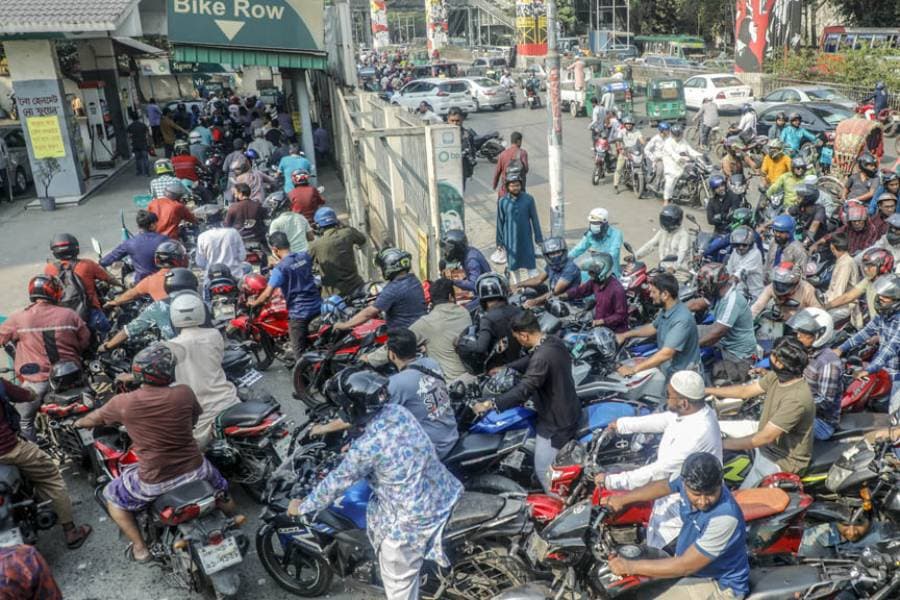
Fuel traders say the pressure on Bangladesh’s fuel supply, particularly petrol and octane, is not driven by the crisis in the Middle East but rather by flawed government management and what they describe as “erroneous” calculations.
At a press conference held at a Dhanmondi restaurant on Thursday, the Bangladesh Petroleum Dealer’s, Distributor’s, Agents and Petrol Pump Owners’ Association demanded the immediate withdrawal of petrol and octane rationing to restore stability to the market.
The association argued that the decision to limit fuel sales was unnecessary and served only to ignite public anxiety.
Syed Sajjadul Karim Kabul, the association’s convenor, pointed out that a significant portion of the country’s petrol and octane demand is met by condensate produced at the Sylhet gas fields and processed in local refineries.
“The production of gas and condensate in Sylhet has no direct or indirect connection with the war in the Middle East or international instability,” Kabul said.
He emphasised that since the Bangladesh Petroleum Corporation (BPC) receives the entire output from these domestic sources, the global conflict should not have impacted the availability of these specific fuels.
The traders alleged that while the crisis began with rumours and panic-buying, it was exacerbated by the BPC’s “hasty” implementation of a rationing policy without consulting stakeholders.
On Mar 6, the BPC set fuel sales limits at two litres of octane/petrol for motorcycles, 10 litres for private cars, 20–25 litres for SUVs and microbuses, and for diesel, 70–80 litres for local buses and pickups, and up to 220 litres for long-haul trucks and lorries.
The motorcycle oil refill limit was later increased to five litres.
The association claimed the BPC’s calculation is fundamentally flawed.
The calculation behind the rationing is based on the average fuel consumption from March to June, a period of lower demand, the association said.
The BPC ignored the high-demand period of January to April, it added.
The association also argued that while the BPC officially announced a 25 percent supply cut, the actual market shortage has reached 45 percent because the regulator failed to account for the fact that pumps only uplift oil 20–22 days a month, not 30.
The traders warned that the current “quota” system has made fuel distribution commercially unviable.
Many pumps are receiving such small allocations that they cannot fill a standard 5,000 to 9,000- litre tank lorries.
“In many cases, the transport cost for partial loads exceeds the dealer’s commission,” the written statement read out at the press conference noted.
Many pumps have stopped collecting oil altogether because it is “unprofitable and ineffective,” the statement added.
Kabul blamed “bureaucracy” for creating the crisis that severely impacted public life, causing people to spend hours in queues to get fuel in the fasting month of Ramadan. People even clashed with pump staff for fuel.
The association urged the government to replace daily quotas with weekly allocations and to adjust supply based on actual demand fluctuations.