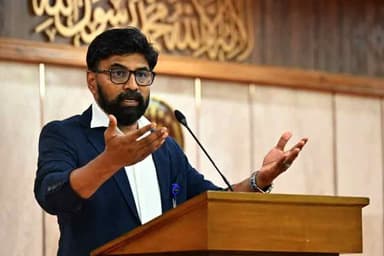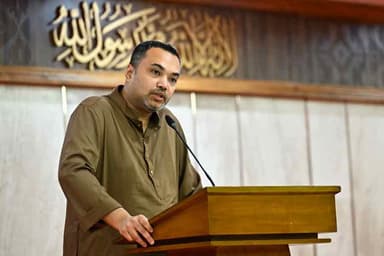




Bangladesh’s foreign affairs adviser to the prime minister, Humayun Kabir, has said Dhaka is ‘not afraid of barbed wire’ after newly elected West Bengal chief minister Suvendu Adhikari announced plans to accelerate fencing along the India-Bangladesh border.
Asked to comment on reports that the West Bengal government would hand over land to India’s Border Security Force (BSF) within 45 days to facilitate new border fencing projects, the adviser said: “There is no longer any scope to intimidate a country like Bangladesh with barbed wire.”
“If you want relations with people, the people of Bangladesh are not afraid of barbed wire. The Bangladesh government is also not afraid of barbed wire. Wherever we need to speak, we will speak.”
Humayun Kabir also referred to past incidents of killings along the border, saying Bangladesh would no longer tolerate what he described as the practices seen during the tenure of former prime minister Sheikh Hasina.
“Many people were killed at the border during the Hasina period. That pattern will never return, God willing,” he said. “And if anyone wants to manage the border in that manner again, this Bangladesh is not a subservient country that will simply sit and watch. Bangladesh has plans for what needs to be done.”
The adviser said Dhaka still preferred dialogue and regional stability over confrontation.
“We hope they will not go down that path,” he said, referring to India. “Neighbouring countries should maintain regional stability. We want dialogue with our neighbour to address challenges.”
In a pointed remark, he accused Sheikh Hasina of fleeing to India after “killing 1,500 people”, and urged New Delhi not to allow Bangladeshi political activities from Indian soil that could destabilise Bangladesh.
“She is now staying in the sovereign territory of India,” he said. “We have been assured by the Indian government that they will not provide her the space to destabilise Bangladesh from there.”
Despite the tensions, Humayun Kabir said Bangladesh remained committed to improving bilateral relations with India.
“We want to move bilateral relations forward,” he said. “The mindset of the leadership of both countries must be geared towards moving ahead. There are certainly many challenges. As long as the door to dialogue remains open, there is always an opportunity to resolve problems.”
He added that some issues could be resolved quickly while others would require more time and political negotiation.
The adviser also cautioned against reading too much into campaign rhetoric from Indian politicians, saying there was often a difference between election promises and actual government policy.
“Many kinds of promotional statements are made to win elections,” he said. “But the position of a government once in power is entirely different. We should give it some time. Campaign rhetoric and government policy are not the same.”
He noted that Bangladesh’s primary engagement would remain with India’s central government, while closely watching political developments inside West Bengal.
Responding to a question about the long-stalled Teesta river water-sharing agreement, Humayun Kabir suggested that the political change in West Bengal could potentially ease negotiations.
“Now the BJP is in power in West Bengal,” he said. “Previously, even if the central government in India wanted to move forward, it also had to take into account the position of the Trinamool Congress government in the state, which became a challenge for us.”
“With the state and central governments now under the same political party, we hope the situation may become more positive and less challenging. Time will tell,” he added.
mirmostafiz@yahoo.com