


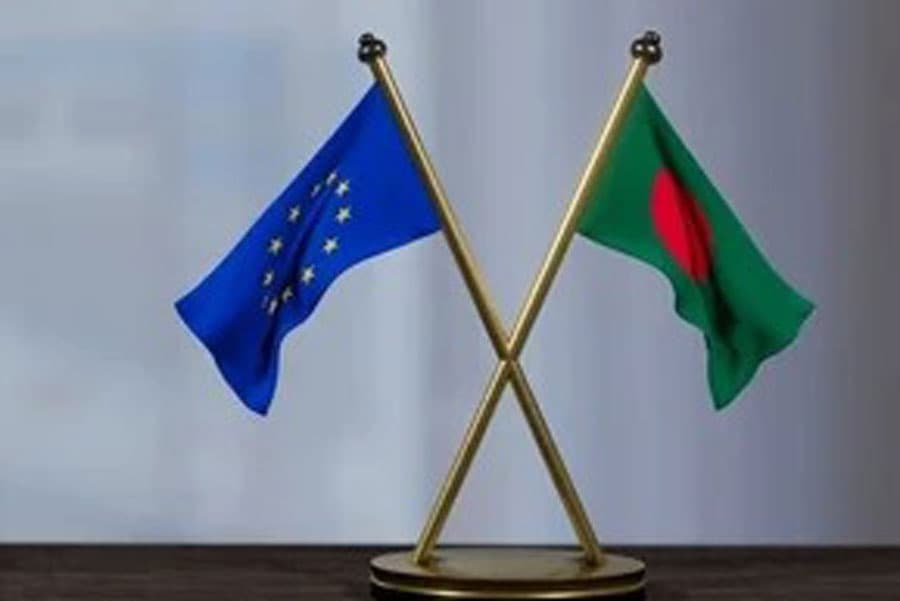
Bangladesh and the EU discussed the possibility of signing a Free Trade Agreement (FTA) on Monday.
The issue was highlighted during a discussion between Foreign Minister Dr Khalilur Rahman and a delegation of EU ambassadors, who paid a courtesy call on him.
Both sides discussed the possibility of launching negotiations for a comprehensive free trade agreement, signalling a potential new phase in relations following the Bangladesh Nationalist Party’s sweeping victory in this month’s parliamentary elections, a foreign ministry official said.
Michael Miller, head of the EU delegation in Dhaka, led a group of resident EU ambassadors from Denmark, France, Germany, Italy, the Netherlands, Spain and Sweden in the courtesy call on Bangladesh’s Foreign Minister Khalilur Rahman on Monday. The European diplomats congratulated Prime Minister Tarique Rahman on what they described as a massive electoral victory for the Bangladesh Nationalist Party and extended their felicitations to Khalilur Rahman on his new ministerial appointment.
According to officials present at the meeting, both sides expressed satisfaction at the steady expansion of Bangladesh-EU ties, describing the partnership as having evolved into a multifaceted relationship that extends beyond trade into political dialogue, development cooperation and shared global priorities.
The ambassadors reaffirmed their intention to work closely with the new government to “maximise the longstanding, predictable and mutually beneficial partnership” between Dhaka and Brussels. They also praised Bangladesh’s democratic transition and pledged continued EU engagement in support of constitutional, judicial and labour reforms.
Khalilur Rahman, for his part, welcomed the EU’s deployment of a large Election Observation Mission during the 12 February national polls, underscoring the government’s stated commitment to democratic consolidation, the rule of law and good governance.
Trade and economic cooperation dominated the talks. Both sides exchanged views on the potential commencement of negotiations towards a comprehensive Bangladesh-EU free trade agreement, a move that could reshape the country’s export trajectory as it prepares for graduation from least-developed country status.
Later, speaking to reporters, EU Ambassador to Dhaka Michael Miller said the European Union (EU) is eagerly awaiting the beginning of a new chapter in its relations with Bangladesh.
Miller said the EU remains Bangladesh’s most reliable partner, noting that it is the country’s largest trading partner, biggest investor and a major provider of development assistance.
“As a very important partner of the newly elected government, I came to meet the Foreign Minister and the State Minister. We are pleased with our meeting. The EU is eagerly awaiting the start of a new chapter in EU-Bangladesh relations,” he said.
He said the talks covered a broad spectrum of bilateral engagement, including development cooperation, humanitarian affairs and migration.
On priorities for engagement with the new government, Miller stressed the importance of continuing reforms initiated during the interim administration. He expressed particular interest in progress on judicial reforms and improved migration management, describing these as especially significant areas of cooperation.
“We want to fully realize the potential of EU-Bangladesh relations,” he added.
Regarding the proposed Partnership and Cooperation Agreement (PCA), the envoy said discussions were advancing steadily and the agreement was close to finalisation. He expressed hope that the deal could be signed in the near future.
Miller also said issues relating to human rights, freedom of speech and freedom of expression were discussed during the meetings, underlining that respect for fundamental freedoms remains central to EU-Bangladesh relations.
The EU is Bangladesh’s largest export destination, with garments accounting for the bulk of shipments. A future FTA could help cushion the impact of the eventual loss of preferential market access and lock in more predictable trade terms, while also expanding cooperation into services, investment and regulatory standards.
Beyond trade, discussions covered a wide range of shared concerns, including regional and global developments, humanitarian cooperation, water-resource management, climate change, the blue economy, migration governance, skills development and employment generation.
Earlier in the day, the EU envoys also met State Minister for Foreign Affairs Shama Obaed Islam to congratulate her on her appointment. She reaffirmed Bangladesh’s commitment to deepening what she described as a “win-win” relationship and welcomed enhanced engagement with the EU and its member states in areas of mutual priority.
mirmostafiz@yahoo.com