

Published :
Updated :
 For all latest news, follow The Financial Express Google News channel.
The drought that has engulfed the Barind tract is threatening to catch south and central regions as temperature rise continues unabated, warned speakers at a workshop ahead of COP28.
Global warming has also brought in a shift in seasonal weather behaviours, shrinking the duration of winter season, and also affecting human working capacity and food safety, they cautioned.
The speakers said this at a two-day workshop styled 'Journalism in the Age of Climate Action: COP28 Coverage Strategies and Mentoring' that began on Friday.
The event was aimed at the capacity development for media people ahead of covering the upcoming COP28.
The Centre for Atmospheric Pollution Studies (CAPS) and the Press Institute Bangladesh (PIB) are co-hosting the workshop in collaboration with some nine environmental organisations.
Prof Dr ASM Maksud Kamal, the newly appointed vice-chancellor of Dhaka University, addressed the opening day as the chief guest with PIB director general Zafar Wazed in the chair.
Lawmaker Shamim Haider Patwary, who is also a member of the Climate Parliament Bangladesh, was present as the special guest at the programme moderated by CAPS chairman Prof Ahmad Kamruzzaman Majumder.
BRAC University emeritus professor Dr Ainun Nishat, Change Initiative chief executive M Zakir Hossain Khan and Centre for Policy Dialogue research director Khondaker Golam Moazzem were among the trainers.
Addressing the event, Prof Kamal said in case of the temperature rising by 2.0 degrees, the drought in Barind region would gradually spread to the southern and central regions of the country.
This could have a major impact on food security, he added.
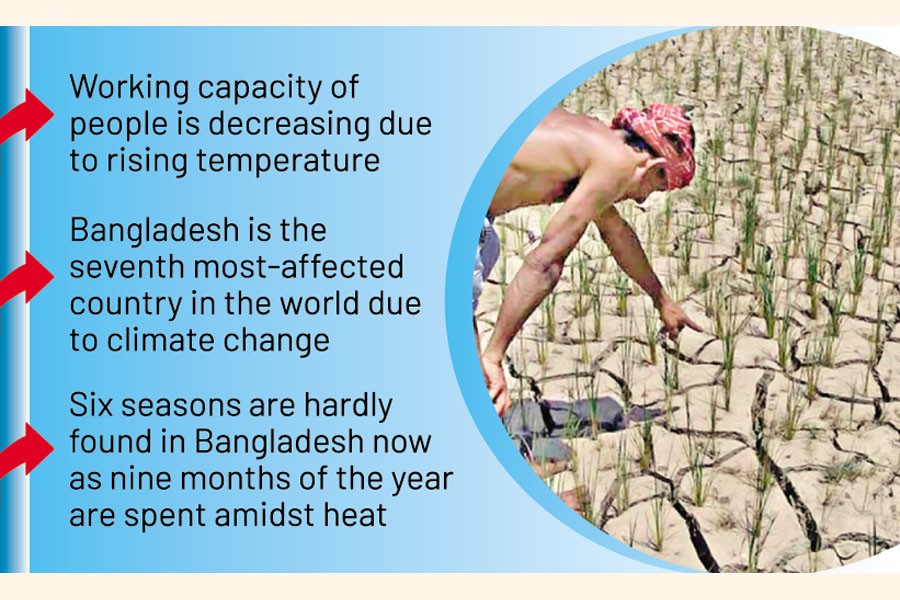
Casualties were discussed in past climate conferences (COPs), there was no talk about funds, lamented the VC, saying that the working capacity of people was decreasing due to rising temperatures.
Bangladesh is the seventh most-affected country in the world due to climate change.
"We're suggested to raise the number of green industries to fight climate change, but who will provide necessary funds for it?" questioned Prof Kamal.
"Six seasons are hardly found in Bangladesh now. We spend nine months of the year in the heat. The severity of winter has also increased more than before for climate change," said Mr Wazed.
According to Mr Patwary, "We're not living in the era of climate change, but of climate disaster. Bangladesh has the second-highest number of climate refugees after China."
What would happen to those helpless people if 25 per cent of the delta was lost, he questioned.
The adverse effects of climate change are greatest on Bangladesh, so it is time to take effective steps now.
Conservationist Dr Nishat accentuated the need for protecting biodiversity and natural ecosystems. In that case, the 'theory of change' should be applied along with the 'project of analysis'.
nsrafsanju@gmail.com