

Published :
Updated :
 For all latest news, follow The Financial Express Google News channel.
The Basanta Utsab has drawn a packed crowd to the lobby of the Liberation War Museum in Dhaka's Agargaon, with barely any room to move as spring revellers turn out in large numbers.
Most attendees have come dressed in shades of yellow, some with friends, others with parents and family members, while many remain busy capturing photos with their groups.
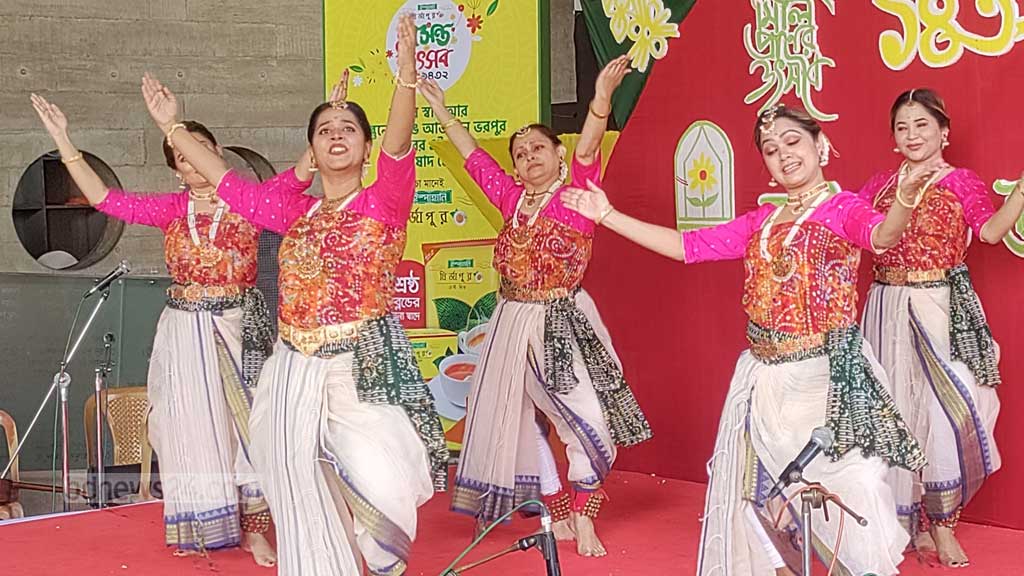
On stage, performances unfold one after another. From Shah Abdul Karim’s “Bosonto Batase” to classic Bengali hits, the air fills with the voices of the artists.
Amid the festivities, bdnews24.com spoke with Mesbah Uddin Ahmed Sumon, joint director of the Bishwo Shahitto Kendro.
He said, “I attend the Basanta Utsab every year. I wasn’t sure if the festival would take place this time. I only found out [on Friday] from a bdnews24.com report that it would. After that, I decided to come and informed my acquaintances as well.”
Following the recently concluded national election, organisers had been hesitant about holding the festival on Saturday at 8am due to the country’s overall situation.
After three decades at Bakultala of Charukola (Faculty of Fine Arts, Dhaka University, the venue moved to the open courtyard of the museum as uncertainty over the post-poll atmosphere made the traditional site inaccessible.
Manzar Chowdhury Sweet, general secretary of the National Basanta Utsab Udjapan Parishad, noted that while they attempted to secure Bakultala, the alternative venue was chosen because the Liberation War represents the roots of Bangladesh, just as spring represents its cultural heritage.
Since 1994, the council has hosted this celebration, but this marks the first time the primary event has shifted from its ancestral home at the Faculty of Fine Arts.
Sweet noted that while the festival has branched out to locations like Bahadur Shah Park and Uttara in the past, Bakultala remained the core.
He expressed a desire to return there next year, urging the incoming government to maintain a free environment for healthy cultural practice and keep the "windows of culture" wide open.
As the first day of Falgun, the 11th month in the Bengali calendar, coincided with Valentine's Day, the hues of spring blended with the spirit of love on Feb 14.
The programme began with choral and instrumental music by students of the Bengal Parampara Sangeetalaya.
The festivities continued until 12pm, featuring dance troupes, soloists, and performances by ethnic minority artists, alongside the traditional exchange of Abir (coloured powder) and spring greetings.
Safiuddin Ahmed, president of the council, said: “We were uncertain whether we would be able to host the event. There was doubt about whether the post-election administration would permit such a celebration.
“We are delighted that it has been possible. Despite limited publicity, many people have come voluntarily.”
Kajal Debnath, vice-president of the council, said the festival symbolically reopened the “closed window” of cultural practice.
“In the past, ‘mob violence’, attacks on shrines, and cancelled cultural events created a dormant period for cultural engagement. We have managed to hold this festival, and it has reopened that closed window of cultural life,” he said, adding that they hope the new government maintains this openness.