

Published :
Updated :
 For all latest news, follow The Financial Express Google News channel.
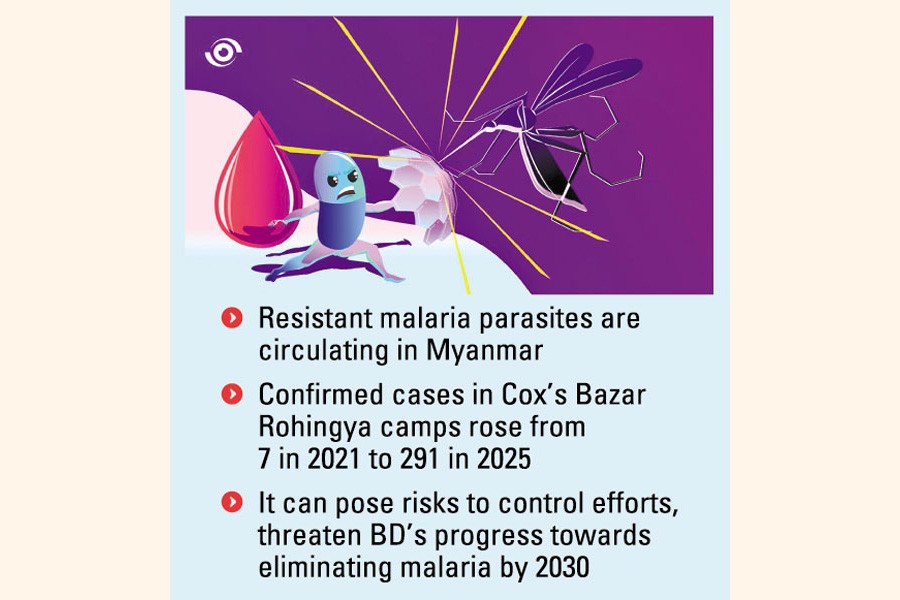
Bangladesh is launching its first surveillance study to track drug-resistant (DR) malaria in the Rohingya refugee camps in Cox's Bazar amid growing concerns that resistant malaria parasites are circulating in neighbouring Myanmar.
The surveillance is led by icddr,b in collaboration with the national and humanitarian partners, as this spread could threaten Bangladesh's progress towards eliminating malaria by 2030, said icddr,b on Wednesday.
The Rohingya camps lie close to the Bangladesh-Myanmar border, where artemisinin (a group of drugs) resistance has already been reported. Frequent cross-border movement, high population density, and limited surveillance in humanitarian settings may increase the risk of resistant parasites entering or spreading in Bangladesh.
The 33 Rohingya camps in Cox's Bazar form the world's largest refugee settlement, hosting more than 1.18 million refugees.
Malaria is a potentially deadly mosquito-borne disease. The most dangerous form, Plasmodium falciparum, has become easier to treat in recent years thanks to effective medicines. However, the emergence of drug-resistant parasites could weaken these treatments and pose new risks to malaria control and elimination efforts.
To address this risk, the Office of the Refugee Relief and Repatriation Commissioner (RRRC) convened a discussion in Cox's Bazar on 10 March, bringing together representatives from the government agencies, research institutions and humanitarian organizations, working in the camps accommodating the Forcibly Displaced Myanmar Nationals (FDMN).
The surveillance study will focus on the Rohingya camps in Cox's Bazar, which face several risk factors for the emergence and spread of drug-resistant malaria.
Recent surveillance data from BRAC show that malaria testing and case detection in the camps increased in recent years, with confirmed cases rising from 7 in 2021 to 291 in 2025.
"Bangladesh has made significant progress in controlling malaria, but continued vigilance is essential," said RRRC Mohammed Mizanur Rahman. "Strengthening surveillance in the high-risk areas, such as Cox's Bazar, will help protect both the refugee and the host communities and ensure that malaria treatments remain effective."
"Drug-resistant malaria can spread silently, if it is not detected early," said icddr,b scientist Dr Mohammad Shafiul Alam, who has been involved in malaria research and control initiatives for more than a decade.
Bangladesh's National Strategic Plan for Malaria Elimination (2024-2030) aims to achieve zero indigenous malaria transmission by 2030, making surveillance and early detection of drug resistance critical to sustaining progress.
nsrafsanju@gmail.com