

CA confident party of young people will win seats in February polls
Published :
Updated :
 For all latest news, follow The Financial Express Google News channel.
Chief Adviser Professor Muhammad Yunus, on Tuesday, expressed optimism that some of the candidates of a newly formed political party, launched by young people, will secure seats in the upcoming national elections to be held on February 12.
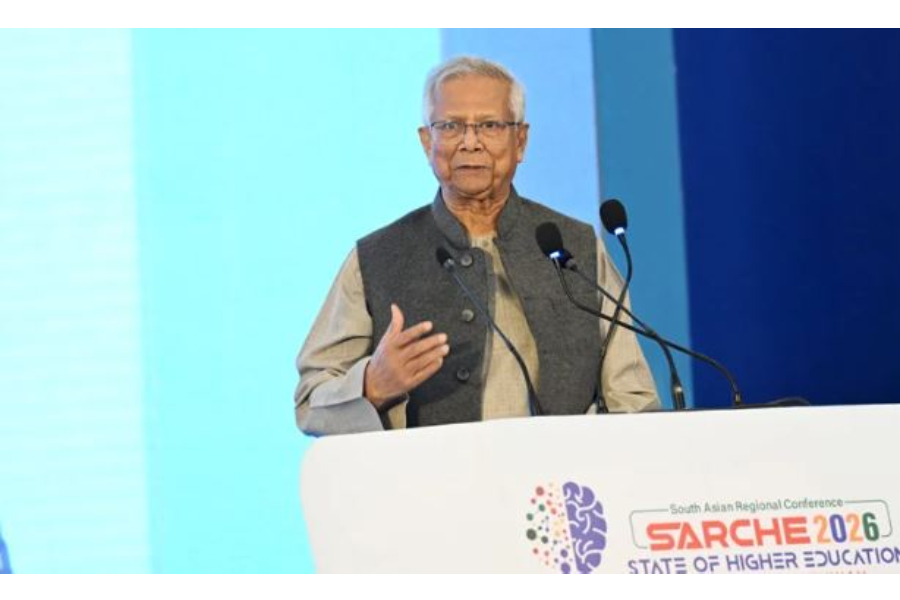
Speaking at the opening of a regional higher education conference in Dhaka, Yunus said that young people had floated a political party and would appear on the ballot in elections scheduled for 12 February. “I am confident that some of them will be elected,” he said, without naming the party.
Yunus was addressing the inaugural session of the three-day South Asian Regional Conference on State of Higher Education and Future Pathway (SARCHE 2026), held at a city hotel and attended by academics and policymakers from across South Asia, the UK and the World Bank.
Referring to the July 2024 uprising that led to the collapse of Bangladesh’s previous government, Yunus said universities and academics must reflect on recent events to understand the aspirations of the country’s youth. “They stood up, raised their voices and brought down an ugly fascist regime, knowingly risking their lives,” he said.
He urged educators to examine why students confronted state violence and what kind of education system could respond to such social and political realities.
“It would be a missed opportunity if we do not try to understand what they did, what they expected and what they aspired to,” he added.
Yunus cited the letter written by school student Shahriar Khan Anas to his mother before he was killed during the protests, describing it as a powerful expression of moral responsibility and resistance to state repression.
The chief adviser argued that the uprising was not an isolated event, pointing to similar movements in Sri Lanka and Nepal, though he said the scale and intensity were greater in Dhaka.
He also criticised the decline of the South Asian Association for Regional Cooperation (SAARC), calling its stagnation “a shame” and urging regional governments to revive it as a platform for academic and political cooperation.
Turning to education reform, Yunus said Bangladesh’s system was overly focused on producing job seekers rather than independent thinkers and entrepreneurs.
He questioned whether the purpose of education should be to prepare students for employment alone, describing job dependency as a modern form of “slavery”.
“Human beings are not born as slaves,” he said. “Education should turn creative beings into job creators, not obedient workers.”
He argued that entrepreneurship and imagination should be central to learning, reflecting the same spirit that drove young people to challenge the state.
Yunus also confirmed that a referendum would be held alongside the elections to determine the future direction of the country’s constitution, which he described as the root cause of many of Bangladesh’s political problems.
The conference is being organised under the Higher Education Acceleration and Transformation (HEAT) project, funded by the Bangladesh government and the World Bank. Delegates from the UK, Maldives, Malaysia, Nepal, Pakistan and Sri Lanka are taking part.
Education adviser Professor C R Abrar and senior officials from the University Grants Commission and the World Bank also addressed the opening session.
mirmostafiz@yahoo.com