

Published :
Updated :
 For all latest news, follow The Financial Express Google News channel.
Bangladesh's major political parties pledge to stay united against a "coordinated bid" to jeopardize the July uprising and jointly protest the shooting of an activist and prospective independent election candidate, Sharif Osman Hadi.
Leaders from the Bangladesh Nationalist Party (BNP), Jamaat-e-Islami and the National Citizens Party (NCP) swore the solidarity pledge at a meeting chaired by interim government chief Professor Muhammad Yunus at the state guesthouse Jamuna in Dhaka, a day after the daring daylight gun attack.
They said the attack on Hadi, a spokesperson for the pro-uprising Inqilab Mancha platform and a likely candidate from the Dhaka-8 constituency for the upcoming general election, was part of a "wider conspiracy" cooked up to destabilise the political transition through obstructing the next general election.
Participants in the meeting included senior leaders from all three parties, representatives of the Inqilab Mancha and law adviser Asif Nazrul, according to an official briefing.
Yunus told the meeting that the attack on Hadi was pre-planned and involved a "deep conspiracy" with "powerful forces working behind the scenes".
The objective, he notes, is to prevent the election from being held.
The head of post-uprising interim government describes the shooting as symbolic, intended to demonstrate strength and create fear among political actors and voters.
He mentions that preliminary information suggests the perpetrators expanded their networks and deployed trained gunmen, raising concerns over organised violence ahead of the polls.
Wise after the attack, political parties agreed to organise an all-party protest rally in the coming days under the initiative of Inqilab Mancha. Leaders also said they would step up coordination among parties aligned against authoritarianism to prevent divisions within the broader political alliance.
Senior figures from BNP, Jamaat and NCP said maintaining unity is critical and warned that internal rifts could be exploited by opponents seeking to disrupt the election process.
They also called for intensified operations to recover illegal firearms before the vote.
BNP standing committee member Salahuddin Ahmed said political forces must remain united and avoid blaming one another during the current crisis.
"Differences in political views should not override national interest and the legacy of the July uprising," he said during the exigent conclave.
Ahmed also urges authorities to strengthen action against illegal weapons and those involved in the alleged conspiracy.
Jamaat-e-Islami secretary- general Mia Golam Parwar said recent public statements by political actors had increased mutual accusations, allowing adversaries to take advantage of divisions.
"Parties allowed narrow political interests to overshadow broader national concerns," he says and calls for renewed commitment to unity.
Convenor of the NCP Nahid Islam notes that efforts to undermine the July uprising have been underway since it took place, alleging an "orchestrated campaign across media, administrative institutions and social platforms".
According to Islam, narratives are being promoted to portray those involved in the uprising as criminals, while attempts are being made to rehabilitate the Awami League and the Jatiya Party in public discourse.
Islam warns that whoever forms the next government would face the consequences of such destabilisation and says no single party would be able to govern alone under those conditions.
He rejects calls for special security arrangements for political leaders, saying that the focus should instead be on collective ownership of the July uprising that toppled the Awami League government.
"Internal divisions," he says," are being viewed by adversaries as a sign of weakness."
Law adviser Asif Nazrul said infighting among political forces had strengthened the Awami League, urging parties to remain vigilant about national interests rather than focusing solely on party agenda.
In his concluding remarks, Yunus said responsibility did not rest with the government alone and urged all political actors to remain cautious in their rhetoric.
"Political debate is inevitable, but it should not turn into hostility," says the Nobel laureate-turned interim ruler of Bangladesh following the student-mass uprising.
Election periods often generate tension, Yunus adds, but that tension must remain within manageable limits to safeguard the country's future.
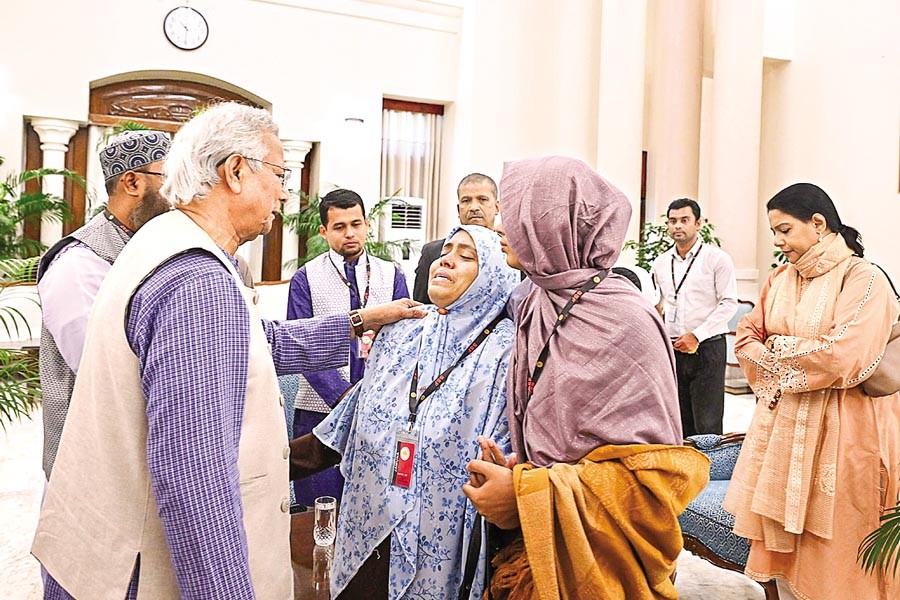
Chief Adviser of the interim government Professor Muhammad Yunus sympathizes with the family of Sharif Osman Hadi, a political activist and prospective parliamentary candidate who was critically wounded in a shooting widely seen as a test of the country's fragile post-uprising transition, and assures justice.
His assurances came in his meeting with the dejected family members on Saturday morning at the state guesthouse Jamuna. Yunus spoke with Hadi's brother Abu Bakar Siddique and his sister Masuma, and senior figures from the Inqilab Mancha platform, which emerged as a key force during the July uprising.
The head of post-uprising government assures the family that the government was taking all possible steps to ensure Hadi received the best available medical treatment. Nothing that the entire country is praying for his recovery, he says arrangements would be made for treatment abroad if doctors deemed it necessary.
"If his condition requires treatment outside the country, the government will ensure he is treated wherever needed," Yunus told the Hadi family, according to officials present at the meeting.
Hadi, a spokesperson for Inqilab Mancha and a likely independent poll candidate for the Dhaka-8 constituency, has become a symbolic figure for supporters of the July uprising, which reshaped Bangladesh's political landscape earlier this year. His shooting has heightened fears of targeted violence aimed at intimidating activists and derailing the electoral process.
Speaking emotionally, Hadi's sister describes him as a lifelong idealist shaped by poetry and rebellion.
"From childhood, he loved this country with all his heart," she says. "He was drawn to revolutionary poetry and loved reciting it. He has a 10-month-old child. Hadi is the backbone of our family."
She appeals directly to the interim government to protect those who carried the July movement forward. "You are a revolutionary government. You must protect the revolutionaries of July at any cost."
Hadi's grief-stricken sister alerts that failure to do so would place the country's independence and sovereignty at risk.
Leaders of Inqilab Mancha pressed for swift accountability, arguing that the attack was not an isolated crime but part of a broader pattern of intimidation.
Abdullah Al Jaber, a senior leader of the platform, said Hadi had refused to retreat from public life even after many activists returned home following the upheaval in August last year.
"After 5 August, many people stepped back. Hadi did not," Jaber said. "He embodied the July uprising and worked day and night for it."
He also calls for an investigation into how the suspected gunman, previously arrested in another case, had been released on bail.
Another Inqilab Mancha leader, Fatema Tasnim Juma, urges the government to ensure comprehensive security for those she describes as "fighters of July", saying their safety is essential to preserving the gains of the uprising.
Yunus says law-enforcement agencies had been instructed to act with urgency and that a full investigation was under way to identify not only the attackers but the wider network behind the assault.
"Those involved in this brutal attack will be brought to justice," he assures them.
Senior advisers, including law adviser Asif Nazrul, environment adviser Rizwana Hasan, industries adviser Adilur Rahman Khan and national security adviser Khalilur Rahman, were present at the meeting, underlining the political significance the interim government has attached to the case.
The shooting has become a focal point in Bangladesh's tense political moment, as rival forces jostle to shape the narrative of the July uprising ahead of national elections.
For many of Hadi's supporters, his recovery and the outcome of the investigation will serve as an early test of whether the new leadership can protect dissent and deliver justice in a deeply polarised environment.
mirmostafiz@yahoo.com