

Published :
Updated :
 For all latest news, follow The Financial Express Google News channel.
Interim government chief Prof Muhammad Yunus said Bangladesh's forthcoming 13th parliamentary election must set a democratic benchmark for the future as authorities Wednesday unveiled extensive security and monitoring deployment involving body cameras, CCTV surveillance, drones and central control room.
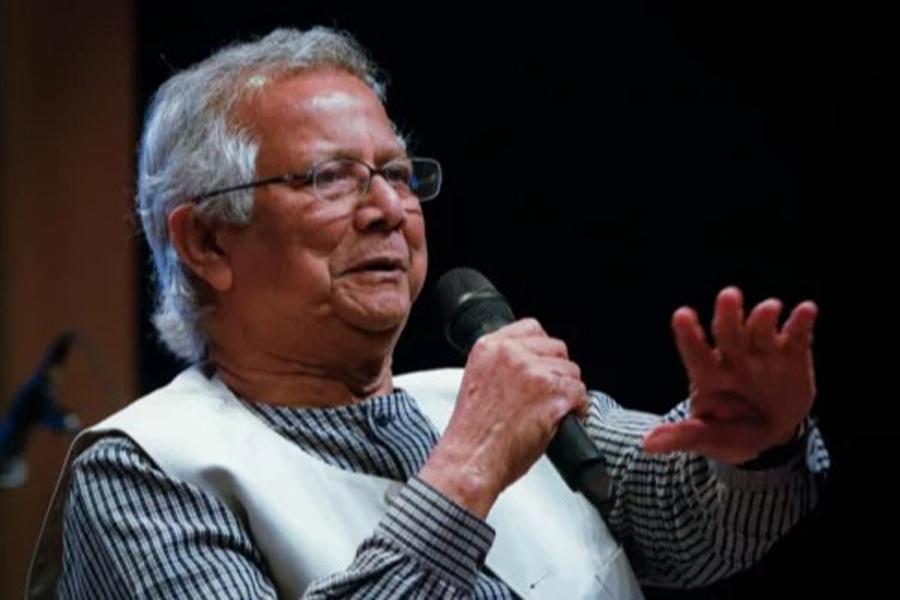
Speaking at a high-level meeting on law and order at the Chief Adviser's Office in Dhaka, Yunus said the interim administration's core responsibility was to support the Election Commission (EC) in delivering a credible vote and the referendum on implementing the July National Charter of change.
"This is a major challenge for the nation, and one we must accept," Yunus said. "Our task is to complete this enormous responsibility and turn it into a historic achievement. The 2026 election must be one that creates a standard for future elections."
The meeting brought together the country's top civilian, military and security officials, including the home affairs adviser, the chiefs of army, navy and air force, senior police and border-security officials, the cabinet secretary, the election commission secretary, and the heads of intelligence agencies.
It underscores the scale of coordination the interim government is attempting in a country where elections in recent years had been marred by allegations of manipulation, violence and voter suppression.
Yunus stresses that nothing should be left to chance on polling day, set for 12 February. "From today, our test begins. The final test will be on 12 February," he said.
"Right now, the Election Commission's instructions are the highest instructions. Everyone must work together in full compliance with the EC's directives."
According to the chief adviser, the Ministry of Home Affairs will play the central- command role in maintaining law and order while addressing what he described as a new layer of technological challenges alongside conventional security concerns.
For the first time on such a scale in Bangladesh, security personnel will use body-worn cameras at polling centres, alongside CCTV coverage and real-time monitoring from a central control room. Drones may also be deployed where necessary.
"If used properly, body cameras have enormous potential," Yunus notes. "They can deliver success on a very large scale." He also emphasises the need for seamless coordination among the different security forces, warning that any gap could undermine public confidence. With a large number of domestic and international journalists and election observers expected, Yunus alerts, the global scrutiny would be intense.
"They are taking this very seriously. We must be super-serious as well."
Despite the heavy security focus, Yunus strikes an optimistic note about the political climate. He appreciates that candidates contesting the election are, so far, maintaining a positive attitude and mutual respect. "I hope none of them will deviate from this conduct."
The Election Commission secretary, Akhtar Ahmed, told the meeting that 51 out of Bangladesh's 59 registered political parties are participating in the election. He said observers from 26 countries had been invited, with the European Union expected to deploy a mission of around 300 observers. Fifty-six EU representatives are already in Bangladesh, and two have observed the appeals process related to nomination papers.
Campaigning will be allowed until 7:30am on 10 February, starting from midnight on Tuesday, Ahmed said.
He warns that misinformation and distortion in cyberspace would be one of the biggest challenges facing the election. Because ballots will include party symbols, a separate referendum ballot and postal votes, counting may take longer than usual.
"There must be no room for rumours or disinformation around this," he said, urging the media to act responsibly. Other advisers outlined logistical preparations aimed at avoiding disruptions on polling day. Muhammad Fouzul Kabir Khan, adviser for power, energy and mineral resources, said his ministry was working to ensure uninterrupted electricity supply across the country during voting. Fayez Ahmed Taiyeb, chief adviser's special assistant for posts, telecommunications and ICT, said mobile network and internet services would be kept running at all polling centres.
Army chief General Waker-Uz-Zaman said that during the mass uprising of August 2024, a total of 3,619 weapons were looted from police stations across Bangladesh. Of these, 2,259 - about 62.4 per cent - have so far been recovered. Out of 456,418 rounds of looted ammunition, 237,100 rounds, or roughly 52 per cent, have been retrieved. He said the armed forces and other agencies were taking coordinated steps to ensure public reassurance during the election period, adding that if these measures are implemented effectively, a peaceful election would be possible.
mirmostafiz@yahoo.com