


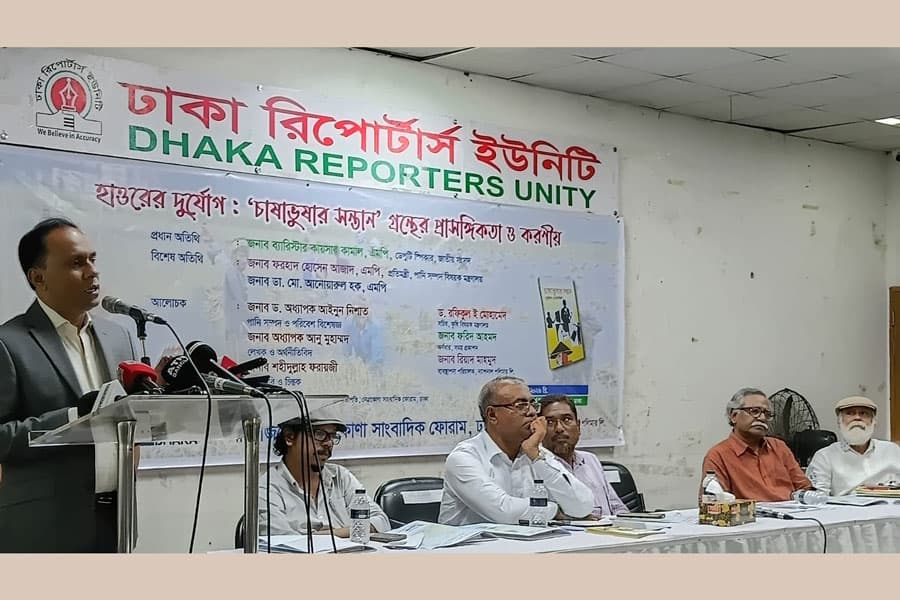
Barrister Kaiser Kamal, Deputy Speaker of the Bangladesh Parliament, said on Sunday that no effective steps have been taken for the haor (wetland) region since independence.


He said that despite making critical contributions to the nation’s food security and economy, the people of the haor region have faced generations of neglect and discrimination.
He noted that there are significant questions regarding the efficacy of those working on haor issues, as initiatives are often implemented without consulting the affected local people.
“Due to bureaucratic complexities, relevant authorities frequently fail to recognise the necessity of consulting local Members of Parliament,” Mr Kamal said.
To safeguard the lives and livelihoods of the haor population, the Deputy Speaker called for the formation of a special task force tasked with adopting long-term, sustainable, and integrated initiatives.
He made these remarks as the chief guest at a seminar titled Haor Disaster: Relevance of the Book ‘Chashabhushar Shontan’ and the Way Forward” held at the Shafiqul Kabir Auditorium of the Dhaka Reporters' Unity in Segunbagicha, Dhaka. The event was organised by the Netrokona Journalists' Forum-Dhaka.
Presided over by Rafiq Muhammad, President of the Netrokona Journalists' Forum-Dhaka, the seminar featured a special guest speech by Member of Parliament Dr Anwarul Haque, while economist Professor Anu Muhammad and lyricist Shahidullah Faraizi participated as chief discussants.
Mr Kamal shared that he was born and raised surrounded by the haor, allowing him to witness the hardships, struggles, and deprivation of its people firsthand from childhood.
He emphasised that while farmers constantly battle natural disasters to sustain the national economy, sustainable initiatives remain absent.
He lamented that discussions only spark after a disaster strikes, while research-based planning and realistic initiatives for permanent solutions remain entirely absent.
Identifying himself as a child of a farmer, the Deputy Speaker noted that the book "Chaashabhushar Shontan" vividly portrays the reality, human struggles, and multidimensional impacts of disasters in the haor region, adding that such research-driven books can play a vital role in policy-making and raising public awareness.
Alleging irregularities in the management of fisheries resources in the haor region, Mr Kamal stated that influential individuals were grabbing haor resources through lease systems, depriving genuine fishermen.
He explained that deep trenches dug in water bodies disrupt natural water flow, harming farmers.
Furthermore, farmers are deprived of fair prices for crops and are losing fishing rights under the lease system, he said, describing these as forms of discrimination he had personally witnessed.
He also referred to what he called a systemic form of exploitation in some local areas, where buyers demand 43 kg of paddy from farmers while paying for only 40 kg.
He regretted that such oppression was not being addressed nationally but expressed a firm belief that if everyone worked together with the Prime Minister, it would be possible to build a humane Bangladesh for future generations.
Speaking on haor disasters and necessary actions, author and economics professor Anu Muhammad said development driven by individual interests yields no national benefit.
He noted that visible infrastructure projects implemented by a former President in the haor region have now become a major threat to biodiversity.
Commenting on the book "Chaashabhushar Shontan," he said those furthest from the soil occupy the highest social echelons, while the farmers tied to the earth remain at the bottom.
He said rural workers are forced to migrate to cities out of desperation because their labour is not properly valued.
Lyricist Shahidullah Faraizee said that while the nation had seen 55 political governments, it had failed to secure a truly pro-people government.
He stated that because the state has failed to guarantee human dignity across all professions, working-class people and farmers continue to face systemic marginalisation and rights deprivation.
Member of Parliament Dr Anwarul Haque stressed that the haor region plays a vital role in national food security.
He explained that flash floods and natural disasters that damage haor crops severely impact the national economy, making integrated protection efforts urgent.
He added that much of the infrastructure built in the name of development had caused more harm than good, leading to a repeated waste of millions of government funds on repairing damaged haor roads.
Mohammad Mufazzal, author of "Chaashabhushar Shontan," said the Industrial Revolution in Europe had been built upon an agricultural revolution.
He said that because structural changes have failed to reach rural areas to address local issues, climate-driven migration to cities is rising exponentially.
This, he said, disincentivises agriculture, threatens food security, overburdens cities, and pushes the country toward a massive systemic crisis.
He urged that the dignity of farmers must be ensured at the state level.
During the seminar, which was moderated by General Secretary Shawkat Ali Khan Lithu, speakers also raised a demand for the establishment of a separate, dedicated Ministry of Haor Affairs.
They emphasised combating the impacts of climate change, preserving wetland biodiversity, implementing science-based water management systems, and formulating an authentic list of genuinely affected victims.
Journalists Faruk Ahmed Talukdar, Masud Karim, Rajon Bhattacharya, and Bahram Khan, among others, spoke at the event.
mufazzal.fe@gmail.com