

Can Bangladesh’s upcoming election reset democracy post uprising?
Published :
Updated :
 For all latest news, follow The Financial Express Google News channel.
Bangladesh is facing its first election since Sheikh Hasina was ousted in an uprising. However, the ongoing cycle of “revenge politics” and economic uncertainty are dimming hopes for democratic reforms, says British journalist James Orr.
In an article published on the website of London-based international research institute Chatham House, he wrote that Bangladesh now needs a democratic “reset”.
But can the upcoming 13th parliamentary elections deliver it?
Bangladesh will head to the polls on Feb 12, 2026 in its first national election since the ouster of former prime minister Sheikh Hasina.
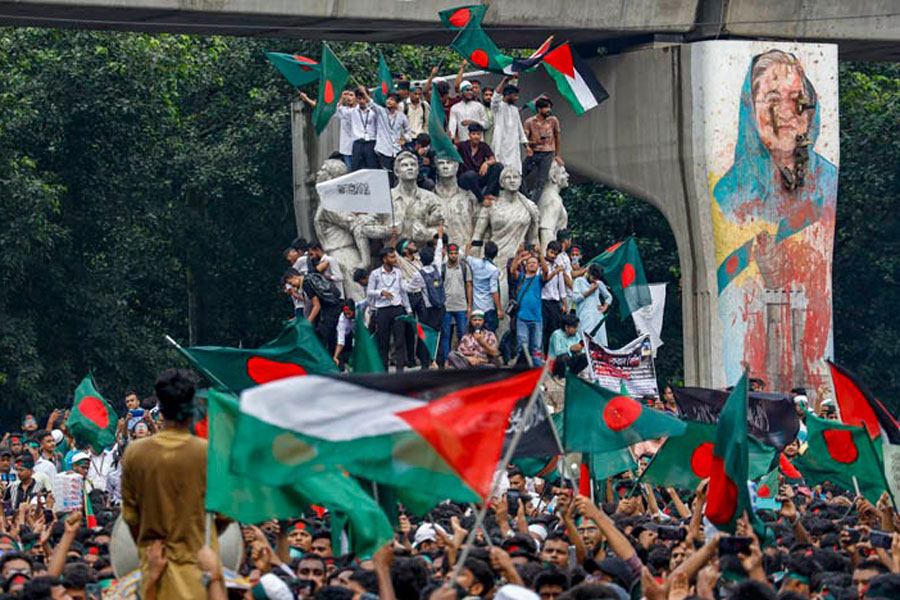
The election comes under an interim government led by Chief Advisor Muhammad Yunus, who took charge after Hasina was forced from office in August 2024 following weeks of student-led protests.
Yunus has faced mounting pressure to hold a general election before Ramadan begins in mid-February.
Hasina, a three-time prime minister, was toppled after her Awami League government faced widespread accusations of corruption and heavy-handed repression.
Analysts say the most likely outcome of the election in February is a return to power for the Bangladesh Nationalist Party (BNP), led by Acting Chairman Tarique Rahman, who has lived in exile in London for nearly 20 years, according to the Chatham House report.
REFERENDUM ON REFORM
Alongside the election, voters will also be asked to weigh in on a package of political reforms agreed by 25 parties under the July Charter in 2025.
The proposals aim to restructure the electoral system, Constitution and key state institutions, but whether any new government can implement them remains uncertain, the report says.
“What happened last August – the so-called Monsoon revolution – was referred to as the country’s second liberation, but I think the reality will be more continuity than change,” said Chietigj Bajpaee, a senior research fellow for South Asia at Chatham House.
“In terms of the cycle of often violent revenge politics that we’ve witnessed throughout Bangladesh’s history, we haven’t really seen any movement towards a genuine national reconciliation. We merely see the pendulum swinging from one extreme to the other.”
According to the United Nations, as many as 1,400 people were killed during last year’s crackdown on protests, the deadliest violence the country has seen since the 1971 Liberation War.
Hasina fled by helicopter to India just hours before protesters stormed her residence in Dhaka.
In November, a special tribunal sentenced her in absentia to death for crimes against humanity, including her role in ordering the crackdown.
She remains in exile in India, which is widely seen as unlikely to extradite her.
Months earlier, the Awami League, which ruled for 15 years, was barred from contesting the election -- a move that critics warn could undermine the credibility of the vote.
“The most likely outcome does seem to be that the BNP will win and that the Jamaat-e-Islami party [Bangladesh’s largest Islamist party] will be the main opposition,” said Naomi Hossain, a professor of Development Studies at SOAS University of London.
“But the BNP are very unpopular and people will be holding their noses and voting. Anyone who remembers them from the early 2000s will recall how violent, thuggish and corrupt they were.”
INSTITUTIONS HOLLOWED OUT
Bangladesh ranked 151st out of 180 countries in last year’s Transparency International Corruption Perceptions Index, placing it among the world’s most corrupt states.
Experts say that before Hasina’s long tenure, state institutions largely functioned independently of the executive.
Chatham House Journalist James Orr writes that the separation has since eroded, with the civil service and accountability bodies weakened, and the military, police and media increasingly politicised.
“Under the previous Hasina government, we saw the persecution of BNP and Jamaat-e-Islami, and now we’ve seen a purge of the Awami League,” Bajpaee said.
“So the question now becomes - how do you break this cycle? There has been a lot of positive intent from the interim government but there’s a gap between rhetoric and reality.”
He added that disillusionment is already emerging among younger activists, including those linked to the National Citizen Party student movement, as established political dynasties reassert themselves.
ECONOMIC HEADWINDS
The political uncertainty is compounded by economic strain.
While Bangladesh recorded strong GDP growth over the past two decades, momentum has slowed since the COVID-19 pandemic.
The country imports all of its energy and has limited natural resources.
A recent shift away from close economic ties with India towards deeper engagement with China, Pakistan and Turkey also signals a strategic realignment that carries risks.
“Governments of Bangladesh really depend on economic development performance for their legitimacy, and this new government is going to have very little fiscal space to help the poor and rebuild the economy,” Hossain said.
“Whether or not the BNP wins and replicates the Awami League’s crony capitalism model we don’t know yet. But the only restraint on them is likely to be the possibility of another uprising – there’s not much else.”