

COX'S BAZAR-ST. MARTIN'S SHIPPING ROUTE
Airport runway expansion creates navigational hazards
Published :
Updated :
 For all latest news, follow The Financial Express Google News channel.
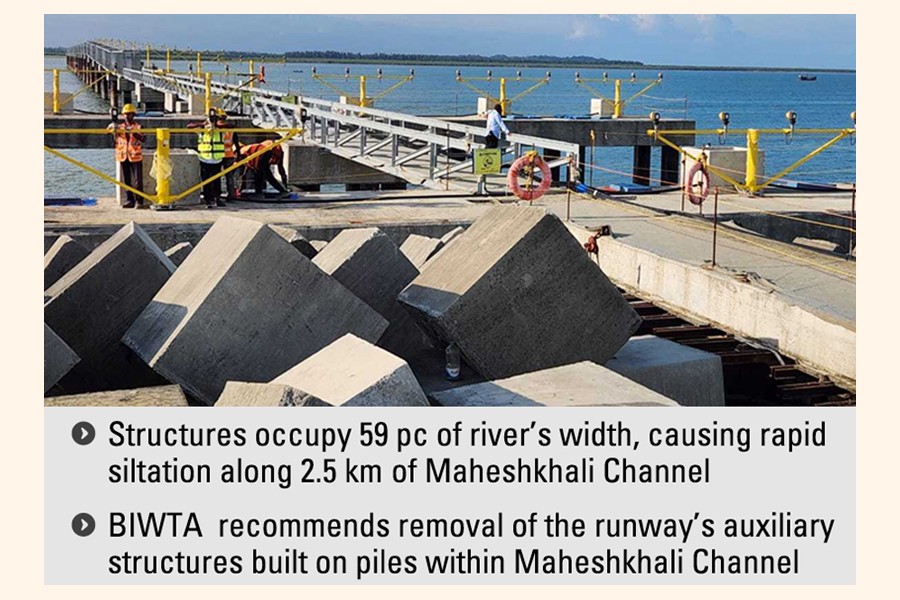
The expansion work of Cox's Bazar Airport has created serious environmental and navigational hazards, as the support infrastructure for the extended runway is being constructed by piling at the mouth of the Maheshkhali Channel, where the Bakkhali River meets the sea.
Experts warn that the development has already begun to disrupt natural water flow, posing a major threat to the Cox's Bazar-St. Martin's Island shipping route and the livelihood of Sonadia Island residents.
According to the Bangladesh Inland Water Transport Authority (BIWTA), structures now occupy nearly 59 per cent of the river's width, causing rapid siltation along approximately 2.5 kilometres of the channel.
If the situation continues, the Maheshkhali Channel may lose its navigability, potentially forcing the closure of one of the country's most important southern sea routes.
As part of the airport expansion, runway facilities and aircraft approach lighting systems have been installed at the river-sea confluence of the Maheshkhali Channel. The construction of temporary jetties and other structures on the river foreshore has obstructed the natural current, accelerating sediment deposition and the formation of sandbars. As a result, the channel's mouth is gradually narrowing.
BIWTA reports that the impact of the runway expansion has already caused severe navigational difficulties in the Nazirartek area. Although an alternative channel has formed along the western side of Sonadia Island, it is gradually shifting further west, raising concerns about long-term environmental damage and risks to local settlements on the island.
In this context, BIWTA has recommended the removal of the runway's auxiliary structures built on piles within the Maheshkhali Channel. In a letter signed by BIWTA Chairman Commodore Arif Ahmed Mostafa and sent to the Ministry of Shipping, the authorities highlighted the urgent need to address the issue.
The letter stressed that a comprehensive study-covering hydrology, sediment transport, environmental, social, and economic impacts-must be conducted by a consultant firm, funded by the Civil Aviation Authority of Bangladesh (CAAB), to assess the long-term consequences on the Maheshkhali Channel and surrounding waterways.
The study should include a full Environmental and Social Impact Assessment (ESIA).
BIWTA has also alleged that CAAB implemented the project without obtaining mandatory clearance from the authorities responsible for river ports and navigable channels.
The letter further noted that more than Tk 41.2 million in unpaid revenue is due to BIWTA for the use of foreshore land, construction of temporary jetties, and loading and unloading of materials. BIWTA has recommended convening an urgent inter-ministerial meeting to resolve the matter.
Sources said that expanding the airport inland would have required the demolition of numerous hotels, motels, and private establishments, along with costly and time-consuming land acquisition.
To avoid these challenges, CAAB opted to extend the runway towards the river and the sea, allegedly without consulting BIWTA.
The project, launched in 2021, aims to extend the runway to 10,700 feet, with approximately 1,300 feet constructed over river and sea areas. Initially estimated at Tk 15.69 billion, the project cost has risen to nearly Tk 17.94 billion. Two Chinese construction companies are jointly implementing the project.
BIWTA has warned that unless immediate and effective measures are taken, the Maheshkhali Channel could suffer irreversible damage. Such an outcome would severely affect key southern shipping routes, including the Cox's Bazar-St. Martin's route, as well as tourism and the local economy.
ahjibulanam18@gmail.com